


Joshua Remerowski, Vice President, Learning & Development, SRS Distribution
Joshua Remerowski leads Enterprise Learning at SRS Distribution Inc., where he designs and delivers leadership and learning programs that make a measurable impact. His career includes senior learning roles at Fortive, Walmart, and Verizon, where he focused on talent development, change management, and business-aligned learning strategies. Josh’s unconventional path from truck driving to CLO roles reflects his commitment to continuous growth and adaptability. He is recognized for building high-performing teams, establishing robust vendor partnerships, and developing engaging, purpose-driven learning experiences. Josh is passionate about empowering people, fostering inclusive cultures, and enabling organizations to thrive in today’s fast-changing business environment.
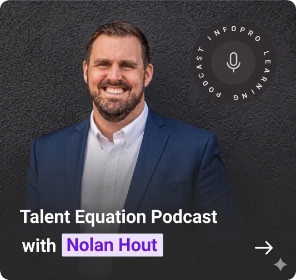
Nolan Hout, Senior Vice President, Growth, Infopro Learning
Nolan Hout is the growth leader and host of this podcast. He has over a decade of experience in the Learning & Development (L&D) industry, helping global organizations unlock the potential of their workforce. Nolan is results-driven, investing most of his time in finding ways to identify and improve the performance of learning programs through the lens of return on investment. He is passionate about networking with people in the learning and training community. He is also an avid outdoorsman and fly fisherman, spending most of his free time on rivers across the Pacific Northwest.
What’s the right outsourcing strategy for modern L&D? In this episode, Joshua and Nolan Hout discuss practical frameworks for leveraging outsourcing, insourcing, and Artificial Intelligence (AI) to build impactful learning experiences that drive results.
Listen to this episode to find out:
- Why is outsourcing a strategic decision, not just a cost-saving measure.
- How an unconventional career builds strong leadership skills.
- The power of a three-tier vendor strategy.
- Key factors for insourcing versus outsourcing choices.
- How AI streamlines low-value L&D tasks.
- The importance of vendor partnerships for Chief Learning Officers (CLOs).
- How to calculate ROI on learning investments.
- Why transparency matters when outsourcing works.

You never have enough people, time, or money to do everything internally. Outsourcing allows you to scale efficiently while your internal team focuses on what they do best – creating experiences deeply tied to your culture.
Vice President – Learning & Development, SRS Distribution
Introduction
Nolan: Welcome to the Learning and Development podcast sponsored by Infopro Learning. I’m your host, Nolan Hout. Today, we have Josh Remerowski joining us to talk about a very timely topic: Outsourcing versus Insourcing. For the large companies we’re talking to, we’re seeing trends of organizations looking for a more mature strategy to leverage partners for real value, versus the older way of viewing outsourcers and vendors as just an extra set of hands. Excited to get into it. Let’s meet our guest.
Josh, welcome to the podcast.
Joshua: Thanks for having me.
Josh’s Career Journey
Nolan: Before we get into outsourcing and insourcing, we’d love to learn a bit more about your background. We’ve found that many people in the L&D spectrum have taken interesting paths. Sometimes their origin story is linear, sometimes it has lots of zigs and zags. What’s your story, Josh?
Joshua: Mine is definitely unconventional. Pretty much my entire life has been unconventional. I started as a temporary truck driver at FedEx after I dropped out of college in my senior year. I played baseball in college and had some troubles my last year, so I dropped out and started driving trucks – from big trucks to small trucks – to get a stable job with FedEx.
I held a field technician role for DirecTV, installing satellite and cable internet for a while, and then transitioned to outside sales for Comcast. Eventually, I decided to get a desk job to see what it was like to work in an air-conditioned environment. I’d never done that before; I’d only done construction, landscaping, and similar work. So, I started at Verizon back in 2011. While working there, I found an opportunity to get into HR and development. I never really knew what learning and development was, like most people, I thought HR just fired people. People still say that to me when I tell them I work in HR. There are many misconceptions about what HR does and provides to an organization.
I grew my career at Verizon in learning and development as a training facilitator and instructional designer. I worked with technology and leadership development. Then I moved to Walmart, where I led talent and learning in eCommerce, and later oversaw change management, HR tech, onboarding, and strategy work under their customer pillar, which was a lot of fun.
After that, I worked at a global organization called Fortive, which combines manufacturing and software, with a focus on precision technology. They recently spun off to a company called Ralliant, where I served as their Chief Learning Officer, overseeing learning and leadership development.
Now I’m here at SRS, leading the learning function for the enterprise and all employees, similar to my last role at Fortive. We focus on building leadership experiences and learning that are simple, fun, and relatable to the job, aiming to make it a great place to work.
Curiosity and Coaching Driving a Talent Focus
Nolan: Is there something that drew you to the talent side of things? Was it curiosity about what they do? Was it having really good coaches growing up, or maybe really bad coaches, that made you want to be a better one?
Joshua: I’ve had lots of bad coaches. That’s part of the reason why I dropped out of college. I’ve been around people who are difficult most of my life. Coming from an abusive childhood with a dad who was in and out of jail and in and out of my life, to having coaches that yell at you – you see this in professional coaching too – I’ve never been responsive to that. I just don’t like it. It’s not great when you don’t have control of a situation, and people don’t treat you well or fairly.
I experienced that with almost every coach through my career, even at the Division I level. I always knew that if I ever got the opportunity – originally, I thought I would be a baseball coach – but if I had the chance to guide people in their lives, their development, in the things they love, or in the things that provide their livelihood, I would do it a lot differently.
When I realized there was an opportunity in the corporate world, as I was figuring out what I wanted to do as a grownup, I knew for sure that I would focus on being transparent, having humility, working hard, and figuring out how to cast vision so people understand where we’re going and why. There’s a purpose to what we’re doing; we’re not just working for the sake of working. That really sparked it.
In baseball, as you mentioned, there’s a lot of failure. If you want to play baseball for a long time, you have to be willing to put in the work and constantly figure out new ways to do things, because you might get in a slump or things might not work mid-game or during an at-bat. For me, just constantly developing and figuring things out has always been a passion, and I’m lucky enough to now do that in the HR and learning and development space.
Nolan: I’m not sure if you swore off baseball afterwards or if you still enjoy it. I’m a big Giants fan. This was back when it was Pac Bell Park. My son’s named Wrigley because my wife’s a big Cubs fan. Nolan is after Nolan Ryan. According to my dad, I was supposed to be Nolan Ryan, but somehow, I just didn’t have it in me. Who knows why?
Joshua: That’s awesome. Not many of us can beat Nolan Ryan.
Strategizing Talent Utilization
Nolan: Maybe that’s a better thing. One of the things I heard, and I’ve heard this before from another high-performing athlete, is that if you’re pitching at a D1 level, that’s the highest level of college you can get. I spoke to Lisa Willis, who was a member of the women’s gold medal-winning USA basketball team, and she mentioned that she had terrible coaches. She kept thinking that if she had the opportunity to coach, she would do it so much better.
A lot of it was what you talked about – they never taught her the bigger vision of what she was trying to do. It was always, “This is the jump step,” or “Hold the grip like this,” or “Push more through your index finger at the end,” rather than discussing a bigger-level strategy.
Now that you’re in that role and have held it in past companies, which leads us to today’s topic. In enterprise organizations, especially, the decision of who to work with and how to leverage talent becomes one of your biggest challenges. How do you leverage your resources – your people, time, and money? When you look at outsourcing, vendors, or partners – whatever term you use – how do you even start planning? Is this an annual thing? What is your overall strategy for determining your path and assigning responsibilities?
Joshua: You never have enough people or hands to do the work, so having vendors is essential. I think partner is a great term, as many people prefer that language. When I use vendors, it’s because I already know I won’t have enough people for what I want to do. That’s the reality. And whatever I think I’m going to need next year, I’ll probably have even less.
That’s the reality for most learning and development, as well as HR, functions. I’ve never worked anywhere with enough time, people, or money. This isn’t the movie Blank Check. For me, I look at it long-term: how can I talk to as many vendors as possible to find out what’s available? What are they best at? They all provide similar services, but some are better than others in terms of product quality, turnaround speed, or nearshore, onshore, or offshore options. I built a coalition of people I know I can rely on. Then I start with small projects to see their sample work and understand their barrier to entry, their product, and how they work.
I have vendors for scrappy projects that don’t impact culture or require much context – they’re cheap, fast, and get the job done. My team may not have the time or the necessary skill set for these. Then there’s the middle tier, where projects require a bit more time, money, and cultural nuance. We must work with them to ensure alignment with our company’s structure and the characteristics of our customers.
Finally, there’s the top tier – projects executives care about. These vendors are thoroughly vetted because the stakes are high, and they must align closely with our culture. They cost more and require hands-on involvement from me and executives.
Vendors want to sell their products quickly, which is admirable, but I’m not going to present something to my CEO, CHRO, or executive team without knowing its quality. Some vendors understand this; some do not. Because I’ve worked with many, I know who can be accelerated through this process. High-tier projects require more money and involvement, but they are tied to meaningful cultural impact. So, I ask, who are my people for what?
I keep that picture clear. When I plan for next year or beyond, I already know who to talk to for specific needs. We have a strategy where I can assign my team to work with certain vendors as needed, and that’s been the most helpful.
I always consider if a project is culturally impactful or not, if it needs to be scrappy or refined, and who will see it. Lower-tier projects can go to Fiverr or Upwork for small gigs. Most vendors fall in the middle tier, and very few handle big executive-facing projects. This process has enabled us to remain agile, accomplish great things, and work effectively with vendors. We’ll continue to use vendors and our internal teams, weighing options each time, and enjoying the process. I’ve enjoyed pretty much every vendor I’ve worked with so far in my career.
Nolan: Yeah, and I think what you touched on, in addition to that, you mentioned the ones that you vet heavily are those that are touching your culture. Sometimes, on both our side as vendors and on the client side, we undervalue the time it takes to establish a rapport, learn about each other’s business, and understand that if we don’t do that upfront, we’re missing out. But we also sometimes try to do that when it’s not needed.
Infopro has fallen victim to situations where we’re just being used in tier three right now. For example, this is a tier three project – we need you to create 50 assets or something similar. Even if it’s high value, it’s not high touch. We look for that investment when you’re just looking for something to be done without much of your time invested.
But when you get to that top level, that’s why, traditionally, the number of vendors in that tier A list is one or two, maybe, because as a client, you have to invest so much of your time. That’s why, if you track CLO movement, a lot of times when a CLO moves jobs, they bring their vendor with them because they have that relationship. Perhaps they are unfamiliar with the new business, but they are familiar with how that vendor operates. And if they’re an extension of them, they need that tight handshake.
Making the Insourcing or Outsourcing Decision
Nolan: One of the things you touched on was doing some work internally and some externally. How are you determining that? Do you plot out your next six months? Six months, or even a year, now feels like an eternity, given how fast things are changing. So, maybe it’s not even six months, but how do you sit down and make that decision on whether to insource or outsource?
Joshua: Well, you have to know the skills of your team. I evaluate myself and my team pretty ruthlessly. I’m not under any illusions about being more talented than we are in certain areas. It doesn’t mean we can’t do things, but executing a gamified solution at the highest level versus just getting it done, or building a highly interactive, complex e-learning scenario with great video and cohesive branding versus just building an e-learning platform, are different.
Nolan: Right.
Joshua: We look at that. I look three years out at what I want to do. My team focuses on what we want to do this year. For me, it’s about the experiences we want to create for our employees, how we want to evolve and improve them. From there, we determine if my team has the skills to do it or not. The landscape and makeup of my team could change, so we pivot and adapt. If I end up hiring someone with a skillset we’re missing today, six months from now, when we work on that project, I might decide to insource it.
However, I still need to evaluate whether it’s the right thing for them to spend their time on, considering their priorities and our current commitments. I never have enough time, money, or people – that’s true for most departments. So, I’m constantly reevaluating. I know what I want to use a vendor for in three years, two years, and one year. I have an idea of which vendors I want to evaluate and which ones I’ve used successfully in the past.
There will always be projects that arise where we simply send it to someone on Fiverr because they can complete it quickly, it doesn’t cost much, and they don’t need to know anything about the company – they just need to edit and make it look good. That’s been my process, and I find it works well. I know what experiences we want to create, and over time, I build a list of vendors, which makes decisions easier. I continually meet new vendors to evolve the roster, because you want the strongest team to get the best job done, period.
Nolan: We look at that. I look three years out at what I want to do. My team focuses on what we want to do this year. For me, it’s about the experiences we want to create for our employees, how we want to evolve and improve them. From there, we determine if my team has the skills to do it or not. The landscape and makeup of my team could change, so we pivot and adapt. If I end up hiring someone with a skillset we’re missing today, six months from now, when we work on that project, I might decide to insource it.
However, I still need to evaluate whether it’s the right thing for them to spend their time on, considering their priorities and our current commitments. I never have enough time, money, or people – that’s true for most departments. So, I’m constantly reevaluating. I know what I want to use a vendor for in three years, two years, and one year. I have an idea of which vendors I want to evaluate and which ones I’ve used successfully in the past.
There will always be projects that arise where we simply send it to someone on Fiverr because they can complete it quickly, it doesn’t cost much, and they don’t need to know anything about the company – they just need to edit and make it look good. That’s been my process, and I find it works well. I know what experiences we want to create, and over time, I build a list of vendors, which makes decisions easier. I continually meet new vendors to evolve the roster, because you want the strongest team to get the best job done, period.
Joshua: Whether it’s AI or using a vendor, someone on your team has had the experience where something happened at their last job, so they think it will happen here. Even if it’s not true, I still have to communicate transparently about what this means. Nothing about the future of your company, business model, or customers is certain. That’s the hardest part of doing business, and many individual contributors don’t appreciate that or often forget it.
Nolan: Right.
Joshua: Most companies aren’t sitting on endless cash to pay people. They’re running on thin margins, and if they don’t make the quarter, that’s why many don’t last long. You must be creative, know when to be lean, when to grow, when to outsource, and when not to. The change piece is always there because of past bad experiences. I’m always upfront and as transparent as possible when managing that.
At the end of the day, if people are doing what they’re supposed to, creating value, having a good attitude, improving culture, and driving better business outcomes, it’s very difficult to justify letting them go or outsourcing their work. But that doesn’t mean it won’t happen. The business environment is unpredictable, creating uncertainty for your team. All I can do is communicate that as transparently as possible.
When I came to this company, I told my team upfront that we would outsource things. That doesn’t mean they’ll do less work. We don’t have enough people. At my last company, it was the same – we outsourced facilitation, instructional design, administration, content development, video creation, and more. I let them know early so there are no surprises later.
If you’re transparent, communicate the vision clearly, and set the tone as a leader by stating that we will use outsourcing partners and vendors, and communicate when and where, your team won’t be surprised. It doesn’t mean they’ll always love it or won’t think they should work on a project instead, but setting the tone early and being clear helps.
Measuring ROI: Vendors vs. Internal Teams
Nolan: At the heart of this is ROI. Where can I get the best value? A lot of it comes down to ROI. How are you holding your vendors and employees accountable? How are you measuring ROI, specifically for your vendors, and also for internal operations?
Joshua: I look at both the same. Anywhere I’ve worked with vendors and employees, I’ve been fortunate to work for Verizon, which was fantastic at measuring the impact of learning, from Phillips to the fifth level, in terms of ROI. I tell my team the same thing. When I joined here, I said we’re going to measure things; we’re not just going to produce things without knowing if we’re making an impact.
If it’s a vendor versus an in-house option, I conduct a cost analysis. How much does it cost my employee per hour to build this if they spend 40 or 100 hours, versus what it would cost the vendor? Perhaps the vendor can complete it in 20 hours, as they’ve already developed similar material and just need to reskin it.
Nolan: Totally.
Joshua: What is the cost-benefit analysis? That ties back to the tiers. If it doesn’t require cultural nuance, the cost to do it will be lower, potentially yielding better ROI. We evaluate where the cost trade-off is. Usually, programs in the middle tier are where you can truly measure ROI. High-tier programs often cost so much that it’s nearly impossible to recoup the ROI quickly, especially for executive development programs. And the scrappy stuff has little context.
We look beyond whether people like it. What are the KPIs and actual metrics that will be moved? My team works with stakeholders to ensure they’re comfortable with outsourcing, covering cultural nuances and verifying that they’re okay working directly with the vendor, as they’d typically work with us. We don’t want to become the middleman that slows down the process.
Nolan: Right.
Joshua: We look at metrics, break-even points, and what it takes to be successful. We measure against a control group. We go in with assumptions about expected ROI and measure cautiously. Six months post-implementation, we review performance: Are promotions happening at higher rates? Are engagement scores better for leadership teams? Is branch performance higher than that of peer groups? Are sales or safety violations up or down? We look at real data.
If it’s successful with a vendor, it builds confidence in the team. The experience was great, employees loved it, ROI was achieved with better business outcomes, and we partnered with a company that built something amazing. We still have to execute, set up follow-ups, and embed it into what we’re doing. As long as you approach it that way, it can be very successful. You have to look at it upfront. You can’t measure after it’s happened.
Nolan: Correct.
Joshua: My team goes into everything with a measurement plan. Some things can’t be effectively measured, and we evaluate that too. If it’s going to be a loss, but it costs us less to outsource than to insource, we proceed.
Nolan: So, what I’m hearing is that the ROI equation has a couple of factors. One is cost: internal versus external. Then, between external vendors, how can I get the best price? You calculate what it would cost in-house versus out-of-house, then look at what you’re getting back. You want to know what you’re spending to achieve the outcome, and that cost is made clear up front.
We’ve started mandating that any proposal must include an ROI statement. With market volatility and scrutiny over spending, if you don’t have a clear picture of what it will do for the company, it’s an issue. Sometimes, such as with small eLearning modules costing $20,000, you may not recoup $50,000, but you need to demonstrate something – satisfaction scores or reach, for instance. I appreciate how you’re considering both sides, not just the cheapest way to get it done.
Turning Strategy into Execution
Nolan: As we move towards the end of this podcast, we’ve talked a lot about strategy. Now, focusing on execution, looking back at your experience at companies like Walmart and others, what do you see as the low-hanging fruit that always makes sense to outsource? If you step into an organization, what are the four or five things you immediately look to outsource?
Joshua: I think you always want to have a few people who can facilitate certain leadership experiences. Some things don’t make sense to certify people in because employees come and go. You spend money getting them certified, and two years later, they’re gone, and you have to pay to certify someone else. Many of those experiences require zero cultural nuance to deliver.
For me, you always want to have people who can facilitate leadership sessions, keynote speeches, or topics that are important in almost every company, like emotional intelligence or servant leadership. Have a small group certified in programs like Hogan or similar executive development tools.
I’m certified in all of them, but if I leave and no one else is certified, who will be able to run workshops, conduct debriefs, or provide executive coaching? You always want people in that bucket to deliver those experiences. It’s not super repeatable because you’ll always have talent gaps. Then I look at administrative tasks that can be outsourced or automated using AI, if you have the right team or technology. Can you utilize RPA or UiPath to automate processes, allowing your team to focus on higher-value work that requires human thinking? Can AI handle that, or can you outsource at a lower cost?
That’s always something I consider. Administrative work is always on the list. Another key area is having people who can develop content—eLearning, facilitations, gamification—people who can create these experiences with dedication and expertise. Sometimes, if no one on your team has done it before, an outsourced partner is the best option. They can deliver a higher-quality product.
I always have vendors I trust. Even if an individual contributor hasn’t done it, working with that vendor helps them learn how to build great learning experiences.
Then you have that vendor relationship to carry with you in your career. If the next company faces similar challenges due to a lack of talent, funds, or resources, you can determine how the vendor can assist. These three buckets work well for me. So, admin, content development, and leadership or executive development always fall into that category.
Nolan: I love that you touched on the value of vendor experience. I was chatting with a friend who leads learning at a finance company. He wants to shift to other roles. I told him we don’t work together, but where you’re weak is vendor relationships. That drives a lot of CLO decision-making because you can’t move fast enough by hiring alone.
As a vendor, I’m telling you—if you see vendors as a necessary evil, you’re not well suited to lead a large learning organization. Vendors need to be a critical part of your strategy. Teaching your team to leverage vendor relationships versus employee relationships is valuable.
Joshua: You won’t survive otherwise. As a CLO, you’re asked to do things, and even if budgets change, expectations remain. If you can’t solve performance or skill gaps quickly because you’ve never worked with vendors or don’t have people in your network to help, you won’t last. I’ve seen many people not last long.
They end up going backwards in their careers instead of advancing. I’ve worked with so many vendors over the years, and what’s most important is they’ve worked with so many companies. The odds I have a problem they haven’t solved are almost zero, or at least they’ve handled something similar.
People often think their problems are unique, but almost every company has the same challenges, constraints, and skill gaps. We’re all working toward growth and dealing with market volatility. Vendors have already solved these problems. Whether you can afford it is another matter, but I love having vendors in my network because they’ve faced the issues I need help with.
Nolan: Yeah, I use this approach often. When I’m doing something new, I go to LinkedIn, find people in the space, and ask to buy them coffee to learn from their experience. For example, I reached out to someone with 20 years at Ford to understand the automotive industry. He appreciated that I just asked for help, and people are willing to do it. That’s been one of my favorite parts of this podcast—connecting people. Problems may be nuanced, but they are rarely unique.
The Impact of AI on Sourcing Strategies
Nolan: You also mentioned AI, and I don’t think you’re allowed a session without mentioning it these days. How is AI changing your sourcing strategy? Companies tell us that developing tech skills internally will take too long, so they want us to handle it. How does that change your approach?
Joshua: AI will replace a lot of bottom-tier, quick turnaround, low-cost work. My team already uses AI widely. There are varying skill levels in using tools, and generative AI is just the start. Agentic AI and other sophisticated models are emerging.
My team isn’t deeply entrenched in that yet. Their literacy is mostly around generative AI, like GPT. So, AI can replace the bottom tier. Now, I think about companies offering AI products we can’t build or that would take years to develop.
We need proof of concept before signing long contracts. Let’s prove within six months that it does what they claim. Some tools clearly show we could never build them ourselves, or it would take too long.
Nolan: Yeah. Two months, two days.
Joshua: Exactly. I think about how AI can replace admin tasks to make jobs easier and more efficient. Then, what companies can provide AI tools to enhance our platforms and talent development? For truly bespoke tools, especially for executive experiences, what will it take to implement AI effectively without it being a disaster?
AI isn’t perfect and still gets things wrong. I see it eventually partnering with the middle tier, although human intervention remains necessary for cultural nuance. Agentic AI might surpass that, but for now, I focus on eliminating scrappy tasks and partnering effectively in the middle tier.
Nolan: Totally. We worked with a company on an 18-month AI transformation, and we started by saving money on basic tasks. Eventually, you move to not delivering traditional content anymore, but integrating AI agents for real-time learning.
For example, a leadership bot where people ask, “How do I ask for a raise?” when they need it, instead of watching a one-hour video. But don’t get bogged down by step three. Start with step one—save time and money first. Step three is transformational, but saving money is powerful too.
Closing Thoughts
Nolan: Josh, thank you so much for your time. This was a phenomenal conversation.
Joshua: Yeah.
Nolan: Awesome. Have a great rest of your day. We’ll talk again soon.
Joshua: Bye.