

AI for L&D workflows is now a strategic enabler, shaping how learning teams work and scale their impact. L&D teams have been ruminating for some time on whether AI has a place in corporate learning. The discussion is now shifting to how AI can be leveraged to improve L&D strategy and the speed and quality of learning, while still maintaining the human touch.
Amid the ongoing transformation organizations are experiencing, L&D teams are pressured to respond quickly, upskill employees at scale, and remain aligned with business priorities. That’s where AI in corporate training has a strong impact. When thoughtfully employed, AI augments human capability, enhances decision-making, and automates day-to-day learning activities.
According to ‘The 2025 State of AI in Learning & Development’ report, AI isn’t replacing L&D; it’s reshaping it. From adaptive learning platforms to workflow-embedded AI agents, the role of the Chief Learning Officer (CLO) is evolving from content curator to capability strategist.
This blog explores AI for L&D workflows and learning operations automation, and how it enables teams to increase speed and quality in 2026, while keeping individuals at the center of every learning experience.

Why AI for L&D Workflows Matters in 2026
Change has become constant at all levels, including jobs, technologies, and skills. Traditional L&D models often struggle to keep pace; manual processes bog down teams; and static training programs don’t keep up with real-world workplace needs.
AI for L&D workflows helps to solve these challenges by:
- Reducing time spent on routine activities.
- Enabling faster alignment between learning and business objectives.
- Helping L&D teams focus on the skills that matter most.
It’s important to note that AI does not replace learning professionals in this shift. Rather, it enhances human potential. With the right L&D strategy, AI enables teams to move faster and deliver learning experiences that resonate as relevant, supportive, and practical.
AI and L&D Strategy: Connecting the Big Picture to Daily Details
A robust L&D strategy ties long-term business objectives with day-to-day learning activities. AI bridges this gap by providing actionable insights from complex data sets.
In 2026, high-performing organizations will leverage AI to:
- Translate business goals into skill priorities.
- Adapt learning tracks as roles and expectations evolve.
- Maintain visibility into workforce capability needs.
This allows L&D leaders to engage with the immediate learning needs daily while maintaining a broad perspective of the learning landscape. Teams become faster when they make more focused and clear decisions rather than when they rush.
AI-Driven L&D Workflow Model for 2026
Below is a practical view of how AI for L&D workflows support learning from planning to delivery.
Each stage combines AI efficiency with human judgment, ensuring learning stays people-centric and outcome-driven.
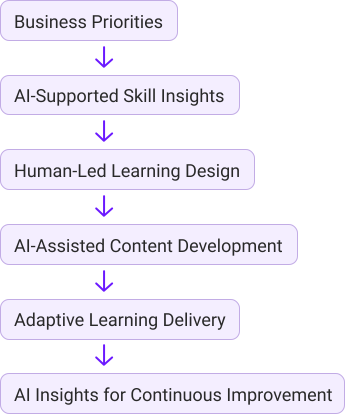
1. Skill and Needs Analysis Through AI for L&D Workflows
Understanding what individuals need to learn is often one of the most time-consuming parts of L&D. AI for L&D workflows speeds this up by analyzing large volumes of information quickly.
How AI Supports This Stage
- Reviews performance trends and learning data.
- Identifies emerging skill gaps linked to business needs.
- Highlights priority areas for development.
- Faster alignment between learning and business needs.
- Clear focus on high-impact skills.
- Stronger foundation for an effective L&D strategy.
- Recommends learning structures and pathways.
- Facilitates role-based learning curriculum planning.
- Assists with mapping skills to learning outcomes.
- Automated registration and scheduling of learners.
- Non-intrusive reminders and nudges.
- Simplified reporting and dashboards.
- Draft outlines and learning scripts.
- Create assessments and knowledge checks.
- Customizes content by role and depth.
- Shortens the development cycle.
- Maintains the quality of learning.
- Frees teams to focus on improving the learner experience.
- Personalized learning recommendations.
- Learning paths that are adjusted based on progress.
- Support for learning in the flow of work.
- Highlights areas where learners struggle.
- Identifies data or content that needs refinement.
- Monitors skill development trends.
- Skill Analysis Prompt: Identify current skill gaps affecting business performance and suggest learning focus areas.
- Learning Design Prompt: Outline a learning journey that builds practical skills for managers within four weeks.
- Content Development Prompt: Draft a scenario-based learning module focused on real workplace challenges.
- Learner Support Prompt: Recommend learning resources based on recent learner activity.
- Human oversight at every critical juncture.
- Clear guidelines for AI usage.
- Transparency for learners and other stakeholders.
- Focus on continuous skill development for L&D teams.
Human Role
L&D teams interpret insights, apply context, and decide where learning efforts should focus. AI informs decisions, but people lead them.
Impact
2. Learning Design Guided by AI, Led by People
Designing learning experiences is still a human job. AI allows teams to move more quickly by handling background tasks.
AI in Learning Design
Human Expertise
Designers create experiences that reflect how individuals learn. They make sure learning is relevant, inclusive, and practical. This balance ensures that the application of AI in corporate training improves training quality rather than degrades it.
3. Learning Operations Automation to Improve Speed at Scale
According to a McKinsey report, almost all companies invest in AI, but only 1% believe they are at maturity. Our research finds the biggest barrier to scaling is not employees—who are ready—but leaders, who are not steering fast enough. Leaders need to focus on AI projects and the resources required to make them successful. In the absence of effective leadership in deploying AI tools, organizations may be unable to leverage the potential of these investments fully.
One of the biggest value drags in 2026 will be learning operations automation. AI frees teams to concentrate on people and performance by removing friction from L&D’s daily tasks.
Examples in Learning Operations Automation
Why This Is Important
Learning operations automation eliminates busywork, increases consistency, and supports scale. Speed increases without adding pressure to L&D teams.
4. AI-Assisted Content Development in Corporate Training
Creating content is one area where AI in corporate training provides instant value.
How AI Supports Content Development
Human Review Remains Essential
L&D can refine the content, add real-life scenarios, and align the learning with the organization’s culture.
This approach:
5. Adaptive Learning Delivery Powered by AI
In 2026, AI in L&D workflows will enable learning tailored to individual needs.
What Adaptive Learning Allows
For learners, this means less time spent searching for the right content and more time building skills that matter.
6. Using AI Insights to Strengthen L&D Strategy
AI also supports continuous improvement by offering clear insights into learning effectiveness.
AI Insight Capabilities
L&D teams leverage these insights to refine programs, adjust priorities, and remain aligned with changing business needs. This helps keep the L&D strategy on track.
Practical AI Prompts for L&D Teams
These prompts help teams apply AI for L&D workflows in everyday work:
Each prompt supports speed while allowing individuals to retain control over their decisions.
Keeping AI in Corporate Training Human-Focused
Speed should never be at the expense of trust. Successful organizations apply strong governance to AI in corporate training.
People-Centric Principles
It is these sorts of practices that ensure AI enhances rather than alienates learning.
AI for L&D workflows refers to using artificial intelligence to automate, augment, and optimize learning design, content development, administration, and analytics processes. By reducing routine manual effort and enabling faster alignment between learning and business needs, AI helps L&D teams improve speed, learning quality, personalization, and strategic decision-making while maintaining human-centered relevance and business impact.
Conclusion
Technology is not the primary focus of AI for L&D workflows. It is about empowering people or individuals to learn, develop, and perform more effectively, quickly, and confidently. Blending AI, learning operations automation, and human expertise makes learning and development a powerful driver for speed, skills, and organizational readiness.
If you want to improve your L&D strategy and use AI in corporate training in a useful, people-focused manner, we can help you turn strategy into action and scale learning impact with speed and skill.
Frequently Asked Questions (FAQs)
-
remove How is AI transforming L&D workflows in 2026?AI is automating time-intensive L&D tasks such as content curation, needs analysis, assessments, and reporting. This enables L&D teams to reduce development cycles, improve learning accuracy, and focus more on strategic capability building rather than manual execution.
-
add In what ways does AI improve both speed and quality of learning programs?AI accelerates design and delivery through adaptive learning paths, real-time feedback, and data-driven personalization. At the same time, it enhances quality by aligning content with learner behavior, skill gaps, and performance metrics, ensuring higher relevance and impact.
-
add What should L&D teams consider before adopting AI-driven workflows?Teams should assess data readiness, integration with existing learning platforms, ethical use of AI, and upskilling of L&D professionals. A clear governance framework and pilot-based implementation are essential to maximize ROI while maintaining learning integrity.