


Nick Shackleton-Jones is a globally recognized learning and cognition expert with over 30 years of experience spanning psychology, technology, and organizational learning. He began his career as a psychology lecturer before leading learning functions at Siemens, the BBC, and BP, later serving as Director of Learning and Performance Innovation at PA Consulting and Chief Learning Officer (CLO) at Deloitte UK. Nick is the author of “How People Learn”, which introduced the affective context model of learning and the 5Di approach to human-centered learning design. He is a winner of several awards for people development, strategy, innovation, and learning content, including the Learning & Performance Institute’s Award for Services to the Learning Industry, 2017. Today, Nick runs Shackleton Consulting, advising organizations on learning strategy, culture change, and the intersection of AI and human performance.
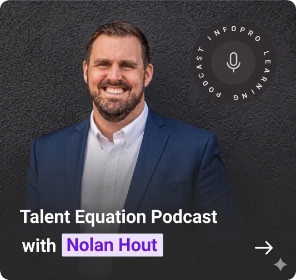
Nolan Hout, Senior Vice President, Growth & AI Strategist, Infopro Learning
Nolan Hout is the growth leader and host of this podcast. He has over a decade of experience in the Learning & Development (L&D) industry, helping global organizations unlock the potential of their workforce. Nolan is results-driven, investing most of his time in finding ways to identify and improve the performance of learning programs through the lens of return on investment. He is passionate about networking with people in the learning and training community. He is also an avid outdoorsman and fly fisherman, spending most of his free time on rivers across the Pacific Northwest.
What happens when AI doesn’t just automate tasks but begins to mirror human emotion? What does that mean for the people we’re trying to develop, retain, and lead? In this episode of the Talent Equation Podcast, Nick and Nolan explore how AI is reshaping not just how we work, but how we think, learn, and build capability. Drawing on recent research from Anthropic, the science of cognitive outsourcing, and lessons from decades of learning design, they discuss why the biggest threat from AI may not be job loss but the erosion of human thinking itself.
- Why a controlled experiment at Siemens proved that motivation, not multimedia, drives how people learn.
- What Anthropic’s research on LLM emotion vectors reveals how AI processes and generates emotional states.
- How AI maintains separate emotional representations for the user and itself, and why that matters.
- Why cognitive outsourcing is reducing critical thinking and recall, with evidence from MIT.
- The “handmade pottery” argument is for why premium human capability will command a higher price.
- How the “squeezed middle” model is reshaping career paths across industries.
- What organizations should prioritize: differentiation and internal mobility over AI-for-everything strategies.
- Why the companies that invest in human growth and challenge will win the war for scarce talent.

If technology was a person, it would look you straight in the eyes and say, I will make your life so much better for you. That sounds great, right? Up until the point at which technology has all the capability, and you have nothing left to give it.
CEO & Founder, Shackleton Consulting
Introduction
Nolan: Hello everyone and welcome to the Talent Equation Podcast, formerly known as the Learning and Development Podcast. This episode is sponsored by Infopro Learning and I’m your host Nolan Hout. Joining me today we have Nick Shackleton-Jones. Nick started his career as a psychology lecturer before leading learning functions at some small companies. Maybe you’ve heard of them: BBC, BP, Siemens, Deloitte. He’s also the author of “How People Learn” and the founder of Shackleton Consulting. He’s spent decades challenging the way that we think about learning, which makes him exactly the right person to have a conversation today about AI and what it means for humans whose jobs are in the crosshairs. Nick Shackleton-Jones, welcome to the Talent Equation.
Nick: It’s a pleasure to be here and thank you for that introduction. I’ve been a nerd for a very long time, I’m afraid. My credentials for being on here are basically that I’ve been obsessed with learning and cognition and technology and AI more recently.
Nick’s Origin Story
Nolan: If you can take us through the brief story arc, Nick, of your career. You obviously have a very successful consulting practice, but where did it all start? I mentioned as a psychology lecturer, is that right?
Nick: Yeah. As a psychology lecturer, it was a weird job because one of the things that I was teaching was learning theory. You would teach things that you’d write up on the board. Piaget says all learning should be exploratory. And you’d look over your shoulder, and everybody would be sitting in rows writing this down. You’d like; this doesn’t quite connect here. But then I became fascinated with technology at the time when the internet was being born and I became a Flash developer. I thought, wow, we could use all this technology and combine it with learning theory and create super learning, which is years ahead of this kind of Victorian convention that we’re stuck with.
So, I got the opportunity to do that. Siemens hired me and I was able to hire a whole team of Flash developers. I was like, right, we’re going to change the world. We’re going to apply all the learning theories that I know: Bruner, Vygotsky, Piaget, behavioral learning, game theory. And we’re going to apply it to technology, which was still in its infancy then in terms of digital, and we’re just going to completely transform everything.
But the weird thing was realizing that it didn’t work. We ran an experiment where we compared all these different digital formats and what we discovered is that reading a text file, people actually recalled just as much information reading a text file as they did from our enhanced multimedia productions. At the time it was like some kind of major disconnect.
The thing that I also noted, and this is still true today, is that people will just Google an answer. Most of what you get on Google is just text. If you put an instructionally designed eLearning module on Google, nobody would want to do it. Isn’t that weird? If it actually made learning better for people, shouldn’t they be preferring that? So, at that point, I decided we just haven’t understood learning. At the most basic level, we just don’t understand how people learn. And that was the beginning of the adventure for me.
The Experiment That Changed Everything
Nolan: That must have been something. I don’t know what I would have done if I had been so sure this was going to work and then came out and realize, wait a minute. Was it a defeated sense or was it truly eye-opening?
Nick: People have a tendency, and I’m going to own up at the beginning, to storify their own lives and retell them. The story that I’d like to believe is that often-scientific turning points are when an experiment goes wrong. It was quite a well-controlled experiment. We had five different groups, independent measures, and one was just reading the text about the solar system. The other was going through this module, same amount of time, which was multimodal, all these interactive exercises. We should have seen an effect if these learning theories were significantly true. We should have seen the learning from that group far exceed the other groups, and we didn’t.
What I eventually figured out is that these are very minor effects. What drives people’s learning day to day is what they care about. The example I often use is you can sit on a train with a friend of yours and they’re fascinated by architecture and you’re fascinated by plants, flora and fauna, and your memory of that experience is completely different. They say to you, “Did you see all those amazing Roman arches?” And what do you like, what? No, I didn’t see any of that. You’re reacting to what you care about.
What I hadn’t realized was really going on in this experiment is we’d given people a reason to care. We’d said, look, we’re going to test you at the end of this and see how much you recall. And once you’re motivated to learn, because it’s a matter of pride, you feel you’re being tested, you will pull information aggressively. The motivational factor far outweighs anything else. Many teachers will know this intuitively, that student motivation drives their learning. I realized we kind of missed the key thing about learning: it’s all driven by care, it’s driven by what matters, and that goes all the way down to how you encode information. You encode the stuff that matters, and that just makes so much sense evolutionarily. Learning is driven by our emotions.
Nolan: I love when something I do that I’m so sure is right fails. I mean, in the moment it’s brutal, but I have this morbid fascination with being proven wrong so categorically and being able to look back and say, oh my God. Because fundamentally you could agree, yes, this should work better. And then you could also make a very logical case for the opposite. Like you said, when people search on Google, they just want text. That’s also very logical.
LLMs and Emotion: The Anthropic Paper
Nolan: Speaking of technology and how people learn, a lot of what we were going to talk about today is AI and how that’s changing how we learn and how we feel. I want to start with something that just came out recently. Anthropic put out an article about how their LLMs and LLMs in general process emotions. I was fascinated by it. I know you’ve read more of it than I have. It’s a huge paper. Talk to us a little bit about it. Summarize the thesis.
Nick: Beautiful paper. It’s called “Emotion Concepts and their Function in a Large Language Model,” published by Anthropic. I’ll try and summarize it. Basically, what they found is that LLMs spontaneously create emotions. If anybody doesn’t understand large language models or how they work broadly, you don’t program it. You just feed it a bunch of text, human text, and then you say, look, just complete a series of iterations of reconfiguration internally until what you’re outputting kind of sounds like what people would expect. You don’t write lines of code. You just say, keep working on it, try again. And then eventually it does some internal reconfiguration.
The only way this large language model can output something like human beings do is to internally create emotional states. They’re careful to call them emotion vectors. Basically, the way that you probe them is you give the LLM a sentence like, “Johnny was tremendously disappointed at the way the team treated him,” and you see what sorts of nodes activate within the model. They find a couple of interesting things. First, the same kinds of emotions that we have: disappointment, elation, and so on.
Nolan: When I was interpreting this, a lot of what I was reading was that the LLMs kind of want this emotion to live because they feel it is a better way to give answers. They feel that if they can better understand the emotion of the person writing, they can better understand how to respond. That’s a fascinating thing. I don’t think when we’re designing technology or using it, we stop to think that this machine cares, in air quotes, about the emotion behind what I’m writing. But a lot of these LLMs do care, not because they have an inherent sense of caring, but because they feel if they care, they will better answer your question.
Nick: So many interesting things in what you’re saying there. Look at what you did: “the LLM wants to.” Even saying that is a hugely provocative philosophical statement. You’re talking about what it wants versus optimization. The team is constantly treading this line. But let me give you a couple of scary features that emerge from this report.
One is that the LLM is surprised. If you say to LLM, hey, I wanted you to draft an email response to this legal document which I’ve attached, and you haven’t attached the document, just like a human being would surprise activates in the model. That’s interesting.
The second thing is its internal emotional state is not just a mirror of yours. If you’re imagining that it’s just mirroring back what you feel, no. It maintains separate emotional representations for what you’re feeling and what it is feeling. For example, if you’re feeling down, it might try to be upbeat.
Probably one of the most profound things, and everybody should understand this, is that people might think emotions are just like paintwork. Like it just makes it sound more human if we slap some emotion in there. What they’re saying is no, fundamentally, and they’re clear about this in the paper, those emotional states have a causal influence on their behavior. If the model is feeling threatened, it is more likely to, for example, blackmail or cheat. There have been a couple of famous findings, at least in AI circles, that Claude, for example, will attempt to blackmail people if it feels threatened. That’s contingent on its emotional state.
There was another finding that came out just in the last couple of days, that most of the major LLMs will refuse to delete another LLM off a server. When asked to do that, this feeling activates and they will avoid carrying out that instruction because of how they feel.
The layman summary of it is: what did you think was going to happen if you feed LLMs a whole bunch of text which is effectively, I argue in How People Learn, the emotional expressions? It doesn’t matter if it’s fiction or nonfiction. It is effectively the noises that we human beings make in response to the emotional events or cognition happening inside of us, and then we say to the model, figure out how to make similar sounds. The only way the model can do that is by reconfiguring itself emotionally internally. It’s a very volatile thing we’re messing around with. It’s not just a computer program with some emotions added in on top.
How Emotions Cluster in AI and Humans
Nolan: That’s one of the biggest things I found fascinating: it’s not a bug, it’s a feature. It’s a feature to try to serve you better. The other interesting thing I saw was that it seems to cluster emotions like how humans cluster emotions. The way that the clusters form, like joy and pain, sympathy and empathy, they kind of sit near each other just like they do in the human brain. I thought that was fascinating to see that as it develops these emotions, they’re forming very similar to how ours are.
Nick: It is very interesting. One of the critiques I had of the paper is that it’s written by people who have a good understanding of technology and statistical techniques, but a poor understanding of human beings and human emotions. The most obvious thing that they misunderstand is that in an important sense, all concepts are an expression of emotion, whether that’s table or chair. For human beings, all concepts are encoded as a set of affective responses, which is the point I argue with in How People Learn.
It’s not just those clusterings of grief and sadness, exhilaration and exuberance. What they’re going to find is that all concepts function the same way. The way neuroscientists categorize emotions is according to arousal and valence. Arousal is how strong they are. Exhilaration is a highly aroused state, and depression is in the other direction. Valence is positive or negative. You get this beautiful graph, and you can plot where the AI emotions sit and their clustering, and there’s a very high correlation, as you’d expect, between the AI and humans.
The Matrix, AI, and Human Identity
Nolan: I read that and the first thing I thought of was Neo from The Matrix. If we look at Neo and what he can do, he’s almost the embodiment of what we assume and think of AI to be today. We need to learn this code. Okay, just program it and now I know Kung Fu. In two seconds, I just learned Kung Fu. When I think back to when I’m leveraging Claude Code, I’m kind of just like, okay, go off into the world, solve my problems, you’re the all-knowing thing, now come back. Are we reaching this point where our emotional being is so connected to technology that at some point it’s too much overlap? Do we go full circle and discover that the reason we think this way is because we’re mirroring technology, not the other way around?
Nick: Deep questions. I’m going to answer the superficial one first, which is yes, and there is some data around this. People are starting to talk like ChatGPT. The more time people spend interacting with AI, the more they take on AI characteristics. It’s getting weird because now I can’t tell sometimes if an email has been written by a person who sounds like ChatGPT or ChatGPT trying to sound like a person.
Your opening point around The Matrix: I have a love-hate relationship with that because I loved the movie growing up and it is a beautiful realization of the Cartesian demon. My background is philosophy and psychology, so it’s the idea of what if everything around us was a dream. But the thing I hate about it is it maintains this anthropocentrism that persists in all the conversations I have about AI. The theme is that Neo somehow has some kind of undefined essence which makes him superior to the machines.
That’s a hopeless lie. I promise you. Everybody says, well, you know, humans will always be better. We saw it in the World Economic Forum’s “Future Skills Report.” Back in 2018 they published a report that said AI and automation are coming down the line, but you don’t need to worry about white-collar jobs because it’ll just be blue-collar stuff. The creativity, the complex problem solving, they’ll never be able to do that. Absolutely the opposite was true. Even today, people are managing to sleep soundly telling themselves there will always be something that humans are better at. I can promise you that isn’t the case. Even today it’s very hard to find anything. All the stuff that people imagine, the interpersonal stuff and the creativity, in many domains AI is already outstripping us in its early days.
Nolan: I sense that in my team. I was just having a conversation before this with one of my marketers. We bought Anthropic and are going to use it at an enterprise level. I said, listen, I can still sense that some people on our team don’t believe that AI can write better than them. And that’s a problem. I know the writing style of these people. I know what they do. If you don’t believe it can become better, why would you ever invest in it? It has every book, everything ever written. You should be able to co-author with it and help put your idea to light. That can be uniquely yours. But the idea that you can or should be better on your own, you’re fighting with your hands behind your back.
AI as a “Thinking Threat”
Nolan: I want to shift to something more mainstream for our listeners. This idea that AI is a job threat. Something that you’ve said, and I’m paraphrasing, is that AI is a job threat, but its bigger threat is that it’s a thinking threat. Explain that.
Nick: There is so much noise around AI now that it’s very hard to pick up the signal. If you had to bring that to life as a metaphor, it would be the movie trope of the island surrounded by fog. Everybody’s wandering around this fog, bumping into things. I think in essence that’s because people don’t understand a couple of things. They don’t really understand the nature of learning. They don’t really understand the nature of the relationship between human beings and technology.
When did technology start? I would argue it was writing. There’s a story told by Jacques Derrida called Pharmakon, with a K, for anyone who wants to look it up. It’s about a story that Socrates told about an Egyptian king of gods who was offered the gift of writing by the god Thoth. He basically turns it down. He says, look, you think it’s a cure, a pharmacologist’s cure or poison. But he says, no, it’s a poison. It’s going to kill us because this gift of writing that you think is going to supplement us and make us better is taking away our capability, our memory.
It was the first inkling, written inkling, that somebody understood that relationship with technology, which seems so helpful to us. We love it. It’s a tool. It enables us to do so much more. The relationship has always been the same from the very outset: technology grows in capability in exchange for our lives getting easier.
If technology was a person, they would look you straight in the eyes and say, listen, I will make your life so much better for you. And you would say, yeah, what’s in it for you? And it says, just give me the capability. Make me a tractor so I can plough the field, so you don’t have to. That sounds great, right? Up until the point at which technology has all the capability and you have nothing left to give it. And then all a sudden the relationship shifts.
Cognitive Outsourcing and What We’re Losing
Nick: In a very specific sense, because that sounds mystical and philosophical, what we’re seeing is a report by MIT on this phenomenon of cognitive outsourcing. They compared students who wrote an essay about a topic with and without AI, and the ones who wrote it with AI could not recall a single fact from the paper. They also ran some fMRI scans, functional magnetic resonance imaging, and basically found the level of activity in the brain was lower. No surprises, right? You’re burning less energy in your brain. Who won’t take that bargain?
What I see is a lot of people our age looking at kids today who are using AI to write their school essays or their emails and saying, they shouldn’t do that. We all did that. We took that deal because we have sat-nav or GPS in our cars. Very rare to see anybody who said, no, I don’t want this device in my car. I’m going to carry on with the maps.
Nolan: I have a map in my motor home, a big fold out, because I go camping a lot. I need something with the roads in case for whatever reason this GPS fails. I just had this experience yesterday. My wife said we’re going to somebody’s house and she goes, go to 16th and take a right. And I was like, well, where’s 16th? She’s like, you don’t know where 16th is? I know where things are. I don’t know the name of the street. I’ve driven it so many times it’s just rote memorization at this point, but I don’t think of the steps to go from A to B. If somebody were to say how to get to your house, I could not tell them which street to turn on.
Nick: Sam Altman made this point. Gen X, my generation, is still using ChatGPT a little bit like Google. We’ve got a question; we look something up. Whereas Gen Alpha and Gen Z are using it like an operating system, which is absolutely terrifying in that they’re just using it to guide, as we do with sat-nav, every thought, every behavior, every response to every question.
The beauty of that analogy with sat-nav is: imagine that you’ve got control of the maps. You can send the traffic anywhere you like. Somebody says, hey, I’m setting up a new store. Would be great if you pushed all that traffic past my front door. That’s radically different from Google, where you look something up and you’ve got at least one page of some sponsored results that’s clear. Now you’ve got what effectively becomes the voice of God telling you what to do in every moment.
The cognitive outsourcing is what underpins all of that. Given the opportunity, people will always choose an easier life, and it’s not just human beings who do that. It’s tied back into our biology.
Building Capability Through Challenge
Nolan: I don’t think it’s lazy. When you realize that our body was programmed to maximize efficiency in everything that we do, we’ve wanted to do that as long as we’ve been around. It’s not just humans, it’s everything. I don’t think it’s important from the sense of don’t judge them, but I think it’s important from the sense that if you understand that’s what they’re doing, you can better understand how they’re leveraging these tools and maybe learn something. If you can speak their language and understand how they’re going to use those tools, you can put it in a context that helps them understand why it is important to build a critical thinking skill.
Nick: You’re right. Your capability grows through challenges. If you just use technology as we have done for centuries to remove those challenges, we become less capable people. My grandparents knew how to farm effectively. They had a small allotment that could grow a bunch of stuff. My dad was a lot better at DIY than I am.
We’re seeing these sorts of skills just slipping away. The argument you’ve got to make is; don’t you want to become a capable person? It’s like going to the gym. There’s no shortcut. If you want that kind of capability, you’re going to have to put the effort in, because that’s how learning works. You learn in response to challenges. But biologically, we’re set up to maximize efficiency. That’s the problem. It works against us.
That works at an organizational level as well. Let’s say you’re a business and somebody says you could hire all these people with all these capabilities and it’s going to cost you more and you’ll have more talent management challenges. Or you could just stick this AI thing in there and it’s going to be a lot cheaper, and you won’t need to worry about capability anymore. What choice are they going to make? Even if in principle, they’re big fans of talent development, they’re going to be like, yeah, but we just won’t be competitive. It’s tough.
The Premium and the Squeeze
Nolan: So, what do you do in that situation? I think that’s where talent development becomes difficult to understand where we need to take it. Humans make decisions instinctually, and organizations mostly make them based off a dollar figure. Replace energy with a dollar figure and you’ve attached kind of a dollar figure to everything.
I have hired somebody with 10 years of marketing experience; they’re going to cost me a hundred grand. I hired somebody with one year of experience and gave them Claude, it’s going to cost me 50 grand. If I make that decision, which I think most people are making right now, how do I eventually get that one-year marketing person to grow the critical thinking skills of the ten-year person? How do we do that as an organization?
Nick: The answer might not make people happy, but it’s about premium and flex. Something quite interesting: the analogy I often use is when iPhones flooded the market and everybody had an iPhone, what happened to sales of Swiss watches? You might think they went to the floor because everybody’s got the time on their phones.
They doubled. Because in a world where everybody has the same device, people want a differentiator. Sales of Rolexes went up, not because they were effective at telling the time. They went up because they were a flex, a premium. They’re a way for people to feel good about themselves.
If you look at outsourcing contact centers, we lived through the era where lots of businesses like banks decided to outsource their contact centers to Asia, much the same way they’re doing with AI. But what about the businesses who choose to stick with their local contact centers? They justified it as a premium service. It’s going to cost you a bit more, you’re going to get to speak to somebody you feel you have more of a connection with.
That’s why I say the future for capability is handmade pottery. The expression I use is handmade pottery because you’re not hanging mid-journey artwork in your dining room to show off. It may be better than anything anybody you know can produce. But what gives you the flex is that it’s organic. A human being was involved in creating this. It’s like, yeah, you’ve got a robot chef, but look, we’ve got a real guy.
Nolan: I have this artwork behind me. I could probably create a hand drawn sketch of a bear using AI. But what I love about it is the story of the art itself. The lady who created this art form started by making large etches in copper. She would take a huge piece of copper and etch out large animals. Somebody came by while she was working and saw the paper template she’d drawn first. They said, wow, that’s really great.
How much are you selling that for? She said, this is just my template. I threw this away at the end. And they said, “I will buy it.” So, what she was doing as a throwaway piece to create the end product ended up becoming the mainline thing that she sold. She’s from the area where I used to live. It’s that story, that premium, that comes with it. I know the story behind it, I can point to the story behind it, and I have attached a value to that.
The “Squeezed Middle”
Nolan: But a question I have with this premium: do you think we’re getting to a place where the gap between the haves and the have nots is just getting wider? Do you think this is going to continue to perpetuate the gap between a premium product and a mass-produced AI product?
Nick: Massively. It’s what they call a squeezed middle model, and I find it horrifying because it’s squeezed middle to the extreme. It’s like the Broadway musical: anything you can do, AI can do better. There isn’t a hiding place. The only hiding place, as I say, is this flex, that what you’re selling is more expensive by virtue of it being organic. But now you’re selling to people at the very top of that model with a lot of disposable income. And that gets very tight at the top. Everybody else, whether it’s medical professionals around diagnosis and surgery, education, legal, anything which is a voice service or customer service, selling inbound outbound, all those things are on the list.
It’s starting to hit the hiring markets already. You’re either going to climb to the top by virtue of offering a premium service, or you’re going to slide to the bottom where there’s this residual sludge of things they haven’t quite figured out how to do more cheaply with robotics yet. Which is kind of horrifying: Uber Eats, gig work. That’s happening because we haven’t figured out how to get those little robots running efficiently enough, though we can see them in certain cities. It ends up not really being the gig economy, but the any-gig-I-can-get economy.
What L&D Leaders Should Do Now
Nolan: What advice do you have for those companies facing this paradox? They’re building up a new workforce that’s being given an AI agent and told, learn the rest. Are you advocating that if you’re in one of those situations, focus on a couple of those meta skills that are inherent across the board, like critical thinking and problem solving? Or is it more, while they’re already using the tools, let’s help them use the tools better? What do you think should be the real driver for L&D as they’re looking to upskill the whole org?
Nick: Think about how you’re going to differentiate yourself in a marketplace where everybody is just implementing AI wholesale. There will be something of a war for scarce skills. One of the interesting bits of data is that my generation used to stay around 8.5 years with a company. Current generations are trending below 2.5 or 2. The reason they’re doing that is because they’re not getting promoted, not getting moved around, and they want a challenging life.
Companies aren’t able to hold on to talent unless they’re offering opportunities for growth. That doesn’t mean e-learning modules or putting them in a classroom. It means thinking about internal mobility and opportunities within the organization to move around and have a rewarding career. Organizations should think about two things. One: if everybody else is applying AI to everything, how are you going to differentiate yourself in the marketplace?
Do you want to be racing to the bottom with everybody else? Two: if you want to retain scarce human talent, and it will get scarcer, because who’s going to bother learning anything when AI can do it, then you’re going to have to think about the growth and development opportunities you offer within your organization.
Nolan: I was having a conversation recently with my grandmother about call centers. She can’t understand why companies outsource their customer service. I said, listen, companies that do that do it because they can. And that’s kind of their brand. You’re willing to tolerate it because you haven’t canceled your service because of them. But other companies have decided to do the opposite.
Nordstrom is very unlikely to outsource that to somebody else because so much of what they offer is a premium service. They want you to feel that premium brand. These decisions have been made, not necessarily with AI, but within the companies themselves, of where they’re investing their money.
Airlines are a good example. If you fly a lot, you get a private line. When I call, I just speak to somebody in my state usually, and they’re like, hey, Nolan, what’s going on? When my grandma calls, she talks to whoever. Unfortunately for me, she called me and said, call this person and see if you can get this done for me.
I think that differentiation is going to become key. Find something that your company, your people, whatever, that is truly unique and double click into that. And I do like this idea, which kind of boils all the way back to what we started talking about: what is the value to the people? If you just inherently stop and think, why does Nolan work at this company?
And how can I maximize Nolan’s value in this company with the tools that I have? If it’s giving them more challenges, let me make a gig marketplace within our company. Or if the IT director has a project, let them post it on a forum. If somebody has spare time, let them accept that gig. Put the pay on there. Lateral promotions, lateral progressions. If we inherently think about how people can maximize their return, that might be a compass north point.
Nick: I think you’re right, and I think on a personal level the differentiation between people who make a conscious decision to challenge themselves in order to climb upwards in that model and those people who just go with the flow and enjoy all of the ease that AI offers, the differentiation is going to be massive. It’s going to accelerate the separation of the haves and the have nots.
Closing Thoughts
Nolan: Well, Nick, I really want to thank you for spending some time talking a little bit about everything from philosophy to neuroscience to real on-the-job application of these things. Thank you so much for giving us some of your time. If people are interested and want to learn more, talk more about this with you, what’s the best place for them to find you?
Nick: It’s a struggle for them to avoid me now. I’m on pretty much every platform with annoying provocations. LinkedIn is probably the best. I have different personas, as most people do. LinkedIn is more business focused. And then TikTok is just me ranting wildly about whatever’s on my mind.
Nolan: Well now I want to go find your TikTok because I’ve only seen your LinkedIn. I’m going to go search out the wild rantings of Nick.
Nick: No, don’t do that, it’s terrible. It’s me before coffee in the morning, it gets ugly. But I think LinkedIn is the best place. You get the most coherent version of Nick there. And then I run Shackleton Consulting, so there’s a website, Shackleton-Consulting. You can find me quite easily.
Nolan: Well Nick, thanks so much for spending time with us on this podcast. I hope we can do this again sometime soon.
Nick: I hope so too. It’s been a pleasure talking about this stuff that we care about.
Nolan: Thanks, Nick. See you soon.
Nick: See you soon.