


Dr. Edie Goldberg is the Founder and President of E. L. Goldberg & Associates and a globally recognized expert in talent management and the future of work. With more than two decades of experience, she advises organizations, from Fortune 10 companies to startups, on strategies to attract, engage, develop, and retain top talent. Trained as an industrial-organizational psychologist, Edie has held leadership roles in consulting, including serving as a global thought leader in human capital. She is also an author, keynote speaker, startup advisor, and venture capital partner. Her work focuses on skills-based organizations, internal talent marketplaces, and enabling employee performance through learning and development.
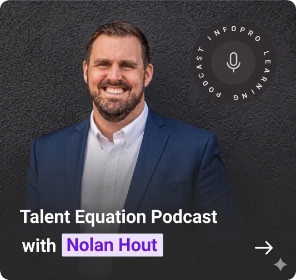
Nolan Hout, Senior Vice President, Growth & AI Strategist, Infopro Learning
Nolan Hout is the growth leader and host of this podcast. He has over a decade of experience in the Learning & Development (L&D) industry, helping global organizations unlock the potential of their workforce. Nolan is results-driven, investing most of his time in finding ways to identify and improve the performance of learning programs through the lens of return on investment. He is passionate about networking with people in the learning and training community. He is also an avid outdoorsman and fly fisherman, spending most of his free time on rivers across the Pacific Northwest.
Internal talent marketplaces are reshaping how organizations think about skills, careers, and performance. In this episode, Dr. Edie and Nolan discuss skills-based organizations, the power of internal talent mobility, and how companies can enable stronger performance through learning, development, and purpose-driven work.
- What an internal talent marketplace is and why it matters for modern organizations.
- How skills-based organizations help companies become more agile.
- Why employees are more than their job titles and how hidden skills unlock opportunity.
- How AI is accelerating skill mapping and talent matching inside companies.
- The role of project-based work in developing new capabilities.
- Why internal mobility improves engagement and reduces employee turnover.
- How organizations can measure the ROI of talent marketplaces.
- Why traditional performance management systems often fail.
- How performance enablement can create more motivated and high-performing teams.

Ask people what they love doing at work and what they hate doing. When you help them do more of the work they love, their motivation, engagement, and performance naturally rise.
Founder & President, E. L. Goldberg & Associates
Introduction
Nolan: Hello everyone and welcome to the “Talent Equation Podcast,” formerly known as “The Learning and Development Podcast.” This episode is sponsored by Infopro Learning and as always I’m your host, Nolan.
Joining me today we have Edie, founder and president of E.L. Goldberg and Associates. Edie’s been a thought leader in the talent management space for over two decades now and is very well known for her thought leadership on talent management as well as the future of work.
She has worked with all types of companies. Whether you’re a Fortune 10 company, the largest company in the world, or a startup with ten employees, she’s been helping organizations create strategies on how to attract, engage, develop, and retain critical employees.
Today we’re going to be talking with Edie about talent marketplaces, which are really built on the foundation of skills-based organizations.
Edie also has a new book coming out that I’ve been dying to learn more about, so if we have time maybe she’ll give us a little sneak peek. Lots to unpack today, so let’s get to it. Edie, welcome to the podcast.
Dr. Edie: Thank you so much, Nolan. I’m really excited to be here and to chat with you.
Dr. Edie Goldberg’s Background and Career Journey
Nolan: Before we get into the topic, what we always like to touch on is your origin story. Tell us a little bit about your background and how you got into the talent management space.
Dr. Edie: That’s a great question. My academic training is as an industrial organizational psychologist, which is essentially the psychology of work behavior. It integrates my interest in work with my earlier interest in psychology.
After I got my PhD, I worked for a small boutique consulting firm that specialized in assessment and development.
Then I went to work for Towers Perrin, a large global management consulting firm. I served as their global thought leader in the human capital practice and worked extensively across Asia as the Asia Pacific liaison.
About 25 years ago, I left to start my own consulting practice so I could focus on doing the work that I love. That allows me to work with everyone from Fortune 10 companies to startups. Living in Silicon Valley, startups are a big part of my world. Today my career is more of a portfolio career.
I’m a consultant, an author, a keynote speaker, and an advisor to several HR technology companies. I’m also a limited partner in a venture capital fund, so I’m deeply involved in the startup ecosystem as well.
Nolan: For people who are starting their own consulting careers, which part of your work is most rewarding to you?
Dr. Edie: That’s a hard question because I love the variety. Each aspect of my work brings something different. Whether I’m on stage speaking or working with a company as a consultant, I get to bring together my academic training and decades of experience to help organizations drive performance and help individuals become the best they can be.
Being on stage is fun. But honestly, having a real impact inside a company — helping create meaningful changes, that’s the most rewarding thing for me.
Nolan: Have you ever bombed on stage?
Dr. Edie: I’m sure I have. Thankfully that’s not the first thing that comes to mind, but I’m sure it has happened.
Nolan: I had one experience where I completely bombed. I thought the content was amazing, but it involved a lot of math and I completely overestimated how much math people wanted to do in the session. Thirty minutes in, everyone was just staring at me. That was definitely a learning moment.
Dr. Edie: You don’t connect with every audience. Some people will think your talk is the best thing they’ve ever heard and others will walk away without much reaction.
During COVID, the hardest thing for me was speaking into a virtual environment where you couldn’t see or hear the audience. Talking into a black hole is really hard when you normally feed off the energy of the people you’re speaking to.
Understanding Internal Talent Marketplaces
Nolan: Let’s shift to our main topic: internal talent marketplaces. For those who may not be familiar with them, how would you define them and why are they important?
Dr. Edie: An internal talent marketplace helps organizations understand the skills that exist within their workforce. Every person is more than their job title. We bring past experiences, passions, interests, and skills that may extend far beyond what we do in our daily job.
Talent marketplaces allow employees to capture all of those skills.
For example: Someone might know Python because they taught themselves coding, even though their current job doesn’t require it. I happen to be a certified wine specialist, which has nothing to do with my professional work.
These platforms capture those hidden skills. Then organizations can post projects or opportunities on the marketplace that require specific skills. Using AI, the platform matches people with the right skills to those projects.
Projects might require a few hours per week for a short period, or they might lead to full-time job opportunities. The technology can also identify internal candidates who already possess the skills needed for open roles.
The Shift from Jobs to Skills
Nolan: Originally, many of these tools were focused on internal job mobility. But AI seems to have expanded them to project work and gigs inside the company.
Dr. Edie: Exactly. In my book The Inside Gig, we explored how shifting from jobs to projects helps organizations optimize how work gets done. During the pandemic this approach proved incredibly valuable.
Organizations suddenly needed new roles, new skills, and new ways of working. Talent marketplaces allowed companies to quickly move people into temporary projects that supported changing business needs. This approach makes companies more agile.
It also supports development. If a company is transitioning from server-based technology to cloud infrastructure, employees can join cloud projects and develop those skills while still working in their existing role.
Talent marketplaces also connect people to career paths and learning opportunities. They show employees which skills they need for future roles and connect them to projects or training that help build those skills.
Skills-Based Organizations
Nolan: A key part of this approach seems to be creating a skills-based organization. That requires identifying the skills needed across roles.
Dr. Edie: Historically that process took forever. By the time organizations identified the skills for a role, the role had already evolved. But AI tools can now analyze job descriptions, resumes, and labor market data to identify the relevant skills almost instantly.
Then employees simply confirm which skills they actually use. This makes the process far faster and more scalable than before.
Skill Validation Challenges
Nolan: One challenge I’ve seen discussed is skill validation. How do organizations ensure employees accurately report their skills?
Dr. Edie: That concern comes up frequently. However, research shows employees usually don’t exaggerate their skills inside their own organization. If someone claims to be an expert in something and gets assigned to a project based on that claim, they will quickly be exposed if they lack the skill. That reputational risk discourages exaggeration.
Some companies add validation from managers, but overall it hasn’t been a major issue. Talent marketplaces also prompt employees to update their skill profiles after completing projects, which keeps skills current rather than becoming outdated.
Measuring ROI of Talent Marketplaces
Nolan: Organizations also want to connect talent marketplaces to business results.
Dr. Edie: Yes, and we actually have strong ROI data.
Companies have measured the value of work completed through internal projects that would otherwise require hiring freelancers or contractors.
The results include:
- Millions of dollars saved
- Hundreds of thousands of hours of additional productive work
- Increased engagement
- Reduced turnover
Employees working on projects they choose themselves often experience greater motivation and productivity.
Introducing Performance Enablement
Nolan: Your new book focuses on performance enablement. How does that connect to your previous work?
Dr. Edie: The connection is development. To truly enable performance, organizations must prioritize continuous learning and skill development. Traditional performance management systems don’t work well anymore. Our new book examines the science behind performance management, why it doesn’t work as intended, and what organizations should do instead.
Why Performance Management Fails
Dr. Edie: Most organizations use coercive control systems in performance management. These systems rely on extrinsic rewards:
- Achieve the goal → receive a reward
- Fail to achieve the goal → lose the reward
But performance enablement is based on enabling control, which focuses on:
- Autonomy
- Mastery
- Purpose
- Intrinsic motivation
When employees feel connected to meaningful work, their performance improves naturally.
Purpose, Goals, and Motivation
Dr. Edie: Goal setting is still incredibly important. Research shows that specific and challenging goals increase performance.
But organizations often miss the context behind those goals. Employees must understand why the goal matters. When people understand the larger purpose, they become more committed to achieving it.
A great example is NASA. When asked what he did at NASA, a janitor famously replied: “I’m helping put a man on the moon.” That connection to purpose drives engagement and performance.
Rethinking Feedback
Dr. Edie: Another key part of performance enablement is feedback. Research shows:
- One-third of feedback helps
- One-third has no effect
- One-third actually hurts performance
Much feedback focuses on judging the past rather than helping people succeed in the future.
Instead, we should emphasize feedforward, helping people apply lessons to future situations. Unfortunately, only about 23% of employees feel they receive valuable feedback. That is a huge opportunity for improvement.
Closing Thoughts
Nolan: To wrap up, what’s one thing leaders can do today to help enable better performance?
Dr. Edie: Ask employees two simple questions:
- What do you love doing at work?
- What do you hate doing at work?
Then help them spend more time doing the work they love. When people do work they care about, they become more motivated, more engaged, and their performance improves.
Nolan: That’s incredibly simple and powerful. Thank you so much for joining us today.
Dr. Edie: Thank you. I loved being here, and anyone should feel free to reach out.