


Dr. Ashwin Mehta, Founder and Director, Mehtadology
Dr. Ashwin Mehta is an AI strategist, learning technology expert, and founder of Mehtadology. With over 14 years of experience across industries, he advises organizations on integrating AI to drive learning, performance, and workforce transformation. Holding a PhD in learning technology adoption and an MBA, Dr. Mehta is a sought-after keynote speaker, consultant, and thought leader. He leads AI masterclasses, contributes to global discussions on ethical AI, and produces original research as well as podcast content. Through Mehtadology, he helps businesses cut through the AI noise and implement strategies that deliver measurable, sustainable impact — the kind that matters in real-world transformation.
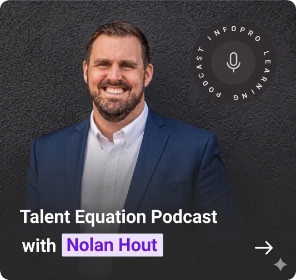
Nolan Hout, Senior Vice President, Growth, Infopro Learning
Nolan Hout is the Growth leader and host of this podcast. He has over a decade of experience in the Learning & Development (L&D) industry, helping global organizations unlock the potential of their workforce. Nolan is results-driven, investing most of his time in finding ways to identify and improve the performance of learning programs through the lens of return on investment. He is passionate about networking with people in the learning and training community. He is also an avid outdoorsman and fly fisherman, spending most of his free time on rivers across the Pacific Northwest.
In this episode, Dr. Ashwin Mehta joins Nolan Hout to explore how AI is redefining the role of Learning and Development. From automating routine tasks to reshaping L&D’s strategic footprint within organizations, this conversation dives deep into the present and future of AI-powered learning.
Listen to this episode to find out:
- How AI is reshaping L&D roles: from content creation to strategic decision-making.
- Which L&D tasks are most susceptible to automation, and which remain uniquely human?
- Why performance metrics, not vanity metrics, should define L&D’s impact.
- How learning leaders can use AI to create cost-effective, scalable learning solutions.
- The risks of relying on traditional eLearning in an AI-enabled workplace.
- How L&D can influence business transformation through operations and organizational design.
- Why the future of learning might merge with functions like HR and operations.
- What skills learning professionals need to stay relevant in an AI-powered world.

If everyone has access to AI that can summarize primary data in seconds, why are we still investing so much in reformatting it into e-learning modules? We need to move beyond content delivery and focus on creating meaningful learning experiences that drive real business value.
Founder & Director, Mehtadology
Introduction
Nolan: Dr. Ashwin Mehta, welcome to the podcast.
Dr. Ashwin: Thanks for having me.
Nolan: Yes, thank you for joining us on this series we’re doing together. For those of you who are catching this first series of the podcast, we have already released three to four podcasts on AI in L&D. Today, we’re going to discuss the role of L&D with AI. And joining us, as I mentioned, is Dr. Ashwin Mehta, who has invested probably more hours than any other learning leader I know in the space of AI in L&D. Nobody is better than him.
L&D’s Evolving Role
Nolan: But before we delve into the role of L&D with AI and how things are changing, what’s really on the minds of many of us now is what we’re going to do next year. Often, when we discuss roles, we’re not talking about what we’re going to do next year. It’s more, where should we see ourselves? What is the vision of L&D? But before we do that, Ashwin, I thought, let’s start with what the role of L&D is as we see it today? Before we can pinpoint the location on the map where we think it will go, we need to know our current location. So, where are we today?
Dr. Ashwin: That’s a point. Yeah. What do we do in terms of learning and development departments? And it’s variable, right? Because some L&D departments are heavily involved in eLearning development, they often overlook aspects such as skills, behaviors, performance, intelligence, and other related factors. And some L&D departments span a fairly wide range across this spectrum.
Some individuals get involved in implementing all the necessary technologies for these types of projects. And some don’t. They rely on their IT departments to perform this task. Some go off and conduct procurements, surveying the market and trying to make sense of the sprawling landscape of technology that we have. And some don’t; they rely on procurement departments.
The role of L&D depends somewhat on the scale of the organization and its remit. In a small organization, and this isn’t an L&D comment. This is any department in a small organization. You get your hands stuck in, you do a little bit of everything, and you make things happen. Big companies have way more structure than you do, of course, for different reasons. And therefore, they have roles and departments where you might have a hundred people, and their job is to buy things, and you have a hundred people, and their job is to implement IT. And then the role of L&D becomes that of users of the purchased IT, which is then implemented.
It’s a sprawling thing. And this is the necessity of business, and this is the necessity of scale. But when we boil all of that away and we think about, commonly across all of these structures, what do we see? We see a human capital department, which encompasses HR, rewards, learning, and all the various elements that come together.
Talent acquisition, succession planning, strategic workforce planning, and all of these kinds of things. And that is effectively one part of a puzzle. Learning is one part of a slightly larger puzzle where you’re trying to ensure that the organization has the necessary human capital, including the people, skills, and headcount, all of which are required to achieve what the business needs to do as part of its operating model. And that operating model should include people, premises, processes, technology, data, supply chain, finance, and all of these elements that come together to enable a business to operate effectively.
Within that, there are various departments, including HR, talent, succession planning, workforce planning, learning and development, and a few other areas. To me, that’s how it partitions out. And when we think about learning, we think about effective strategy. Depending on the scale of the business, how do we ensure the scalable availability, supply, and demand of skills, behaviors, knowledge, and all the other factors that make human capital work? And that could include interventions, platforms, and data, as we’ve discussed before. However, it could also be a matter of performance and impact. Of human capital.
It could be tactical things, such as management information, being reported to the people who are responsible for releasing budgets for learning. It could be a collaboration between departments; IT is usually a good one to think about. You may have a small department and work closely with the supply chain. However, all of these things come together to enable a scalable strategy in terms of skills. And within that partition, we then have, of course, the interventions. What are the interventions? Are they eLearning? Are they classroom training? Are they virtual online sessions delivered by an expert?
Within this spectrum, we’re examining a continuum of training, learning, and development. We can also discuss these topics digitally, depending on the training, as the risk mitigation measures a business implements through learning expand its development horizons, leading to self-actualization. We have discontinuum. We could be talking about facilitation, coaching, mentoring, virtual instructor-led training, leadership development programs, all of these types of things. And we could be discussing specific, scalable programs. You have a manufacturing business, and you want to implement a program of excellence across all your manufacturing sites to align with your strategy. So, that’s the intervention space, platform space. L&D sometimes gets involved in this, but sometimes it’s completely an IT function.
You need to align with a technical strategy or something. And then there’s the data side of things, with continuous improvements in learning and teaching strategies aimed at enhancing the strategy we’ve discussed. So, typically, this is the spectrum of things. There may be others, but this is the core of what Learning and Development (L&D) does. And then they get involved in things, including skills as well. Considering everything I’ve said, it’s probably more helpful to discuss technology broadly rather than focusing specifically on AI.
However, if that’s the current state of what L&D does, then, considering everything I’ve said, you’ve the opportunity for technology. I phrase it as an opportunity because different businesses are based on scale, risk appetite, appetite for technology, and financial resources, among other factors necessary to make technology happen. Different businesses will, to varying degrees, utilize technology in each of these areas. Some businesses will have an appetite that is very focused on facilitation, coaching, mentoring, apprenticeships, and other similar initiatives.
And that could be part of the company’s culture. It could be part of the necessities of that business. In that space, technology and AI, such as coaching and virtual agents, support mentoring, and consider scalable data to identify trends that inform adaptive learning and teaching strategies. However, on the other side, the more digital side of things, companies are heavily investing in eLearning, simulations, digital environments, and platforms that allow scalable access to these kinds of environments.
This is the space that receives significantly more attention when it comes to technology, because, effectively, you need technology for digital media creation and digital media access, such as websites and other related applications. LMSs, LXPs, we call them. You need all of that to enable scalable access to the thing you’ve created. It’s easier to understand the technical space there and then, when it comes to the side of data, know, having databases, whether it’s Excel spreadsheets or you have formal databases in a technical architecture, these kinds of things also, to some degree, need to be part of the L&D skills spectrum.
But you can apply technology across nearly every aspect of what I said from strategy interventions, platforms and data to make these things work, to give you better visibility of data, to understand your impact, to be able to craft the perfect strategy to reach your learners, to be able to quantify your return on investment and make sure that the business is getting what it should be getting. I would say that you have the role of L&D, which comes with opportunities for technology, and that allows us to then think about what change might look like from that current state. What do you think?
Nolan: Yeah, I was thinking while you were giving me the answer, and a lot of times, when you ask a question, the answer is, here is the answer. This answer is a very long answer and a very hard thing to answer. And, the entire time in my mind, I was thinking, what a hard thing to nail down. And I’ve always subscribed to the thought that this is what makes L&D such an interesting role within an organization, because it serves many different functions simultaneously and many different people simultaneously, right?
It is worth noting that marketers are primarily marketing to your customers. L&D folks, you’re trying to train customers, partners, and employees, including a 65-year-old CFO and a 22-year-old call center engineer, and you have to apply training that works equally well for all of them. What you’re asked to do is wide; defining what it is you’re trying to do becomes complex.
But one of the things you mentioned was the role of transforming the organization. I forgot how you mentioned it, Ashwin. Is there any role, right? You’re intended to add value back to the organization. Now, finance does it through their way, ops does it through their way, and learning does it through their way. And that, for me, was the central point. I know that we’ve discussed this, you and I, and I’m also aware of our conversations on the podcast and with many other guests, regarding the role of L&D and its central point: performance and understanding how you contribute to improving the organization’s performance.
Important Metrics for Learning Leaders
Nolan: And it’s like, do you still see that as the central role? If we were to add performance to that. Do you think there are metrics that learning leaders own uniquely to them? I’m assuming no, because it’s very hard for any one person to own a metric at a large global scale. But what would you say are those metrics that become the most important to learning leaders?
Dr. Ashwin: To strip this out for a second, but there are two ways we could look at metrics. However, before we examine the metrics, I’d like to revisit a point about marketing. I’ve given this some thought. I think marketing and learning are the same thing. The reason is that we implement interventions to try to change behavior. In marketing, we examine customer behavior, purchasing behavior, and engagement behavior.
In learning, we look at the same things. It’s not about purchasing, but rather its intentions and deployments. I don’t see a massive difference between the two, but we do refer to them differently because one faces the customer, and the other faces the workforce. However, I view them as the same thing, which leads us to the concept of metrics. In the business world, we refer to these as metrics, but in reality, they are just data, right?
In the world of data, there are effectively two types; we can partition this into two different areas. I was going to say two types of data, but that’s not entirely true. However, we can break this down into a few distinct areas. One is let’s call them vanity metrics, or potentially junk metrics, or web analytics. That is how many people clicked on the button, indicating that they saw my content.
And I was reading about it. Was it this week? I was reading about what LinkedIn impressions are, right? Because I didn’t know. I didn’t know what they were. Please don’t discuss LinkedIn impressions with me. I was looking at it, and it seemed that if someone has seen your post on their feed for more than 30 seconds or whatever the duration is, that could indicate they’re scrolling. You didn’t read it, but you scroll through.
Nolan: Absolutely.
Dr. Ashwin: And I thought that was a great example to think about how we view some of these vanity metrics in learning, because we, in a traditional LMS setup, where you have eLearning on a system, and people will look at what you have, you have click-through behavior.
You don’t have engagement. You don’t know if somebody’s reading it. You don’t know if they ignored it completely, if they had a different monitor. Some LMSs have ways to control for this. But generally speaking, you’re looking at your click-through behavior. And if we’re examining click-through behavior, that’s no different from any web marketing that anyone else would do.
Vanity metrics, in the traditional sense, include the number of classrooms and the attendance of people who have shown up. How many bottoms were on how many chairs, right? For how many hours, and therefore that’s a measure of something, that’s a measure of attendance, right? And it’s that style of metric where we say, ‘ We have some engagement, but it’s vanity. ‘ Then the second type is, I guess, still linked to vanity, but it’s around the learning operations themselves. When we think about learning operations, we might say, ‘Let’s take an eLearning factory as an example.’ We say that many requests come in, and many bits of media are produced. We can measure this and say that, based on this headcount and this level of technology spend, we have created this many units.
So, again, operational metrics, but it’s in that space of it’s not telling us anything about the output. If we draw a line there, and then we start to think about output. Everything we do should have some impact on the business, on employees, on the workforce, on knowledge, and cognitive capability, depending on the Learning and Development (L&D) departments and their focus.
Now, is it useful to think about operational and vanity metrics at that point? It doesn’t reveal anything about the output. It doesn’t tell us anything about impact. Therefore, when we consider the performance of an organization, we also consider the performance of its workforce. We don’t look at eLearning behavior. We don’t look at how many people clicked on things. We tend to look at, if it’s a manufacturing plant, how many bits were manufactured, right? Or how many defects were there? Or how much lost time was there due to accidents, right? You’ve got things, things that make money and things that disrupt money-making activities.
Those are the two ways you can partition this. And eventually that leads to things that matter to the business. Key business metrics include revenue, sales volume, and product quality. And it varies from business to business. However, generally, when we examine human capital interventions, we ideally want people to utilize all the capabilities, skills, technology, and resources available to them to be more productive in generating revenue, selling more widgets, or achieving other similar objectives.
These are business operation metrics. Whatever the business is, they’ll be measuring things. They’ll be measuring inputs, processes, and outputs, in an I-O diagram style. That’s what they’re doing, so we should focus on L&D’s impact on those metrics. And when we conduct an intervention, we should consider potential A/B testing. You have two options: either pre- and post-testing or a two-group design, where you give one group an intervention and don’t give the other group an intervention, and see if there’s a difference.
And this sometimes happens in sales training. So, you’ll say, we’ve 25 salespeople here and 25 salespeople there. We’re going to give these access to this wonderful simulation, deny access to those, and then compare the two. Was there a difference in the number of successful conversations they had with their clients that led to some conversion into a contract or whatever the sales function is looking at? So, that’s an operational metric that we can track by doing some A/B testing. So, what I would like to see is a lot more of that happening when we consider the interventions that we are doing. You know what it costs to make it. You know what the throughput is. You know, how to operationalize things and whether people clicked on them or not. But does it make a difference? And the only way you can know if it made a difference is to look at ops.
Nolan: As a marketer myself, I’ve realized that much of what I preach to my employees is the same thing I end up doing. We produce thought leadership and similar content, and it’s really about following this approach in marketing. HubSpot, for instance, put out the ‘attract, engage, obtain’ model. You attract people once they’re aware that you exist. You engage them more deeply down the funnel by getting them to take action.
You said, they’re doing the same thing. That model is the same in learning. You attract them to this issue, you engage them with that content, and then they obtain. They consume what it is that you wanted them to do. Then afterwards, it opens back up to value. What value are they getting from this, then? Getting that you delivered. As long as all of those metrics are there, you’re good.
How AI Is Reshaping L&D Roles
Nolan: So, coming back, we talked a lot about the various roles in L&D, from creating the assets to owning the platforms to connecting with the business. Now, as we look forward to considering AI, how do we envision it disrupting our roles today?
Dr. Ashwin: Again, it depends on what your role is, right? I suppose we can now draw a line, given that we have already outlined the current state of L&D, indicating that there are probably activities or roles that, on this end, don’t add as much value to the business as they could.
And on the other end, we have high-value roles. Now, across that spectrum, we also have the capability of AI. So, where can we apply AI to some of this? On this side, we have a process where, if someone gives you a PowerPoint, you add an image and an X button, and then you distribute it back to the organization, and you’re done. That whole area of generating a first draft, making it visually appealing, adding images, and possibly incorporating some interactivity. That entire area can be done to a large degree in an automated way now, because AI is at that point where you can generate a pretty good-looking first draft that needs to be checked by a person, but is almost there.
So, if your role falls within that area, which typically includes developers and instructional designers, then those areas, jobs, roles, and activities likely have some elements of risk associated with AI. If you move the needle even slightly, and you say, ‘My instructional designer doesn’t do any of that stuff,’ because what they do is work deeply back and forth with some people, and they do some writing and some explanation, and explain this to me as if I’m five years old.
They summarize and write bullet points; they can take a 10,000-page PDF and summarize it in five bullet points. Again, AI can now do that to a great extent. So, there is an element of risk associated with those jobs. Even if the role involves something quite complicated, it requires a lot of time. It requires a great deal of specialized knowledge. We are still seeing, to a large degree, that those roles do have an element of risk associated with them.
If we move up the spectrum a little further, we can say that we’re now looking at individuals who lead large programs. Now, the individuals who lead large programs likely possess a range of capabilities, as we’re no longer talking about having a single skill set that you use day in and day out. Now, we’re talking about you having a range of skill sets, and you need to apply the appropriate resources —whether it’s technology, people, or other resources— to a problem that the business has.
That role has a lot less risk associated with it when it comes to AI, because part of your suite of decision-making capabilities should now include determining where to deploy technology and where to deploy people. Where do I deploy people who are enabled with technology? And where do I ensure that collaboration happens? So, the decisions are slightly different, but decisions still need to be made. And because decisions still need to be made that incur capital or operational expenditure costs, those roles are still, to a large degree, necessary.
Are they necessary in the same volume? Are they necessary with the same cadence? Maybe not, it depends on the business. But I would say the risk on that end is slightly less. We then have, on the other end of the spectrum, the high human contact roles. So, that might be the deep one-to-one coaching where you need to have back-and-forth communication between people, you need to have some empathy, and you need to have some relationship-building capability.
Probably less risk there, but on the flip side, we have a lot of AI coaching capability coming out, even from foundational models and even things like ChatGPT, where you could go back and forth on a problem with something that is an AI agent. And you might get to a resolution yourself.
And it’s helpful to be able to distinguish between coaching and mentoring, right? Because there’s also a spectrum in that. And when we think about the possibility of going back and forth with somebody who asks you questions, but you know the answers yourself, right? What we need is someone good at asking you questions that you can reflect on.
Can we apply AI to that? I think we can. But the human contact side of it, the social learning, the peer-to-peer stuff, the Vygotskyian concept of a more knowledgeable other that can provide you with some stretch mechanism, that stuff is. So, we can partition it.
Nolan: Yeah, you’ve got. Some of the more production roles, as you get to more personal roles, the roles change in different ways because you’re dealing less with automation than you were.
Dr. Ashwin: Yeah. And then, of course, we have the leadership roles, where you’re accountable for people, budgets, and adding value to the organization. And those to a large degree still need to be done.
Nolan: So, when I look at this, a lot of it I view as a short-term role versus a long-term change, right? When we were talking, and you mentioned the producers, the people who are doing fairly genius roles day in and day out, it seems a role of today is how to use AI and L&D, right? And if you’re listening to this podcast, hopefully you’re doing that job because you’ve listened to this podcast and the other series, you’re trying to learn. How do I do that? Because, especially for your CLOs, your other learning leaders out there, that is part of your role today: How am I leveraging AI to build widgets faster, better, more effectively, whatever it is.
And I see that as a definite cornerstone of many learning leaders entering 2025. We’re filming this at the end of 2024, which is how we create these coaches that have empathy, or we choose not to give them empathy at all. And as you mentioned, they asked you to do so. I’ve seen a lot of this coaching. I was going to say coaching coaches, but coaching agents, bots, whatever you want to call them, that prompts you to think, when was the last time you had a tough conversation with somebody?
And how did that make you feel at the end of it or something along those lines? This is a really common self-help application. I was speaking with my wife the other day, and she downloaded this modern. Do you remember Giga Pets? I’m not sure if you remember these little Tamagotchis. They were these little characters that you had to feed and pet, and they were on keychains. You had to give them love, and then they would grow and hatch and become whatever. There’s an app, and I don’t remember its name right now, but my wife was telling me about it, and it’s essentially the same thing. It’s a little Tamagotchi, little digital pet you have in your app, but the way that you feed it, the way that you give it love, is by completing these things that are mental health wellness things: journal for, a hundred words of journaling, take 20 deep breaths using this exercise and you have to engage. If you do, you give them hearts, you give them widgets.
So, there are a lot of those elements in coaching that are one way and do make an impact, right? How much do I want to go down that route, versus do I want it to be fully person-involved? It seems that this year and even next year, and possibly for the next two to three years, a lot of the role will be about how much AI, and what my AI journey looks like. But then I feel Ashwin and I’ve talked a lot, and it’s almost the short-term role of L&D, but quickly you will reach your diminishing returns, right?
You would have eaten your 18th piece of pizza soon enough. You’re using AI now, you’re going to know, Ashwin. I don’t know what you see, but I know there’s a 50-60% cost saving. I’m not sure what you typically consult with your clients on, but whatever it is, you’ve already cut your expenditure in half while still delivering the same level of service. But then what’s next? We have this powerful technology, not AI, but technology in general, that’s continually progressing at every step. What do you see, three, four or five years from now? How do you see the role evolving with this superpower?
Dr. Ashwin: There are a handful of answers to this, but they all rely heavily on the T word, right? Transformation. We need to change something. That’s when we adopt the content paradigm. The traditional paradigm of L&D is that we create content, we put it on a system, and people view it. That paradigm, if we’re looking at how we create content with AI and how we integrate AI into our platforms to enable people to find content more effectively, then we’re not talking about transformation.
We still operate under the same paradigm as before. We’re applying AI to some parts of the process. Everything we’ve talked about up to this point, where we’re making AI-generated content, falls into that bucket. If we consider transformation, I’m one of its proponents, and I’ve a few other colleagues in the AI space who share this perspective. And that’s that. I read an article on the subject, and I dare cite it, but it’s not an academic article, nor is it peer-reviewed. It was something that came up in my newsfeed. Think it was; they named that particular model, but other models are available.
But everybody has access to free models. You don’t have to pay; you ask a question. Now, risks, hallucination, errors, etc., you need to caveat that with, you need to check your sources. However, everybody has access to a platform where they can ask a question—used to be Google, Bing, etc., search engines. However, you can go back and forth in a conversation with something that is free, which serves as an alternative to eLearning.
Corporate eLearning has, over the years, become somewhat stale and has developed a somewhat bad reputation. Most people don’t want to do it because it’s a click, click, and it’s something that somebody made me do, which can be a little bit boring, so I didn’t want to. Not relevant to me. You receive personalized information based on the question and the trigger. As a knowledge worker, there’s a trigger. I want to find out something. You can also access a free platform. You know, YouTube is based on the same concept. It’s a free resource where you can search for information and discover something else.
So, when we have all these things available to us and on the enterprise side, let’s now switch from consumer to enterprise. We now have implementations of Co-Pilot, Gemini, Google Suite, Claude, and an open AI implementation, among others. Many enterprises are following this path. If they’re going down that road, and everybody has access to something that is increasingly more contextually relevant, because we’re looking at, for example, the Microsoft instance, if you’re on the Microsoft platform. When you implement Copilot, you can search your corporate repository, SharePoint, and all your data.
You can be looking for contextually relevant things. Now, if all of that’s true, then why do we need eLearning? Nobody has given me a convincing answer to this. Because we somehow are reformatting content. We’re examining primary data and generating secondary or tertiary data from it. And then we expect that tertiary data still has value and a need, even if we have something that can summarize primary data in our hands. I don’t see where the value is in that in a future state where everybody is co-piloting. That’s the point.
Is eLearning Still Relevant?
Nolan: I was starting. I was trying to think about that myself. Do I need eLearning? It’s where I was going, and what the quote came to mind. I don’t know who said it, but it’s I want to learn, but I don’t want to be taught. It comes down to when you force someone to learn something, they don’t feel like they’re learning. They’re being told what to do. They’re being told to learn this. However, there is inherent value in going through the process and learning something, even if you aren’t inherently a curious person who learns easily. And I wonder, how do you? It’s the age-old question. My kids are doing this right now. Why can’t I use a calculator for math? Am I not going to have a calculator? Why do I need to learn addition, subtraction, and other basic math operations? It’s because it builds the foundation for you to understand greater things.
And the calculator did not remove the teaching of addition and subtraction in schools, although it is very easily done with a calculator. Or abacus before the calculator, for that matter. I agree with you that many of these things become obsolete, but how do we address the idea that many people don’t understand the need for education and are unwilling to pursue it? It almost has to be force-fed.
Dr. Ashwin: This is why I made the point about eLearning, right? Because eLearning is not the entirety of what we outlined at the start of this conversation, that is the role of L&D. On the other hand, we have intensive, global, or sustained programs of development. And when we partition what I said earlier —when we partition training, learning, and development —the training risk mitigation measure of the business —I need to demonstrate to an auditor or regulator that I have shown people this information, because that resolves some risk.
Generally speaking, it doesn’t; that’s something for lawyers to talk about, rather than me. But in that space, that’s the market that should go, for two reasons. Reason one is, somehow, I say, if somebody clicked on this eLearning, then that’s sufficient for me to discharge my legal duties. Is it? I don’t believe it. However, on the other side, if we have knowledge workers working in an environment where they follow standardized or automated processes, why aren’t we automating those processes rather than automating the process of creating content that they then have to follow?
There’s an organizational development hat that learning and development could be looking at, thinking about how to change the value structure of the business. Because the value chain isn’t, we’ve had many people talking about this on nearly every channel that people, you mentioned it earlier, you mentioned, can’t remember exactly what you said, but something around growth mindset and critical thinking and, you know, the, things that we say are soft skills that we want people to go and do.
That’s usually what we say: we want the right people with the right information at the right time to make the right decision to make the business happen, right? And if that’s what we want, then why do we want those people to be working in an environment where they don’t exercise their decision making, where they don’t exercise their judgment, where they do what they’re told because we’ve trained them to do? That’s the training side of the business. And that’s why I mentioned eLearning, because eLearning training tends to go hand in hand, as we need to convey information to someone. When we move up the value chain and we start to think about it, we want people to be able to exercise critical thinking and judgment. We want people to exercise their relationship-building skills. We want influence and negotiation. We want these kinds of things to happen. We want some deeply technical programs where you have complex machinery and you want to understand how it works. You want to, pilots, for example, you don’t want the first time anybody’s having a go to be in the cockpit of a plane.
You have a simulation strategy. How do you allow people to engage in experiential learning, practice, and rehearse, and then learn from those experiences, while also being exposed to safe scenarios? You have a whole range of things that L&D does that isn’t the eLearning space, where we could be putting a lot more effort, money, and time into creating meaningful experiences.
‘Meaningful’ is the keyword there because ideally, what we want is for someone to be exposed to new stimuli and make meaning in their minds, generate knowledge, and then apply that knowledge. That’s what we can do. Then why don’t we do that and divert the resources that we had before into these more meaningful things? And depending on the business, the meaningful thing might be something different, but there is a range of things to consider in that space.
Nolan: Yeah, Ashwin, that’s really where I see it. That last bit is, to me, the future role of L&D, and AI is not. Honestly, many L&D leaders would agree that we’ve been trying to pull the business there for some time. Why do you want us to create this training? Tell us why you need this. What business metrics are going to improve? The answers we get back are not always the best. We go off and we create a training program. It doesn’t have the biggest impact because we knew at the beginning anyway that there wasn’t a significant impact to be made, as learning can occur naturally. You mentioned playing up the operational role of this agent, where the person takes the data and searches for an answer, similar to a call center agent, right?
Their job is to, I don’t know, point people to a website or help them recover their password or whatever. And it’s like, we have two options, and this has already been partially automated. But right now, if I forget my password, what do I do? I click a button, select ‘Forget Password,’ and it is sent to me via email.
I am now sure that there are still some people who find it confusing. They call in and say, ‘I forgot my password.’ What do I do? And I’m sure there is someone who has to guide them through that. Now you have two options when you’re an L&D leader. When you’re given this information, someone comes to you and says, ‘We need to train call center reps on how to help customers find their passwords.’ I can do that, but it will be the same for everybody. Correct? Because all we do is take them to the website. And we have them, or we type in their email for them. And then we tell them to go to their email and check that.
There are quite capable AI agents that can converse. This is a highly scripted event. We don’t need it to create a complex answer. These are not level three customer requests that involve adding a hotel room. They have a layover in Denver, and they want to add a hotel room, which will be paid for by Alaska Airlines. It isn’t a highly complicated thing. Their role could be. Why wouldn’t we create an agent that can respond and provide this information without requiring an actual person to be in that role? That seems like a very solvable problem.
That would you agree that the large picture of all of this is that the future role of L&D is one to apply a lot of things we talked about and to make sure that when there are those large, the key words, transformations, that they become an agent in those and invest serious money, butts in seats, grabbing people and make changing hearts and minds, you know, all those things that are high cost but high reward things.
Continue to invest in those areas, but also develop a business mindset and an operational mindset to recognize that when you’re being asked to do something, it’s not that you have to know how to do it, right?
L&D, Automation and the AI Future
Nolan: I don’t think anybody is saying the L&D person needs to know how to train a live agent on how to talk, but then to loop in operations and say, ‘ Hey, know, sales is wanting this job done by this person. ‘ I honestly feel an AI person does it better. Would you agree that’s where you think that’s headed?
Dr. Ashwin: A couple of comments, right? The first one is, I was listening as you were talking, and you went from learning leaders to L&D, right? While you were talking about that. And what I said earlier was about organizational developments, specifically how you structure roles and the operating model, which is ever so slightly different from learning. But when we talk about learning leaders, not learning servants, we’re talking about learning leaders, right?
There’s a difference in working with the business and saying, ‘ What are we measuring? ‘ Where should we be investing our resources? Can we modify the operations here and implement something that offers better value for the business? That would be a leadership call; I need some training for this. Can you do it? And I go, yes, every time. There needs to be a difference in behavior. And the behavior is, can you challenge your business and say there is a better way to do this? And that then takes you down the road of having virtual agents here.
We could automate this because it’s script-based, and I’m not familiar with call centers, but it sounds feasible, off the top of my head. Anywhere where a person is following a script, that role can probably be automated to a large degree.
But anywhere where somebody needs to decide, it’s a difficult call. That’s where the people need to come in. There are usually three lines of support: first, second, and third. First-line support can be largely automated. That takes us down to the partition where you ask, ‘Am I a leader in my business?’
And if I am, then I can engage in those multidisciplinary conversations about operations, where we can discuss human capital, human capital deployment, and technology deployment collaboratively, in a way that allows people to work with technologies and achieve the best for the business. That’s a very different conversation. Do you do some training for me? Yes, I can. I would challenge the leadership aspect of that because that’s the critical part in being able to have those conversations.
Nolan: And, I don’t know, in my opinion, that’s the, that is the future role. You feel I’m repeating myself here about L&D, not L&D, for the workforce today, where workers continually have to pay more for things that can’t be done with technology. Alternatively, it may not be perceivable with current technology. The future role of anyone is to find a way to sit alongside these tools and make informed business decisions. That’s not specific to L&D. I’m having these conversations with a lot of my teams, including marketing, sales, leadership, and learning; we’re all having the same conversations.
Dr. Ashwin: And funnily enough, CTOs and CIOs as well.
Nolan: Yeah. Absolutely. So, it becomes part of the future of skills, if you would. And if we expand on this a bit, we’ve already discussed metrics earlier. One of the things I’m thinking is that if I’m in learning, the metrics I want to know about are the ones that the business considers red alert items. Things I’m thinking about right now, as an example, right?
How long does it take to onboard a new employee? And how much does the resource cost that I’m onboarding? And is there a way that I could take somebody right now? Currently, we’re paying someone $50 an hour, and it takes them a month to be onboarded. Could I find somebody who was available for 30 minutes to an hour, give them an agent via their tablet, and send them off and running on their merry way? It still takes them a month, but now I’m paying $30 an hour because I’m alongside them; they have their copilot, not me. I didn’t mean Microsoft; they have their assistant, their AI assistant, sitting alongside. I feel that would be where my mind would go: where is the most money being spent on our people today?
And what can my influence be on where this money is going? Knowing that, most organizations, however, have the vast majority of their costs associated with their people. And if I can identify those high-cost areas and implement a transformation, I can either make their eLearning process quicker, better, faster, or even make eLearning obsolete.
Alternatively, I can sit them with an agent or change the type of person who has to be in that role. That seems like a big area where I would almost be trying to force myself into those conversations instead of somebody trying to bring me into them.
Dr. Ashwin: I mentioned it on one of our other sessions, which was the concept of task fit and task fit analysis. This involves a combination of deploying technology, deploying technology with humans, deploying humans, and understanding the relative strengths of each of these opportunities.
There was a BCG report on this a few weeks ago, which I mentioned before as well. This concept for me falls within the performance, operating model, strategy, or organizational development spaces. And the question would be, is this an L&D role? For me, L&D needs to shift into one of these other areas, most likely focusing on performance, impact, business intelligence, human capital strategy, or considering the human capital aspect of operations. And that’s slightly away from a traditional L&D role. And this change is needed. And it’s possible in the industry with the L&D teams that we have.
However, it does mean either upskilling or repartitioning of roles and moving away from tasks that AI can perform very well. I would say there is a change needed, but the only doubt in my mind, the reason I’m questioning this, Nolan, is whether this, in the future, will be called L&D or should it be called something else?
Nolan: Yeah, I was talking to a client on Friday, and they were saying, there’s this big transformation, and we rebranded and came out with a new website and changed our language. We’re saying we support from recruitment to essentially offboarding, and that instantly puts you into a different realm, right? When you start thinking about recruitment strategies, who are the people who need to be on the bus, and what seats should they be in?
That is not a traditional L&D role, right? Now you’re in what has traditionally been HR. And, where we could probably spend another hour discussing is how those two roles, HR and L&D, are going to evolve, specifically your HR and L&D, and what that looks like with the two merged, with the ownership of the person coming a little bit closer together. That’s going to be a fairly interesting point, as you mentioned. Do they focus more on the operational side or the people side, or both?
Dr. Ashwin: Yeah. And rather than me make a prediction or you make a prediction, think we’re going to, to some degree, see how it shakes out through 25 different businesses, which are going to call it different things. But yeah, it’s all people at the end of the day. Right. What do we do with people? And we have all these sticky situations outside of, in wider society, such as shortened working weeks, universal basic income, and workforce displacement on a scale that is rightly being discussed by other folks who will, to some degree, influence this debate in different companies.
Closing Thoughts
Nolan: Yeah. Ashwin, thank you very much. I’m not even sure if we were able to cover it. I recall that when we first considered which podcast to feature in this AI series, we had mentioned that we would cover this topic in a separate one. And we said, no, no, no, no, that’s too big of a topic. Let’s make it its own.
And here we are, an hour later, and they still feel we’ve scratched the surface. It may have needed to be its series, but thank you for helping us diagnose the area we’re in today, which is an ever-evolving one. And it will be interesting to see where it goes. Thank you again, Dr. Ashwin Mehta, for joining us on this podcast today.
Dr. Ashwin: It’s been an absolute pleasure, Nolan. Thank you for having me.