


Matthew Eade is the Senior Director of Learning and Development at Empire Today, where he leads a team of more than 20 learning professionals focused on building solutions that improve both business performance and employee engagement. His career spans retail, fintech startups, and large-scale operations, where he has repeatedly built L&D functions from the ground up. Originally from Melbourne, Australia, Matthew’s journey into learning began after a decade in retail leadership and global travel experiences that shaped his passion for development. Today, he specializes in using data, AI, and performance analytics to design scalable learning programs that directly influence organizational outcomes and workforce capability.
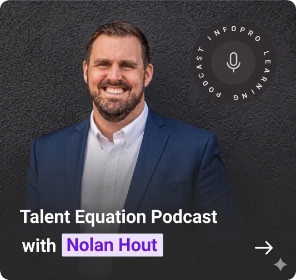
Nolan Hout, Senior Vice President, Growth, Infopro Learning
Nolan Hout is the growth leader and host of this podcast. He has over a decade of experience in the Learning & Development (L&D) industry, helping global organizations unlock the potential of their workforce. Nolan is results-driven, investing most of his time in finding ways to identify and improve the performance of learning programs through the lens of return on investment. He is passionate about networking with people in the learning and training community. He is also an avid outdoorsman and fly fisherman, spending most of his free time on rivers across the Pacific Northwest.
Artificial Intelligence is rapidly reshaping learning and development. In this episode, Matthew and Nolan explore how AI for L&D and data-driven learning help teams better understand business performance, design smarter solutions and measure real impact. Discover how AI-powered learning is moving L&D from content creation to strategic business value.
- How AI helps L&D professionals better understand business challenges before designing training.
- Why moving from “order taker” to strategic business partner is critical for modern L&D teams.
- How combining HR data, performance metrics, and learning data reveals real performance gaps.
- Why the root cause of a performance issue may not always be training.
- How AI accelerates the creation of competency frameworks and learning strategies.
- The role of minimum viable learning products in fast-paced organizations.
- How AI-generated voiceovers, scripts and content speed up course development.
- Why AI-powered role plays and simulations are the future of skill practice.
- How connecting learning data with business KPIs proves real business impact.

AI is allowing L&D teams to connect learning data with performance outcomes in ways we simply didn’t have time or capability to do before.
Senior Director, Learning & Development, Empire Today
Introduction
Nolan: Welcome to the Learning and Development podcast sponsored by Infopro Learning. I’m your host, Nolan. Joining me today is Matthew, Senior Director of Learning and Development, where he leads a team of over 20 learning professionals creating and delivering learning solutions that drive business performance and employee engagement.
Today we’re discussing how AI and data help L&D understand the business, identify performance outcomes, rapidly build content, and measure results.
Matthew, welcome to the podcast.
Matthew: Hi Nolan, thanks for having me. I’ve been listening for a while, and you’ve had incredible thought leaders. I feel humbled by the invitation and hope I can provide value to your listeners.
Nolan: Anytime someone shares their experience, especially with AI, people want to hear it. There’s so much information and sometimes misinformation. Before we get into that, tell us more about yourself. You lead a large team now, but you didn’t start there. How did you get into learning and development?
Matthew’s Career Journey
Matthew: Like many L&D professionals, I took a non-traditional path. My journey began at 14 in Melbourne, Australia. I wanted a part-time job while in high school and started working at Toys “R” Us.
Nolan: Wow.
Matthew: I came from a difficult family background and went to a rough school. Working part-time was an escape. I worked hard in high school and eventually got into one of the most prestigious universities in the country.
During my first year, I struggled financially and experienced imposter syndrome. Still, I loved learning. Philosophy and humanities sparked a real passion for education. At the end of that year, I was working evenings and weekends at Target. They offered me a management position. I stepped away from school to clear debts but ended up loving the role.
Retail management was fast-paced with clear performance outcomes. You either made the sale, or you didn’t. Target also had strong leadership development programs. That’s where I discovered I was an introvert and realized it was actually a strength.
I spent nearly ten years at Target but eventually wanted something more. Before returning to school, I traveled the world, which is common for many Australians. I lived in Canada for a few years and traveled across North and South America. I developed adaptability, resilience, and cross-cultural awareness.
Eventually I returned home to finish my studies in media communications and considered journalism. I interned with a major newspaper and was close to getting hired when the industry declined and the position disappeared.
At that moment, I had an opportunity to move to the United States. I took it and joined a fintech startup called Avant in operations. Within months, my manager offered me a trainer role because I learned quickly and coached others.
For the first time, I felt I had found my passion—training and development. I helped build their L&D function from the ground up while the company grew from 200 to 2000 employees.
Later I joined Empire, where I again built the learning and development function from scratch. Today we have a team of about 20 across training, instructional design, organizational development, and learning administration.
Looking back, the theme of my career is working in fast-paced environments where measurable performance matters.
Why L&D Became the Right Fit
Nolan: You’ve worked across retail, fintech, and home improvement. Once L&D clicked for you, it seems like you knew this was where you belonged. Why do you think that happened?
Matthew: I enjoy big challenges and I love learning. As an L&D professional, you must be a lifelong learner. You’re constantly thrown into new industries, projects, and functional areas.
I also enjoy building things. Whether it was getting into university despite my background, traveling the world, moving across continents, or building L&D functions from scratch.
There’s also a connection to my earlier interest in journalism. That involved learning, educating, and engaging people around important topics. L&D brings those elements together while solving business problems.
Building L&D Teams in the Age of AI
Nolan: You’ve built L&D teams in agile environments. AI is changing how teams are structured. If you started again today, what would your team look like?
Matthew: It would look similar, but there would be more emphasis on performance analysis and data.
There has already been a shift in L&D from focusing on learning attendance and completions toward performance outcomes. To influence performance, we need to analyze large volumes of data.
I already have a data analyst on my team who is extremely busy. AI helps process data faster, but having people who understand data remains critical.
Responsible Use of AI
Matthew: Before discussing AI applications, I want to mention responsible use. AI is evolving quickly and organizations must consider risks like data protection and regulatory compliance. Many tools are free, but that usually means your data is being used somewhere.
Accuracy is another issue. AI outputs must be reviewed and verified. L&D professionals must ensure the quality of what they produce. Our organization created clear AI policies outlining what tools employees can use and how. I encourage others to involve legal and IT teams when defining AI usage guidelines.
Using AI to Understand Business
Nolan: Many discussions about AI focus on creating content. But you mentioned using it to understand the business. How does that work?
Matthew: Understanding the business is the foundation. L&D professionals must speak the language of the business. I use AI in two main ways: external research and internal research.
For external research, AI helps quickly understand industry trends and stakeholder priorities before meetings. It prepares me to engage in meaningful conversations with business leaders. For internal research, AI helps analyze company data. Recently a senior leader noticed sales performance declining in certain regions and requested training.
Instead of immediately creating training, I analyzed performance data, HR data, and training data with AI. We discovered those regions had higher turnover, meaning they had more new sales consultants. The issue wasn’t lack of training. It was the productivity ramp for new employees. The solution was targeted coaching and managerial support rather than retraining everyone.
AI and Data Validation
Nolan: How do you ensure the data you use is accurate?
Matthew: We follow a “trust but verify” approach. Different departments often calculate KPIs differently, so we validate findings with business leaders before acting. AI can also hallucinate. Once it generated quotes in a survey summary that didn’t actually exist. That reinforced the need to review outputs carefully.
Identifying Performance Outcomes
Matthew: We begin with the business outcomes we want to influence, revenue, productivity, engagement, or turnover. AI helps us combine multiple datasets such as job descriptions, performance metrics, learner feedback, and learning data. From that, we build competency frameworks for key roles.
AI also incorporates external benchmarks and best practices to ensure we capture relevant skills and capabilities. This process is faster and often reveals skills we previously overlooked.
Using AI to Build Learning Content
Nolan: Once you define competencies, how do you use AI to build learning?
Matthew: AI acts as a force multiplier for lean teams like ours. We follow a minimum viable product mindset—deliver content quickly and improve it later.
We use AI to:
- Convert competency frameworks into documentation
- Generate eLearning scripts
- Build first-draft courses
- Produce voiceovers using tools like ElevenLabs
- Create assessments and learning materials
AI allows us to produce high-quality content faster while maintaining efficiency.
AI for Practice and Role-Play
Matthew: One area I’m particularly excited about is AI-powered role-playing tools.
Sales consultants need rapid skill development, but managers often lack time to conduct frequent role-plays. AI can simulate customer interactions and provide feedback. I already use AI personally for practice conversations. We’re now piloting solutions that scale this capability across large teams.
Measuring Learning Impact
Nolan: After implementing training, how do you measure results?
Matthew: AI helps us connect learning activities directly to business performance.
We created certification pathways with five proficiency levels:
- Knowledge acquisition
- Demonstration in a learning environment
- Demonstration on the job
- Impact on business KPIs
- Expert level—coaching others
AI helps generate knowledge checks, role-play scenarios, and assessment rubrics.
We also analyzed data from a video role-play platform used by thousands of employees. Employees who participated more frequently in role-plays achieved 2% higher sales closing rates than those who didn’t. That 2% represents millions of dollars in revenue, showing clear impact from learning interventions.
Closing Thoughts
Nolan: That’s an incredible example of connecting learning directly to business results. Thanks for sharing real-world AI applications in L&D.
For listeners, feel free to connect with Matthew on LinkedIn. He’s a fantastic resource for learning leaders exploring AI.
Matthew: Thanks Nolan. This was a great conversation.
Nolan: Likewise. See you next time.
Matthew: Thanks Nolan, bye.