


Mary Logar is a seasoned learning and development leader with over 20 years of experience in healthcare and clinical training environments. She began her career in operations and transitioned into L&D after recognizing that existing learning models were not moving the needle for clinicians. Over the course of her career, she has served as a field trainer, instructional designer, learning consultant, and senior learning leader, including time at Aetna. She holds certifications in Brain-Centric Instructional Design (BcID) and Myers-Briggs Type Indicator (MBTI) and is a Lean Six Sigma Green Belt. She is also a Brandon Hall Gold Award winner for her work in training program design.
Nolan Hout, Senior Vice President, Growth & AI Strategist, Infopro Learning
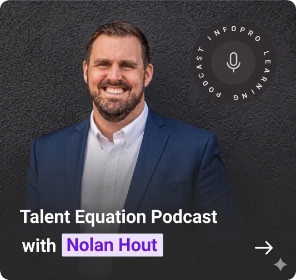
Nolan Hout is the growth leader and host of this podcast. He has over a decade of experience in Nolan Hout is the growth leader and host of this podcast. He has over a decade of experience in the Learning & Development (L&D) industry, helping global organizations unlock the potential of their workforce. Nolan is results-driven, investing most of his time in finding ways to identify and improve the performance of learning programs through the lens of return on investment. He is passionate about networking with people in the learning and training community. He is also an avid outdoorsman and fly fisherman, spending most of his free time on rivers across the Pacific Northwest.
Clinical environments demand more from their people than almost any other industry. Clinicians are expected to master technology, adapt to constant change, collaborate across disciplines, and make high-stakes decisions, often without time to stop and learn. In this episode of the Talent Equation podcast, Nolan and Mary dig into what it takes to build a workforce capable of meeting those demands, and why most traditional training approaches fall short.
- Why the expectations placed on clinical talent have shifted beyond clinical expertise alone.
- What Brain-Centric Instructional Design is and how it builds capability, not just knowledge.
- How to design learning that works in the flow of work for time-strapped clinicians.
- Why is a strong learning culture one of the most powerful signals an organization can send its employees.
- How AI is changing instructional design, and where human judgment still matters most.
- Why gap analysis and performance consulting must come before any training solution.
- What it looks like to shift from learning events to a full learning ecosystem.
- How to measure whether your clinical training programs are actually working.

The biggest gaps that I have experienced in traditional training is that it’s too heavily focused on the knowledge transfer, not the capability building.
BcID, MBTI Practitioner, Former Senior Manager, CVS Health
Introduction
Nolan: Hello everyone and welcome to the Talent Equation, formerly known as the Learning and Development Podcast. As always, this episode is sponsored by Infopro Learning and hosted by me, Nolan Hout. Joining me today we have Mary Logar, who is a veteran in the talent development space. She has worked for over 20 years for a Fortune 5 company. She has an interesting background. We will talk about it throughout, but she has been very hands-on in learning and training, whether it is instructional design or project management.
She even holds a Lean Six Sigma Green Belt, which is interesting. She also pairs that with high-level expertise focused on strategy and performance consulting. With such a diverse background, it is fitting that today we are going to hit a lot of notes. Much of it will focus on healthcare and the clinician side, but even if you are not in those spaces, I think you will gather a lot from this podcast. With that, let us go ahead and meet our guest. Mary, welcome to the podcast.
Mary: Thank you for having me, Nolan. It is a pleasure to be here. I think this is an opportunity to talk about things I care deeply about, so I appreciate that. My path into clinical learning really started in operations. To be honest with you, it was my second job after college. I was in dental hygiene and made a big change. It was the early nineties. It was just something new, something different.
I had a great opportunity when I went to Aetna. I can say that now since it is no more, but it was definitely a great opportunity. I saw from my work in that field that the learning models really were not moving the needle. So, I started working there and advanced my way through the company. I had the opportunity to go from field trainer to instructional designer to learning consultant and into that senior learning leader space where I finally landed.
It has been an incredible experience because clinical spaces are often time sensitive and very high stakes. Being fully equipped to do your job is important. Making sure those colleagues were ready to roll was just an enjoyable experience for me.
Mary’s Career Journey and BcID Explained
Nolan: Something I noticed on your LinkedIn — you have some acronyms I did not recognize. One is BcID and one is MBTI. What are those?
Mary: BcID is Brain-Centric Instructional Design. It is a highly coveted credential to have at the end of your name. It is tough to earn, and it reflects real expertise in the space. Brain-Centric Design was the brainchild of Dr. Kieran O’Mahony and Rich Carr. It is all about the cognitive neuroscience of learning and how you truly empower the people you are trying to educate to do a job.
It gives learners that agency to make mistakes, that safe environment where they can really learn how to do their job to the best of their ability, but be trained so well on their resources that when an anomaly makes itself known, they can go find out how to handle it. It becomes a no-fear, no-lose situation. There are a lot of different activities that go into creating a BcID-branded learning program. People have different learning styles, but there is also a learning personality, and BcID gets at personality. Not everyone is an extrovert or an introvert, but how do you create learning that appeals to all of those people? It is very fascinating.
As for MBTI, that is the Myers-Briggs Type Indicator. I am a certified practitioner, so I do a lot of group and individual coaching to help people understand what their preferences mean. It is not a test or an examination. It is about understanding your preferences as a human and how to use them to your benefit in your personal and professional life.
Nolan: I love anyone who has a certified approach to how people learn. What was interesting is it takes this neuroscience approach, but it is also focused on the job to be done. And from what you described, it is not so prescriptive that when an anomaly shows up, you are completely broken because it is not in your manual.
Mary: Exactly. That repetition in the way you learn, the structure of your day, if you feel comfortable with your processes and procedures, except when something out of the ordinary happens, you will be fine. You will be comfortable going, okay, I am going to research and figure out how to handle this. In a service environment or a clinical environment that is highly active, that is helpful because people can think through it without freaking out when they do not know the answer.
Nolan: Yeah. It is like equipping them with the tools to solve the problem. That is great.
How Clinical Talent Expectations Have Shifted
Nolan: Staying at a high level, in healthcare as a general space, what are the big core themes you have seen come out over the last couple of years? How have things changed, and what do you see on the horizon?
Mary: I think the definition of clinical talent has fundamentally shifted. It is not just about that clinical expertise, because people are expected to be an expert. You passed your NCLEX, you are a registered nurse. But even deeper than that, it is about adaptability. Decision making under pressure, systems thinking. Think about all the technology in use today. They used to chart by hand. But there are so many different EMRs now.
How do you manage that? We want people to navigate increasingly complex environments. There are so many different avenues of healthcare. It is not just going to the doctor, going to the hospital, going home. People can receive additional care at multiple touch points and we need those clinicians to coordinate care across all of them. Very different from what it used to be.
Making Time for Development When Clinicians Are Stretched
Nolan: How do you make time for development when clinicians are already so stretched? It feels like things keep piled on without anything being taken off the plate.
Mary: It is difficult. Today we expect clinicians to not just be a nurse, but to integrate technology, manage ambiguity, and collaborate across disciplines that did not even exist five or ten years ago. I think talent is less about what you know and more about how you can apply a dynamic solution and get to the right result. Creating space for that learning is essential. They are required to do things like continuing education, and that is often in their off hours unless an employer provides time for it.
We have had the luxury in places I have worked to create that downtime for learning. But when people must learn on their lunch hour, that is not of good use to anyone. So we create learning in the flow of work — a podcast, a quick video cast, just-in-time training tools where someone has five minutes of downtime and gets a high-level learning opportunity with the key things they need to know and a quick reference they can come back to when the situation presents itself.
I do not believe workers should be expected to learn in their spare time for their job. If it is personal development, sure, you can do that in your downtime. But employers need to make time for their people to learn. It makes them better employees.
Why Learning Culture Is a Competitive Advantage
Nolan: I think that helps set a culture that says your people are your competitive advantage. I was interviewing someone for a Brandon Hall case study and she said, listen, safety is critical to our culture. Yes, this is mandatory compliance training. But when we invest and show employees that this training program looks like a Hollywood production and has the CEO in it, it lets them understand just how important safety is.
It is using compliance as a vehicle to communicate culture. And I completely agree that if you tell people to find little nooks and crannies to develop themselves, that is not the culture you want.
Mary: Absolutely. Culture is everything. It must speak to employees, and if one piece of it feels off, sometimes they are going to exit. Continuous learning is important to people. Being able to take the time to be the best they can at their craft is vital to their success. Embedding learning time matters.
Capability Building vs. Knowledge Transfer
Nolan: You mentioned earlier that the skills we really want to see are critical thinking and adaptability, not just whether someone knows a specific EMR system. Anthropic, the AI company behind Claude, came out with a report showing there is a huge gap between people who use Claude and understanding how the tool works versus people who just technically know how to click around in it. Their thesis was that it is not about having the best tech.
It is about understanding how the tech applies to you. In a world where the technology layer is always moving, if you understand in theory how these systems operate, you can adapt to whatever environment you are thrown into. Which I think aligns with what you described — do not just teach them how to add a patient record. Teach them how these systems operate.
Mary: You nailed it. One of the biggest gaps I have experienced in traditional training is that it is too heavily focused on the knowledge transfer, not the capability building. You can go into Claude and ask it a question, but do you really know how to prompt it and ask the right questions or identify the task that needs to be completed? We are very good at delivering content. But capability building — the ability to think through a problem, apply judgment, operate in an ambiguous environment — that is what we are often missing.
Training for Adaptability and Ambiguity
Nolan: Can you teach someone to be a fast learner or to thrive in ambiguity? How do you build that capability?
Mary: I am going to give a plug to brain-centric design here, because you want to cater to all learning styles and personalities. If I create a learning program for you, I want all of those modalities built in. So if I am teaching how to process a claim, I am telling you why you are doing it, I am walking you through the process, I am giving you a demonstration, and then I am allowing you to do it yourself in a safe environment where making a mistake is fine because it is a training simulation. You learn from it, you move on, and when you go live you are ready. You can become a faster learner if the program appeals to you, if it is engaging, if it does not feel generic. It cannot just be a lecture.
Content Design, Modality, and Engagement
Nolan: How important is the content itself, not just the modality? I can watch a movie, but if it is on compliance versus Star Wars, I know which one I am paying attention to.
Mary: Themes are successful. What if I created a compliance course around the Star Wars theme? Battle versus evil, stakes that feel real. You can make it appealing to a generational learner or anyone who gets excited about something beyond a dry topic. For example, I worked with a vendor and we created a Hollywood-level production made in Los Angeles with screenwriters and a full camera crew.
We produced a VR experience for home care clinicians going into a patient’s home during COVID, when you could not bring trainers into those environments. It was a five-part series covering preparation, arriving at the home, being turned away, getting inside, identifying fall risks. It gave people an immersive, hands-on experience where they could apply what they had read or been taught, without a headset barrier. We created it as an interactive gaming desktop platform so it was accessible to everyone, including those who are differently abled.
Nolan: Yeah, and you just reminded me, we had a recent guest in the AR and VR space who was making the same point about ditching the headset. It tends to be a barrier for a lot of reasons and it is hard to scale. But the concept of immersive, scenario-based learning — that is really powerful.
How AI Is Enabling Better Instructional Design
Nolan: How is AI enabling you to do that job better, specifically in creating training for these different modalities and types of learners?
Mary: If you work well with your AI tool and you have solid, legitimate content to start from, I think you can create great storyboards and develop themes you might not have thought of on your own. It can speed up the development process significantly. But I do not believe it replaces human touch by any means.
You have to be solid in your craft — a good instructional designer, a good technologist, and a good consultant. If you cannot talk through what you built and explain it, and you are just handing off something you generated without fully owning it, nobody is going to trust the output. AI is a great tool if you know how to use it and you use it ethically.
Nolan: I agree. Human in the loop is really the only way you produce output that is ready. But where I see it have tremendous dividends is brainstorming. I describe Claude as my brainstorming partner. I work remote, so I can call a colleague, but Claude is always on and knows how I like to work. I use it to solve the blinking cursor problem. When you know you need to produce something but do not know where to start, you can just say give me five ideas to engage a group of claims adjusters.
They may all be bad, but one of them prompts an idea you take and run with. And then on the production side, once the content is solid, you can convert a learning asset into a podcast, a video, a PDF, a brochure — in a snap. That used to be completely unobtainable for most teams.
Mary: Absolutely. Anytime we would do something audio or video, it would take three or four times as long as the actual recording to edit and deploy. AI changes that. And it works best in my experience with a closed AI platform that draws on your own content, so the margin for error is significantly smaller.
The Danger of Creating Content Just Because You Can
Nolan: I want to flag something important here, because I think it is a real trap. People are excited that they can now create a thirty-minute eLearning in five minutes. But does that mean your people now have more time to take training? No. They did not have time for the training you already built. And if I take an e-learning and convert it to an audiobook with a click, is that actually a good learning experience for that topic?
Is it a format people can absorb in that way? That is where people with real instructional design expertise are going to shine, because they are not just going to flood learners with content because they can.
Mary: Right. It is an opportunity for a learning organization to really evolve if they use those tools. We shift from thinking about learning as events we push out to people, to thinking about learning as an ecosystem — a suite of offerings in different formats, where the type of information you need to share should help dictate the modality it lives in. And before any of that happens, someone needs to do the gap analysis. When someone comes to you and says I need training, the first question should be: are you sure that is what is wrong? Use your Lean tools, do your value stream design, figure out what is happening before you throw training at it. Be a true consultant.
AI as an Accelerator in Expert Hands
Nolan: What I have noticed is that AI has actually enabled people to be more adaptable, because you can learn about almost anything very quickly. So when you go back to the basics of what your role is — helping people do better at their job — your world opens up. The tool expands what is possible. But the expert is still the one deciding what to do with it.
Mary: Exactly. It becomes an accelerator. It allows you to personalize experiences, gain insights you might not have thought of on your own, and embed guidance and recommendations in ways that were not possible before. The opportunity is really significant if you use it the right way.
Closing Thoughts
Nolan: Before we wrap up, what else do you want to leave people with? What are the big gaps you are still seeing that need more light?
Mary: Clinicians are tested and credentialed. They know their job. But building clinical judgment in a safe environment, and then making sure learning is available within their actual work, is really vital to their success. They are hardwired for a fast-paced, hands-on environment. They do not have time to step away. Continuously learning as the day goes on does not feel overwhelming to them — it allows them to be better clinicians.
Being always in the know. Learning in the flow of work looks like embedding decision-making tools, quick reference resources that are clean and consistent, real-time prompts that give them guidance without making them guess. It also looks like coaching spaces, almost like grand rounds for physicians. Think about how grand rounds used to bring people together to discuss cases. You need that consortium or collective to discuss learning. Time needs to be made for it.
And most important: not everyone thinks or learns or develops the same way. Presenting learning in different ways is going to be critical to everyone’s success. And you must measure it. Track current state versus future state. That is how you know if it is working.
Nolan: Completely agree. I spent X and I moved our patient net promoter score by five percent. That conversation shifts from what was to let us get more of that going. Measurement is everything. And I hope the science of learning does not get lost as AI accelerates content production. The people who understand the why behind good learning design are the ones who are going to help us move the needle systematically over the long term. Mary, thank you for sharing your expertise with us today.
Mary: I appreciate the time and the opportunity. Anytime I get a platform to talk about things like this, I get excited. Brain-centric design and learning in the flow of work — the ROI is real. Sometimes you just need to be able to train that workforce so they can perform, be happy, and contribute. If your learning is subpar, that is a problem. Thank you so much.
Nolan: Thank you, Mary. Thank you everyone for listening.