


Shawn Vanderhoven is a Partner at The Wiseman Group, where he leads the executive development practice for senior leaders and rising talent. He has co-designed leadership development strategies with hundreds of leading global companies, including Apple, Microsoft, Deloitte, and LinkedIn, and collaborated on the New York Times bestseller Multipliers: How the Best Leaders Make Everyone Smarter (Second Edition). Before his work in leadership development, Shawn scaled his family’s software business 30-fold. His debut book, Pause: How to Lead Brilliant Work in a Busy World, releases August 4, 2026.
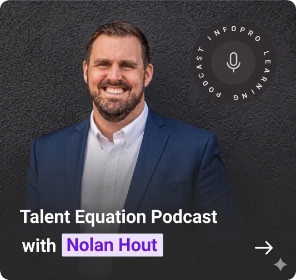
Nolan Hout, Senior Vice President, Growth & AI Strategist, Infopro Learning
Nolan Hout is the growth leader and host of this podcast. He has over a decade of experience in the Learning & Development (L&D) industry, helping global organizations unlock the potential of their workforce. Nolan is results-driven, investing most of his time in finding ways to identify and improve the performance of learning programs through the lens of return on investment. He is passionate about networking with people in the learning and training community. He is also an avid outdoorsman and fly fisherman, spending most of his free time on rivers across the Pacific Northwest.
Everyone is telling teams to move faster and do more. In this episode of The Talent Equation Podcast, Shawn and Nolan discuss why the best leaders know when to tap the brakes, and how slowing down at the right moments can be the key to producing truly brilliant work.
- Why “accidental diminishers” shut down their teams with the very best of intentions.
- The difference between a bias toward action and a bias toward impact, and why only one of them leads to results.
- The three things leaders who protect deep work are exceptionally good at: getting clarity, creating buffer, and clearing out emotional distractions.
- Why organizations are good at adding new priorities but terrible at subtracting old ones.
- The “and mindset” versus the “or mindset,” and why prioritizing requires the second one.
- Why saying no to good ideas takes more leadership discipline than saying yes to everything.
- How the practice of “tune in before you jump in” changes the way work lands on a team.
- Why AI is compounding burnout for some teams while multiplying output for others, and what separates the two.

There’s a huge difference between having a bias towards action, which is good, versus having a bias towards impact. Of course, action leads to impact. But it can be so easy just to get stuck in activity land.
Partner, The Wiseman Group
Introduction
Nolan: Hello everyone, and welcome to the Talent Equation Podcast, sponsored by Infopro Learning. As always, I’m your host, Nolan Hout. My guest today is Shawn Vanderhoven. Shawn started his career not as a consultant or researcher, but as an operator, helping scale his family’s software business 30-fold before stepping into leadership development. He spent the last decade with the Wiseman Group, working with organizations like Apple, Microsoft, Deloitte, and LinkedIn on building leaders who actually get the most out of their people. He collaborated on the New York Times bestselling book Multipliers, and his debut book, Pause: How to Lead Brilliant Work in a Busy World, comes out August 4th. His central argument is a little counterintuitive, coming from someone who’s worked inside fast-moving companies: in a world where everyone is telling you to move faster and do more, some of the best leaders know when to tap the brakes. This is a topic I really subscribe to, this idea of going slow to go fast. Shawn, welcome to the podcast.
Shawn: It’s an honor. I love the podcast and I’m very excited to have this conversation.
Nolan: You don’t have the traditional talent development arc where someone starts in one lane and moves into this. You started off running a business. Talk to us about your life experiences, and maybe end with the point where you said, I’ve got to write this book.
From Family Business to the Wiseman Group
Shawn: When I was in my teenage years, I fell in love with the idea of leadership and teaching leadership. Stephen Covey was inspiring to me. I had a friend, and we’d been in a nonprofit organization together where there was some leadership development and training, and I connected with all things leadership development. I was one of those kids carrying around a nonfiction book and writing in a journal, loving personal productivity. At one point we’d probably misrepresented ourselves a bit to get a meeting with Hiram Smith, one of the co-founders of Franklin Quest, which became Franklin Covey. Hiram was their client-facing persona, the guy behind the planner everyone had, the one you’d buy inserts for every year. This was before smartphones.
We pitched him an idea about the disruption coming to the time management market, since phones and the PalmPilot were on the way. He was a little confused and said, essentially, I don’t know how you got in this room but let me tell you what I know: you don’t know anything, and you’re definitely not in a position to teach leaders how to do anything. What you need to do is go back to school, get a job, and actually apply these principles in a business and have some success. It wasn’t what we wanted to hear, but I took it seriously. I dropped out of college and knew I needed to re-enroll. He really influenced me. I realized in that moment that I knew nothing, and it’s hard to admit that as a younger person.
That led to fifteen years later. I went back to school, and it took me ten years to get my undergraduate degree since I’m dyslexic and was working full time. I then worked for fifteen years in my family’s software business. We had some real scale and success. My wife and I would team up. She’s a reader, so she’d give me business books, and I’d try to apply those ideas in the company. Throughout that period, I kept my eye on leadership: how could I be a better leader, and how could I help other teams be effective and feel satisfied with their work.
After fifteen years, I was ready to make a move. I moved to Silicon Valley, and a couple of years later bumped into Liz Wiseman and joined her team. I helped with a second edition of Multipliers, which was an honor because it’s an awesome book. I’m still at the Wiseman Group. During that time, I found a research question I was really interested in, and that became the book. This whole journey, I’d say I was a huge benefactor of that tough feedback as a kid: you don’t know anything, go learn, go do, become the thing you want to become before you start teaching anybody. I don’t think I ever fully became that thing, but I got the ideal. Twenty-seven years on from that conversation, I feel like Hiram did me a massive favor.
Nolan: It’s rare that people actually take advice like that. I commend you for it. Many people, especially younger people, would have brushed it off.
Shawn: I probably did brush it off for a couple weeks, licking my wounds, but somehow it permeated and I acted on it.
The Premise of PAUSE
Nolan: I want to talk about the book coming out in August, Pause: How to Lead Brilliant Work in a Busy World. Talk to us about the premise so there’s some context for people interested in the topic.
Shawn: The premise is that you don’t have to lose your team’s best thinking and best work to distraction and burnout. We live in hyper-connected worlds where we’re expected to do more with less, and that’s been amplified by AI. We’ve got tools now that let us do more with less, and we’re expected to be on, move quickly, and do high quality work at speed. So many people are burning out. They feel like they’re drowning in the margins with too much work.
I’ve always been interested in personal and team productivity, and there was a moment where I bumped into this topic. I was teaching a Multipliers workshop in San Jose at a cloud computing company. We were exploring the concept of the accidental diminisher, where a leader doesn’t realize that, with the very best of intentions, they’re accidentally shutting people down. Usually it’s a strength that’s overplaying, like being full of ideas or wanting to be helpful and rescuing people instead. We were having this conversation in a room of two hundred people, an entire marketing staff. In the middle of the presentation, a man in the room, let’s call him Jeff, stood up, slammed his hands on the table, and yelled that he was so angry. He said he’d become this reactive person, emailing and slacking his people constantly, trying to move fast, and that his team was addicted to speed, so sped up that none of them were doing great work anymore.
Everybody looked at him, then back at me. I didn’t have an answer in that moment, but it represented something we’d been hearing consistently when we asked people what held them back from doing their best work. The overwhelming majority said: I just can’t get deep, I can’t focus. It’s task switching all the time, this ambient pressure that builds as the day goes on, and you never feel calm, clear, or collected enough to get into deep work.
That moment with Jeff, combined with everything else we’d heard from professionals, was the beginning of the research. I wanted to know: are there leaders out there who create the conditions for people to focus in hyper-connected environments, versus leaders who just amplify the chaos? What are they doing differently, and what can we learn from them? That research became the book.
Bias Toward Action vs. Bias Toward Impact
Nolan: What’s the actual takeaway? Is it that we should be asking less of our team, producing fewer widgets?
Shawn: It doesn’t sell easily when you say let’s just slow down and do less. What we actually found was the opposite: leaders who produced more brilliant work through their teams. I want to throw in a caveat first: there’s no way I would have read a book called Pause, because I’m one of those leaders addicted to action, who wants to move fast and break things. That mindset really worked for me when I moved to the Bay Area, and I’d been rewarded through my career for getting things done quickly.
So, it was a real revelation that there’s a way to get even better work from people in the same fast-moving environments. Think of it this way: there’s a huge difference between having a bias toward action, which is good, and having a bias toward impact. Of course, action leads to impact, but it’s easy to get stuck in activity land, doing many things in a thousand directions that don’t amount to much. What we learned about leaders who produced incredible work in hyper-connected environments was that they didn’t stop for the sake of stopping. They were really good at tapping the brakes at the right time, like a race car driver: brake too early and you lose momentum, brake too late and you go off track. Hit it right, and you accelerate out of the corner and maintain momentum. Like a pit stop, it exists for performance.
The core finding is that leaders who create space for deep, focused work are incredible at calibrating speed, because speed is only useful if you’re going in the right direction and it’s sustainable.
Nolan: So, it’s less about telling the team to make eight widgets instead of ten, and more about asking why you’re making ten widgets in the first place, what a valuable widget looks like, and making sure the team has already worked through the roadblocks before they hit them.
Shawn: You nailed it. What’s the very best way we can do the most important things? That takes pit stops, tapping the brakes, a continual oscillation of slowing down so you can really accelerate. The research broke into three areas. First, leaders with a bias toward impact were good at calibrating speed so their team could focus on deep work on the right things. Second, they were good at getting clarity on what matters most and maintaining that clarity as things changed. They created buffers, finding ways to give people more space in the margins to stay in a train of thought longer. Third, and this was a real revelation, they were exceptional at clearing out emotional distractions: people who are frustrated, ruminating, anxious, or time traveling because something didn’t go as expected.
There are twelve verbs in the book that bring these behaviors to life, but you don’t have to do all of them. You have to become aware of what’s stealing your team’s attention and work together to create an environment where personal productivity becomes possible, because in most hyper-connected work environments, social pressure eats personal productivity for breakfast.
Clarity, Subtraction, and the “Or” Mindset
Nolan: The clarity piece resonates. We use OKRs at our company, and when our CEO comes to me with an idea, it’s hard to say no, even when we already agreed on our priorities for the quarter. What I typically say is: when we paused to think about what we wanted to accomplish this quarter, we put a lot of thought into it and landed here. I’m not saying this new idea is wrong, I’m asking whether we should pause again before adding it on top of what we already paused to decide.
Shawn: That showed up a lot in the research, especially when organizations are changing direction or adding something new. We’re very good at adding and very poor at subtracting, and subtracting is painful, because the reality is there’s too much important work, forget the trivial work, more good opportunities than any of us could execute on. That means there’s already a built-in pain of sacrifice, because we can’t do all of the important work with finite resources. If you really sit with that, it means saying no to genuinely brilliant opportunities, not just trivial ones, so you can go big on the thing you’ll actually be known for.
We came to call this the “and mindset” versus the “or mindset.” The “and” mindset is great for brainstorming, but not for prioritizing, because you can’t do this and this and this and that forever. At some point you have to get to or. A friend of mine who worked at Apple, Stu MacLennan, grew their carrier and partner business from about a hundred million to 1.4 billion. Whenever he brought something to Tim Cook, who was chief operating officer at the time, Tim would always ask: if we say yes to that, what do we say no to? It was in Apple’s DNA to get clear on how decisions affect the ability to do other things, because you can never do everything.
If you believe this, you have to tap the brakes to figure out what a new opportunity would cost, and how it affects everything else you’re doing. That slows things down for a moment so people can re-accelerate in the right direction. Without it, it’s foot on the gas through every corner, and you know what happens: you blow a tire, you go off the track, and you burn people out. Just like engines, people burn out too.
Nolan: There’s a place for the “yes, and” mindset, like classic improv, but once you shift into execution mode, you need to become more of an “or” thinker. I remember hearing about a CEO, right around when the Palm Pilot came out, who carried a wooden block cut to the size of the device in his back pocket. Whenever someone pitched him a good idea, he’d hold it up and ask, where is that going to fit on this? It forced everyone to think about what they’d need to remove to make room. The real question becomes, what are we going to get rid of, because that’s the hard conversation, much harder than just saying yes.
If you’re someone who says yes to everything, you might wear that as a badge of honor, look how much I’m churning out. But I think that’s actually lazy leadership, because you’re just saying yes to whatever comes to you. It takes more work to pause and intentionally say no. Does it take people a lot of effort to learn how to do that?
Shawn: It’s so hard. For me, activity and speed are seductive. I love crossing things off my to-do list, I’ve got sticky notes all over my desk, and it’s genuinely fun to get things done. Activity feels like progress because it’s visible and measurable, but motion isn’t always progress. You can become frantic and busy moving in the wrong direction and end up feeling like you’re making progress while being lazy about the harder question of what real important work actually is.
One of the biggest things I learned from this research: what you accomplish with your team will not rise to the level of your ambition, it will rise to the level of your team’s workflow. Activity rewards the wrong things. The person sending fifty emails until 9pm looks committed, looks like they’re doing everything that matters, but if it’s not producing deep value for the organization, none of that gets remembered or rewarded over time. It takes real discipline to measure impact instead of activity, to measure what actually shipped, what actually changed, whether it really moved the needle. It’s genuinely hard to push back on activity and lean into impact.
Nolan: I recognize those always-available, always-doing-something people you’re describing. It can get you noticed short term, but eventually people realize there’s no value behind it. Our CEO has always told me he doesn’t care how many hours a day I work, he cares whether the job gets done. Some days that’s fifteen hours, some days it’s five, and if it takes five, take the five and go do something else. Don’t sit at your computer just to be at your computer. I think that idea connects directly to this concept of pausing: sometimes you have to reset, or you’ll wear out your engine and burn out your tires.
AI, Burnout, and Doing Fewer Things Better
Nolan: I want to hear your take on how AI is influencing all of this. I could see it cutting both ways.
Shawn: The early data we’re seeing right now shows more people feeling increased burnout and a bit more desperate at work, rather than clearer, more collected, and more focused, even with AI in the picture. When you ask people whether AI has completely transformed everything they do and whether they’re making three or four times the impact, most say no. They say there’s some benefit in the margins, and that it will grow over time, but right now, what a lot of us are feeling is the pressure to keep learning something that’s changing incredibly fast. People feel overwhelmed just trying to keep up and use it, and the return on investment is often marginal, sometimes people even say their thinking or work has gotten worse. There’s already a temptation to try to do more with less and overcommit. Doing more with less is a good principle, but it can easily turn into just trying to do more, period, instead of asking how we do fewer things better, which is usually what actually gets rewarded.
Nolan: I’ve definitely tripled my own ability to produce output with AI, and we haven’t hired for roles where AI can do the work, so we’ve become more efficient. But when I ask whether we’ve tripled our revenue, the answer is no. I’m now questioning whether every campaign is three times better, or whether we’re just producing three times the number of campaigns. What used to take me two weeks now takes two days, which is a real gain, but I’m not five-Xing the actual value of that work. That’s the margin I keep coming back to.
Shawn: These gains are incredible, and I’d say the same for myself: I’m doing so many things faster and loving it, but it hasn’t 5x’d my output or made me five times richer. One thing I’ve noticed is that I’m tempted to take on far more things across different domains now that I have a tool that can help me do it, even in domains where I’m not actually an expert. That can lead you to say yes to more, because it feels like you can do more, without necessarily producing the outcomes you’re hoping for. Right now, experts in a narrow domain, highly focused, can leverage AI in incredible ways. But if you’re still going in a thousand different directions, I don’t think the benefit is really there.
In the research, we interviewed hundreds of leaders and asked what separated the best work of someone’s career, working for a leader who created space for deep work, from working for leaders who just accelerated the chaos. We identified twelve top observable behaviors, both negative and positive, and the surprising finding was that all twelve behaviors that amplified people’s ability to do deep work were some forms of slowing things down, not for its own sake, but to increase speed and impact. That’s why the book is called Pause. The other interesting finding is that you don’t have to do all twelve. You just need to figure out the few things your team needs you to do to tap the brakes, get clearer, create space, and clear out frustration. Once you do, and then add AI into that space, the results compound.
Nolan: I’ve been telling my team that I’ve had more thinking time because I can move through execution faster, and I’m genuinely thinking more, even though I don’t deny that people everywhere are talking about burnout. I sometimes wonder how much of that burnout is even coming from the job itself, versus everything else going on in the world that we can’t control. What I try to tell my team is: I want you to think more, please think more. But our company culture is execution-biased, and a lot of our workforce is based in India, where the culture leans more toward getting the work done rather than thinking about the work. So, the idea of giving people something like your book to read, even before I’ve read it myself, is appealing, just to signal my commitment to smart work over busy work. I believe that if you can slow down and then leverage AI, you’ll genuinely accelerate. But if you’re just moving without direction, that won’t happen.
Shawn: The tools are there. If people can create space, get deep, and really focus on something that matters, the tools can do incredible things right now.
Nolan: So why force your team to produce the fifty-thousandth blog post nobody reads, instead of something genuinely creative? I want to understand something specific about my own AI burnout: is it the task switching itself, the mental cost of jumping from one idea to the next, that’s exhausting, or is it something else, like the fear of not knowing enough about AI?
Shawn: From a team perspective, looking at collective burnout, it’s all of it. A lot of burnout comes from feeling like you didn’t do anything truly valuable, or a lack of satisfaction that the work you’re doing is building a future you’re excited about. There’s a practice we found that a lot of these leaders use, we call it “put growth on the agenda.” Roughly ten minutes a month, they’d ask their team, one-on-one or as a group, two questions: what does your next role look like for you, and what experience and skill do you need to get there.
Those two questions stay quietly present in the background, and the leader brings them back up regularly. It’s often just ten minutes a month, but it signals that your leader is pausing to talk about your future growth. When people can’t connect their current work to their future, they often feel lost, and that’s its own source of burnout. So, it’s a combination: forces we don’t control, plus these more addressable pieces.
Tune In Before You Jump In
Shawn: It’s feeling like everything’s important and you can’t do it all, task switching with no buffer to get deep, being frustrated with no way to talk about it on your team, being frustrated about career growth with no path forward. What’s interesting is that with small pauses you can program into how you work with your team, productivity pit stops, you start to get more clarity, more buffer, and you clear out things that are emotionally distracting people.
There’s a practice from the research I love, partly because it’s such an indictment of me: tune in before you jump in. Here’s how it works. How many times have I gone to someone, hey, can you take a look at something with me, it’ll only take five minutes.
Nolan: Don’t say that, you’re calling me out right now.
Shawn: What do you already know when your boss says that? You know it’s not five minutes, it’s thirty minutes or half a day. And often I don’t even ask what you’re working on first, I just hand you the thing and walk away. It’s one of the most manipulative things I do, honestly. We call that a jump-in.
Here’s the opposite, the tune-in. Instead, I come to you and say, hey Nolan, I’ve got something I’d like to talk to you about, but before I get into it, what are you working on right now? Tell me. Now I’m tuning in with you. Then I say, I’ve got this piece of work, do you mind if we walk through it together to figure out whether it makes sense for you to take on right now.
The difference is massive, and it takes just a few minutes to change how that conversation starts, because work matters just as much in how it arrives as in what it actually is. If I’m just jumping in all the time, you’re frustrated with me, even if I didn’t mean it that way, because now you’re switching gears and getting overloaded on top of everything else.
If I can learn to tune in, to slow that interaction down just enough to get both of our brains online, the likelihood we can make that change sensibly goes up, and it has less of a burnout impact on you, and on me too. We were able to document these brilliant behaviors from leaders who’d figured this out, behaviors I personally hadn’t figured out.
My own team, going through this research with me, told me at one point, is this book just for you, man. We cried together sometimes, honestly, because I can be a disaster to work for. But I can tell you, it’s been a revelation to me. I’ve made real changes just by learning to tap the brakes a little, and as a result I’ve seen real increases in outcomes, output, and satisfaction on my team.
Closing Thoughts
Nolan: That’s a great way to close. Shawn, thank you for spending about an hour with us today. The book comes out August 4th, Pause: How to Lead Brilliant Work in a Busy World. If people don’t get to the book right away, the “tune in before you jump in” idea alone is worth the price of admission.
Shawn: Tune in before you jump in. Everybody listening, before you delegate something, just ask the tune-in question: hey, what are you working on right now.
Nolan: What a great note to end on. Shawn, thank you so much for joining us. It’s been a pleasure, and I hope to see you again soon.
Shawn: Thanks so much, Nolan. This has been a lot of fun. Love your work, keep going.