


Dr. Nigel Paine, Author, Speaker, Consultant, Co-Presenter at TV Now Learning (LNTV)
Dr. Nigel Paine is a globally recognized expert in learning, leadership, and organizational development. With more than two decades of experience across corporate, public, and academic sectors, he has led major learning transformations, including overseeing large-scale learning initiatives at the BBC. Nigel is the author of multiple influential books on workplace learning and organizational capability, and he is a sought-after keynote speaker around the world. He also hosts the monthly TV program Learning Now and co-hosts the podcast from scratch, where he explores the future of learning and leadership. His work focuses on helping organizations build cultures that foster continuous learning and resilience.
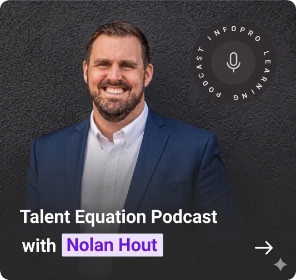
Nolan Hout, Senior Vice President, Growth, Infopro Learning
Nolan Hout is the growth leader and host of this podcast. He has over a decade of experience in the Learning & Development (L&D) industry, helping global organizations unlock the potential of their workforce. Nolan is results-driven, investing most of his time in finding ways to identify and improve the performance of learning programs through the lens of return on investment. He is passionate about networking with people in the learning and training community. He is also an avid outdoorsman and fly fisherman, spending most of his free time on rivers across the Pacific Northwest.
In this episode, Nolan speaks with Dr. Nigel about the power of sharing knowledge and insights to build organizational resilience. They explore why companies must move beyond individual performance and focus on collective learning, culture and collaboration to thrive in an ever-changing world.
Listen to the episode to find out:
- Why focusing only on individual performance can weaken organizational learning.
- How shared knowledge helps build resilience and agility inside organizations.
- What it means to build an “organizational brain.”
- Why culture and mindset are more important than tools when adopting new technologies.
- How organizations can encourage knowledge sharing across teams.
- Why psychological safety is essential for experimentation and innovation.
- How leaders can rethink traditional leadership development programs.
- The role of AI in reshaping learning, collaboration and work processes.
- Why experimentation and collective problem-solving drive organizational success.

If the individual goes, the knowledge remains when it’s embedded in the organization. That’s how you build resilience.
Author, Speaker, Consultant, Co-Presenter at Learning Now TV (LNTV)
Introduction
Nolan: Hello everyone and welcome to the Learning and Development podcast sponsored by Infopro Learning. I’m your host, Nolan Hout. Joining me today is a special guest, Dr. Nigel Paine. Nigel Paine is a change-focused leader with a worldwide reputation and a unique grasp of media, learning and development in the public, private, and academic sectors.
It is rare to have experience across those three perspectives, so it is great to have Nigel with us today.
He has over twenty years of experience with a fascinating career, from leading learning at the BBC and launching a large award-winning program across six thousand people, to writing thought-provoking books. Four books already and a fifth on the way.
Dr. Nigel: Four and a fifth one on the way.
Nolan: Speaking at conferences around the world and presenting a monthly TV program called Learning Now, along with co-hosting a podcast called From Scratch. I could keep going, but we only have a short amount of time for this episode. Let’s meet our guest. Nigel, welcome to the podcast.
Dr. Nigel: Thank you, Nolan. It is a pleasure to be here and to meet you, virtually face to face.
Nolan: I am sure our paths will cross soon. It seems like every time I have someone on the podcast; I run into them within a month. So, before we get into the topic today—sharing insight and knowledge and building organizational resilience—I like to start with an origin story. Nigel, how did your career begin in this space?
Nigel’s Career Origin in Learning Technology
Dr. Nigel: My career began a long time ago during the IT revolution. Personal computing was just starting to grow, and I had the idea that computers could become an incredible environment for learning. At that time, they were mostly used for typing letters.
I became involved exceedingly early in the ed-tech space and ran a software company developing educational and learning software. Later I moved into the corporate world, helping organizations transform how they viewed learning and maximize opportunities for employees.
At the same time, I worked in the public sector helping people gain access to learning and qualifications. We began creating pathways for people who had missed out on traditional education.
I also became involved in one of the earliest online MBA programs. We invented it as we went along. It was fascinating, and there was significant resistance from academics. But we launched it successfully.
That experience shaped my perspective: thinking about opportunity, doing things differently, and thinking big. I became interested in scalability. Learning used to reach only small groups. I started asking questions like: what if learning reached a thousand people, ten thousand people?
Technology made that possible. My career has been a cycle of discovery and implementation. First with CD-ROM learning, then the internet, and now AI. Each shift forces us to rethink everything.
The Role of AI in Learning and Work
Nolan: I was running a webinar yesterday about leveraging AI to develop courses. I asked participants for a word describing how they view AI today. Responses included “scared,” “excited,” and one person wrote “ever evolving.” That description seemed perfect. Anyone deep in AI knows they never know enough.
Dr. Nigel: Exactly. By the time you know enough, it has already changed. It is like trying to pin jelly to a wall. You get a bit to stick, and then it slides off.
AI requires constant reframing and reconceptualizing. New products and ideas appear constantly. Many companies are developing niche AI tools. There are hundreds of small AI startups, like how learning management systems once exploded. It’s exciting but also rapidly evolving.
Nolan: AI ends up in every conversation. Even when we try to avoid it.
Dr. Nigel: We can talk about anything and end up talking about AI.
The Power of Organizational Knowledge Sharing
Nolan: Let’s move to the core topic: sharing insight and knowledge and building organizational resilience.
Dr. Nigel: My last book, Building Organizational Learning, is based on a simple observation. Organizations focus heavily on individuals: individual talent, individual KPIs, individual performance reviews.
The problem is that this approach excludes teams and communities. In fast-changing environments, knowledge held only by individuals moves slowly through the organization. Sometimes it does not move at all. If those individuals leave, the knowledge leaves with them.
My idea was to connect organizational knowledge together so that when individuals leave, the knowledge remains embedded in the organization. I call this the organizational brain.
When organizations build that shared brain, resilience, and agility increase. The organization becomes a powerful entity. When people draw from shared knowledge, they want to stay because the organization itself becomes a powerful learning environment.
Building Organizational Resilience
Nolan: How does that compare with frameworks like OKRs?
Dr. Nigel: Knowledge lives in people. Systems alone are not enough.
Even with structured systems like OKRs, success depends on people sharing insights willingly. That requires the right culture. You need emotional engagement, trust, and respect between colleagues.
Technology solutions are only as good as the people using them. Knowledge sharing works only when people actively contribute and learn from one another. At the heart of all this is culture.
Culture vs. Systems in Knowledge Sharing
Nolan: I see pushback from organizations adopting AI. Employees often say they do not understand the purpose behind the changes. They want direction.
Dr. Nigel: Exactly. Leaders cannot sit in isolation and determine everything themselves. They must involve the entire organization in defining direction.
Another challenge is fear. People worry about making mistakes or appearing foolish. So they do nothing. But waiting for instructions in a rapidly changing environment is dangerous for individuals and organizations. Organizations must engage everyone in the conversation.
Leadership and Organizational Learning Strategy
Nolan: How can organizations start moving in that direction?
Dr. Nigel: One important step is focusing on teams rather than individuals.
For example, if a company wants to integrate AI, leadership should ask teams how they are collectively using it and what benefits it creates. This removes individual pressure and promotes collaboration.
Teams can share best practices, identify problems together, and learn from early adopters across the organization. This approach naturally encourages participation and learning.
Experimentation and the Future of AI in Organizations
Nolan: One challenge I see is that people become afraid to experiment because AI is evolving so quickly.
Dr. Nigel: That is why organizations must create safe spaces for experimentation. Encourage teams to test ideas. Some experiments will fail, but failure produces learning.
Organizations should think big while remaining practical. Improve the present while imagining future possibilities. Encourage imagination, experimentation, and collaboration rather than fear. Innovation rarely emerges from fear.
Closing Thoughts
Nolan: If we summarize this conversation, organizations need to shift focus away from individuals and toward collective learning. That means building strong organizational foundations for knowledge sharing. When change occurs, organizations can adapt quickly without starting over.
Create a safe environment for experimentation and give teams direction and guardrails. Nigel, thank you for joining us and sharing your insights.
Dr. Nigel: It was a pleasure. These are prominent issues, and I enjoyed the conversation.
Nolan: Thank you, Nigel. We will see you soon.