


Kevin Black is a veteran U.S. Army officer, strategic advisor, leadership expert, and founder of Kevin Black Consulting. After serving six years as an infantry officer, he transitioned to the private sector, where he has helped organizations ranging from startups to Fortune 5 companies create more than $500 million in value. Kevin is the author of “Strength in Chaos: The Ultimate Leadership Blueprint for Mastering the Uncontrollable.” His work has been featured in Forbes and USA Today, and he is based in Scottsdale, Arizona.
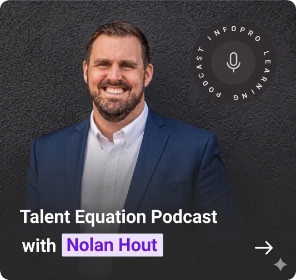
Nolan Hout, Senior Vice President, Growth & AI Strategist, Infopro Learning
Nolan Hout is the growth leader and host of this podcast. He has over a decade of experience in the Learning & Development (L&D) industry, helping global organizations unlock the potential of their workforce. Nolan is results-driven, investing most of his time in finding ways to identify and improve the performance of learning programs through the lens of return on investment. He is passionate about networking with people in the learning and training community. He is also an avid outdoorsman and fly fisherman, spending most of his free time on rivers across the Pacific Northwest.
Every C-suite leader is operating inside some version of chaos right now, whether it’s AI disruption, workforce restructuring, or doing more with less. In this episode, Nolan sits down with Kevin to unpack a framework for diagnosing chaos before it costs a leader their team.
- Why chaos and crisis are not the same thing, and why that distinction matters for how leaders respond.
- The four benchmarks that determine whether a team is gaining strength or sliding into disorientation.
- Why trust is the last thing a leader earns, not the first thing they declare.
- How control-oriented leaders can unintentionally make chaos worse under pressure.
- Why unity on a team comes from shared experience, not forcing people to think alike.
- What “mission command” really means, and why relinquishing control is a deliberate leadership skill, not a lack of oversight.
- How a single team’s stress level can reveal what’s happening across an entire organization.
- A historical case study of how a strong army lost a war by failing at unity and oversight.
- How Kevin’s framework applies directly to C-suite leaders navigating AI disruption and organizational restructuring today.

Trust is the last thing you earn. It is verified, repeatable reliability, and it is built on consistently achieving the first three benchmarks.
Founder, Kevin Black Consulting
Introduction
Nolan: Hello everyone, and welcome to The Talent Equation, hosted by me, Nolan Hout, and as always sponsored by Infopro Learning. My guest today, Kevin Black, spent six years as an infantry officer in the U.S. Army, including a deployment to Iraq in 2003. He then spent more than two decades in the private sector advising executives and leadership teams at companies ranging from startups to the Fortune 5.
Along the way, he started asking a question nobody in the leadership world had really answered: how do you measure chaos? That work became a book and a new field he calls chaos studies; a framework that’s changing how senior leaders think about volatility and team performance. Kevin Black, welcome to The Talent Equation.
Kevin: Thank you, sir. It’s an honor to be here. You’ve had so many great guests, and I’m excited to have a great conversation with you.
Nolan: Well, thank you for your service, Kevin.
Kevin: My pleasure. I appreciate that.
Nolan: Of course. Before we begin, help me with your origin story. How did you get to where you are today? It doesn’t sound like you followed the most traditional arc.
Kevin’s Origin Story
Kevin: I’m originally from Georgia. I was a high school wrestler, and I went to Virginia Military Institute. I wanted a hard learning experience. I graduated in 1999 into the infantry, and then 9/11 happened. I volunteered for the war, and they sent me. I spent six years on active duty. One day, at my last duty station in Korea, I was walking down the street and had an epiphany: I never liked taking orders from people.
So, I decided to get out and take my leadership and strategy experience into the private sector. Since 2005 I’ve been working with both small and large companies. What makes me interested in this space is that I hate traditional training. I like things that are fun and engaging. In my workshops, I do behavioral profiling and put executives through computer war gaming, like military staff, so they learn to think, plan, and communicate under pressure. Over the years, working with organizations that were sometimes great and sometimes not, I realized there was something happening, and it wasn’t until several years ago that I put my finger on it. It’s chaos.
Nolan: And remind me, the book you published last year, what was it called?
Kevin: Strength in Chaos.
Defining Chaos and Disorder
Nolan: I want to dig into this. A lot of leadership books treat chaos as something that happens to leaders. I talk on this podcast about how, since COVID, chaos hasn’t really stopped, it just bled into economic downturn, war, and everything else. So first, when you say chaos, what do you mean?
Kevin: I define chaos as a progressive state of disorder. It’s not a messy desk; it’s a sequence of events that makes you feel like you’re losing control. The source of chaos is the perception of losing control, not reality. That perception is rooted in personality, so it’s different for each person, and that reaction affects the whole team.
Nolan: What led you to the idea that chaos is the permanent operating environment?
Kevin: The answer goes back to philosophy, to the ancient Greeks. There are three things that make chaos exclusive to humans. First, we have a conceptual mind, not just a perceptual one. We see the common thread, like fire, across a cigarette, a match, and a forest fire. That means we can think beyond the moment, strategize, and create expectations for the future. Second, when plans don’t go according to plan, those expectations get shocked, and that creates stress. Third, as a leader or goal-oriented person, when the plan breaks, you have to improvise. So if you’re human and working with a team, you’re always feeling some degree of lost control. The degree varies, and that’s what creates different types of chaos.
Nolan: So it’s not a cataclysmic event like COVID, it’s perennial, because you’re constantly checking your perception of reality against your plan and then bringing a team into that.
Kevin: One more thing: chaos is not a crisis. A crisis is an objectively perceived event, like the Titanic heading toward the iceberg, with a clear negative or positive outcome. Chaos doesn’t work that way. Even something like going to college creates constant stress, tests, expectations, but there’s good chaos and bad chaos. One is distress, the other is eustress, like lifting weights. It hurts, but you know it’s making you stronger.
Why Chaos Is Not the Same as a Crisis
Nolan: In the book, you build out a scale that measures the control dynamic between a leader and their team. Can you walk me through that?
Kevin: Let’s step back. There’s constructive chaos and destructive chaos, four levels each. In my experience, over 30 years of consulting and leadership development, I’ve found four major benchmarks for an organization. If you hit them, you exceed expectations. If you miss one, you slide into negative chaos.
The Four Leadership Benchmarks
Kevin: Number one is people, unity. Your group must become a professional team, setting aside petty differences. That requires a leader with strong personal skills. Without it, you get disunity. Number two is forward integration, having direction and order, knowing where you’re going and why. This is strategy, culture, and systems working together.
Without it, you get disorientation. Number three is leadership and management together, which I call mission command, a philosophy of decentralized leadership that empowers a team to drive toward the mission even when the leader isn’t there. Number four is trust, which is the last thing earned, not the first thing declared. It’s verified; repeatable reliability built on consistently achieving the first three. If you hit all four, you achieve what I call productive power. Miss one, and you’re in descent, and the longer you stay there, the harder it is to climb out.
Building Unity Through Shared Experience
Nolan: Unity feels especially hard in the military, given how diverse the backgrounds are. How do you get people to set aside petty differences?
Kevin: In the military, you’re embedded into an institution with shared values and shared experiences. Even coming from different backgrounds, everyone has the same reference points. The challenge with unity is behavior. By age six, people have a behavioral profile. I’m extroverted, fast-paced, a generalist, and I’m control-oriented. I’ll work as a team as long as I think you’re competent. There are subject matter experts who won’t work with you if they don’t see you as competent either. The leader’s job is to coach people based on their behaviors, helping them build adaptability so they don’t need to be managed constantly.
Nolan: Unity, then, is really the leader’s personal skill set, understanding behavior and adapting to it.
Forward Integration Explained
Nolan: And forward integration feels more like having a North Star, making sure everyone understands the goal.
Kevin: Strategy, organization, systems, and culture are four distinct disciplines, but the most successful organizations fully integrate all four. Here’s an example: imagine putting together a Ragnar relay racing team. If your strategy is just to have fun, anyone can join, no system matters, and the culture is loose. But if your strategy is to win, the filter for who joins gets much tighter, even a strong runner might not be the right fit if their skill set doesn’t match the specific demands of the race. A lot of organizations lack that clarity at the strategy level, and that lack of clarity cascades into disorientation across organization, systems, and culture.
Trust Is Earned Last
Nolan: That reframes trust for me. We usually hear “trust is the most important thing,” but you’re saying it’s earned at the end, through unity, forward integration, and mission command done consistently and repeatably.
Kevin: Exactly. It’s verified reliability. And trust has behavioral dimensions too. I’m a high extrovert and I give out trust easily, almost like business cards, until someone disproves it. Others are more private and methodical, and they’ll withhold trust until you’ve proven yourself in their terms. Neither approach is wrong, but they create real friction between different types of leaders.
Balancing Hands-Off and Hands-On Leadership
Nolan: I see that dynamic with my own boss. I’m more hands-off, trust you to get it done, don’t care how. He’s the opposite, very detail oriented. It’s a good dynamic because it forces me to step outside my comfort zone and check the numbers more closely.
Kevin: That’s diversity of thought and experience working the way it should. The challenge is most leaders default to surrounding themselves with people like them, when the more effective approach is the opposite.
Relinquishing Control on Purpose
Nolan: You talk about leaders who perform best knowing when to let go of control. How do you teach that to people who don’t do it naturally?
Kevin: It’s a balance between natural behavior and leadership competency. The challenge is that leadership today has become divorced from management, decision-making, and strategy, and reduced mostly to communication and empathy. Real leadership requires mission-oriented skills: analyzing a mission, breaking it into essential tasks, planning, and communicating across the organization. A lot of executives I’ve worked with don’t actually know how to plan. They just make to-do lists.
What happens with leaders who lack those competencies is they go into behavioral overdrive. Their natural impulse to control takes over under pressure, they disempower their people, and the team slides. The irony is that gripping tighter for control actually creates more chaos, not less.
Nolan: Because if a leader reverts to old behaviors under chaos, the team notices, their trust in that leader shifts, and now the leader has created chaos for the team. I’ve been saying this a lot lately: we’ve taken leadership for granted as something inherent, when it’s really about decisions, including the decision to give up control. That’s intentional, not laziness.
The British Disorientation Case Study
Nolan: Can you give a historical example of disorientation?
Kevin: There are ten case studies in the book, nine historical. One example is the British strategy in 1777. The Brits had their best generals, Howe and Burgoyne, both intelligent and capable. But the commanding general deferred to his subordinates’ individual visions of success instead of enforcing unity. The two forces diverged, an entire field army was destroyed, and it became a turning point in the war, bringing France into the conflict. Strong advantages and talented leaders can still fail because of a breakdown in unity and oversight, not because of an external crisis.
Chaos and the Modern C-Suite
Nolan: As we wrap up, I want to connect this to right now. Every C-suite leader is navigating some version of the same storm: AI disruption, workforce restructuring, doing more with less. How does your framework apply?
Kevin: The book measures chaos in teams and gives organizations three things: a way to pinpoint where a team sits on the chaos scale, a way to predict where that team is heading, and the big outcomes leaders need to hit to move from surviving to exceeding expectations. What I’ve found is that one team can act as a microcosm for the entire organization. If I diagnose stress and lack of direction in one team, I can go to the C-suite and say other teams are very likely feeling the same thing, just expressing it differently. It becomes a strategic diagnostic.
The Controlled Chaos Workshop
Nolan: Before we close, tell listeners about the Controlled Chaos Workshop.
Kevin: It’s a two or three day retreat where senior executives play a computer simulation modeled on military staff exercises, customized to their actual business. People see their own behavioral profile in action under stress, in a safe environment. Most companies end up applying the templates from the simulation directly to their corporate strategy. Years ago, when I worked with LifeLock, their entire senior team went through it twice, and used the templates to help take the company public. It’s intense, but people leave aligned, speaking the same language across HR, communications, and marketing.
Nolan: Kevin, thank you so much for joining us. This has been a pleasure.
Kevin: Thank you. This was a great conversation. I appreciate you taking the time.