


Eileen Macdonald-Cooke is a seasoned talent development executive with more than 25 years of experience leading learning and performance strategies across major organizations. She has served in senior leadership roles including Chief Learning Officer (CLO) at Amtrak and Vice President of Learning at CVS Health. Known for her practical, business-aligned approach to L&D, Eileen focuses on helping organizations shift from knowledge-based training to performance-driven learning. She is also a sought-after conference speaker, sharing insights on leadership development, workforce capability, and how learning teams can directly influence business outcomes. Her work centers on empowering individuals while enabling organizations to achieve measurable performance results.
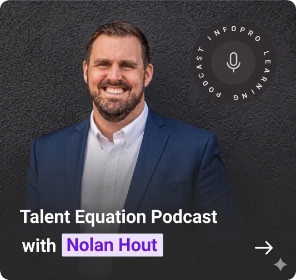
Nolan Hout, Senior Vice President, Growth, Infopro Learning
Nolan Hout is the growth leader and host of this podcast. He has over a decade of experience in the Learning & Development (L&D) industry, helping global organizations unlock the potential of their workforce. Nolan is results-driven, investing most of his time in finding ways to identify and improve the performance of learning programs through the lens of return on investment. He is passionate about networking with people in the learning and training community. He is also an avid outdoorsman and fly fisherman, spending most of his free time on rivers across the Pacific Northwest.
What if learning wasn’t the goal, but performance was? In this episode, Nolan sits down with talent development leader Eileen to explore how L&D teams can move beyond training delivery and become true business enablers by focusing on measurable performance outcomes and real workplace impact.
- Why L&D should shift from knowledge acquisition to performance enablement.
- The difference between a learning culture and a performance culture.
- How skills, environment, and reinforcement combine to drive real performance.
- Practical ways L&D teams can align training with business KPIs.
- How to start performance conversations, even without perfect data.
- Why small, targeted learning interventions often outperform large programs.
- How instructional designers can influence business impact from their role.
- The importance of designing learning with forgetting in mind.
- How AI and technology enable faster, more performance-focused learning.

No one keeps a job just because of what they know. They keep it because of what they can do again and again, really well.
former Chief Learning Officer (CLO), Amtrak
Introduction
Nolan: Hello everyone and welcome to the Learning and Development Podcast sponsored by Infopro Learning. I’m your host, Nolan. Today we’re joined by Eileen Macdonald-Cooke, a leader in talent development for over 25 years. She has served as CLO at Amtrak, VP at CBS, and speaks at conferences around the world.
That’s how Eileen and I first met. If you ever see her speaking at a conference, circle that session and do not miss it. She’s an incredible speaker.
Today we’re talking about my favorite topic and one of hers as well—how L&D leaders can become business enablers and focus on a performance-first mindset. Eileen, welcome to the podcast.
Eileen: Thank you so much. It’s a joy to be here.
Eileen’s Career Journey
Nolan: Before we jump into today’s topic, I’d love to learn more about how you got into this field. You’ve had an incredibly successful career. Where did it begin?
Eileen: I come from a family of business people and teachers. When I was going to university, I wanted to be a social worker because I wanted to save the world.
My business-minded father said, “No, you’re not.” So, I decided I would help people through education. I studied secondary education in college. After graduating, I worked for Montgomery County’s welfare department near Philadelphia with displaced workers who had lost their jobs as factories closed. That’s where I fell in love with the adult learner.
Nolan: That’s wonderful. What sparked that love? Was it mentorship, the diversity of work, or something else?
Eileen: What I experienced—and still believe today—is that when we’re adults, it can feel like the world is happening to us. What energizes me is working with individuals who don’t yet see what could be next for them and helping them get there. In talent development we sit at the intersection of two powerful things: helping a business grow and win in the marketplace and helping individuals develop and perform better. When we say, “workforce development,” we’re really saying people development.
Why Performance Matters
Nolan: Learning roles are challenging because we serve such diverse audiences. Yet you consistently emphasize performance. Why is that so important?
Eileen: Let’s start with knowledge acquisition. People often say learners need to know, understand, or become aware. That leads us to design learning experiences. But I’m not in academia. People may get a job because of what they know. They keep a job because of what they do.
If someone leaves a session knowledgeable but cannot repeatedly apply that knowledge, it doesn’t matter. We go to work every day to perform. If L&D doesn’t help people perform better, we cannot keep our promise.
Skills vs Performance
Nolan: I recently spoke with Dr. Carl Binder, who said every job produces output. We don’t pay people for skills—we pay them for results.
Eileen: Exactly. Skills are important, but they’re only part of the equation. Someone may possess a skill but still deliver poor output because the skill isn’t refined, tools are missing, or the environment isn’t supportive. My job is to understand how skills are applied and supported in real work environments. That’s where performance happens.
Connecting L&D to Business Performance
Nolan: If performance is the key, how can L&D start becoming a real business enabler?
Eileen: It starts with understanding the business. Look at dashboards, KPIs, and operational meetings. Ask what results matter most and where the performance gaps are. Then connect L&D work directly to those outcomes. When my team meets, we don’t review training programs. We review business performance and discuss how our work influences it.
Using Data to Drive Conversations
Nolan: Sometimes organizations won’t share performance metrics. How do you handle that?
Eileen: I call it truth-telling. If I can’t access the exact metrics, I build a directional model based on what we know and present it.
Even if leaders disagree, it sparks the conversation. Is this acceptable? If not, what should we measure? Sometimes the best way to get the right answer is to propose an imperfect one.
Shifting the L&D Mindset
Nolan: How do L&D teams react to this shift?
Eileen: At first there’s hesitation. But when team members start joining operational meetings and speaking the language of the business, something changes.
Proximity to the business becomes the currency of HR and L&D. Once people experience that connection, the shift accelerates.
From Training Experiences to Performance Partnerships
Eileen: Years ago I would run workshops around the world. Participants loved them and gave high ratings. But I couldn’t truly measure their impact. Now the goal is different. Instead of delivering a workshop, we partner with teams to drive performance over time.
Performance vs Learning Culture
Nolan: Many organizations talk about building a learning culture.
Eileen: I challenge that idea. Do we really want a learning culture?
Or do we want a performance culture where people learn what they need, when they need it, to perform well? Learning should exist in service of performance.
Design for Forgetting
Eileen: When designing learning, assume people will forget. Always ask what reminder or reinforcement can be sent later.
Maybe a 90-second nudge or short refresher. Design with reinforcement in mind from the beginning.
Advice for Instructional Designers
Nolan: What advice would you give instructional designers trying to apply this approach?
Eileen: Focus on smaller, targeted performance interventions rather than large programs. Technology allows us to create faster, deliver learning in the moment, and adjust quickly. You’re designing performance enablement, not just training.
Technology and the Future of L&D
Eileen: Technology and AI make this possible. They allow us to monitor performance, target learning precisely, and respond faster.
Technology doesn’t replace what we love about learning and development. It helps us keep our promise to improve performance.
Closing Thoughts
Nolan: Eileen, thank you so much for joining us. This has been a fantastic conversation.
Eileen: Nolan, this was so much fun. Thank you. Take care.