
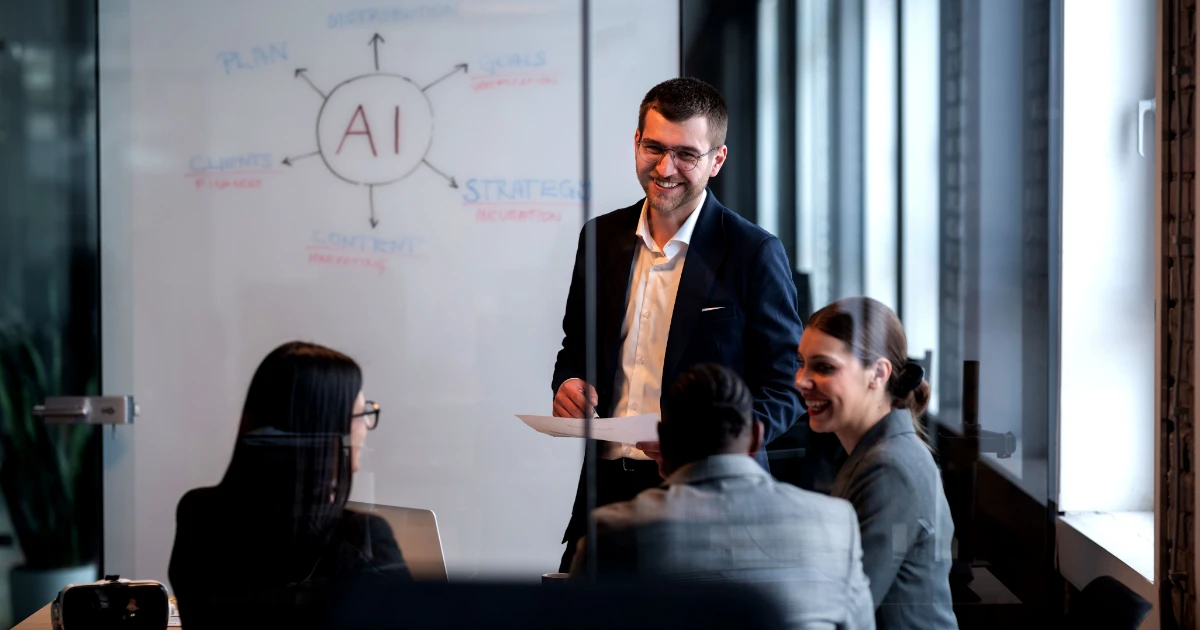
In 2026, learning leaders are balancing growing demand for skill development with the need to move faster and stay deeply human-focused. At the same time, learners want clarity, human connection, and relevance rather than more complicated systems. This is where Managed Learning Services (MLS) has evolved. Human + AI teams can now work together, leveraging the speed of machines and human judgment to deliver learning at scale without losing its human-centric focus, as MLS is now far more than just an operational backbone.
The result is not automation replacing humans, but a people-centric operating model in which humans drive meaning, trust, and strategy while AI handles the volume and complexity.

Why Scaling Learning Operations Looks Different in 2026
Traditional L&D organizations struggle to keep up with rising learning demand. More programs typically translate to more coordination, more vendors and slower execution. This model cannot keep pace with distributed teams, rapid skill shifts, and global learning delivery needs.
Managed Learning Services transforms how an organization operates. It consolidates learning functions while also providing flexibility for the individual learner. When AI is strategically brought into MLS, learning teams can work faster without sacrificing quality or intent. This change supports the big-picture goal of long-term capability growth, not just the day-to-day details of scheduling, localization, and learner support.
The Role of AI in Modern Managed Learning Services
According to a report by Persistence Market Research, the global Managed Learning Services market is expected to reach US$ 8.9 billion by 2033, expanding at a compounded annual growth rate (CAGR) of 11.1% from 2026 to 2033. In MLS, AI works behind the scenes to remove friction from learning operations. It focuses on areas where scale and consistency matter most.
1. Personalization at Scale
AI identifies the role requirements, skills priorities and the learning journey of the user and then recommends relevant learning paths. Instead of offering generic “one size fits all” solutions, learners receive prescriptive advice about what they need now. This drives engagement and enables L&D teams to focus on prioritizing skill development aligned with the business strategy.
2. Faster and More Efficient Operations
Routine work, such as session scheduling, content tagging, enrollment management, and data entry, is automated with AI. This minimizes the drag on operations and allows teams to focus on more actionable decisions. Speed is increased not by working harder, but by eliminating unnecessary manual work.
3. Content Creation and Adaptation
AI supports content creation, simulation development, narration, and translation. It allows L&D teams to be more agile in addressing emerging needs and to serve global audiences more effectively. Most importantly, production is faster with AI, but humans shape the final learning experience.
4. Predictive Insights for Skill Planning
AI analyzes the learning data to identify evolving skill gaps and adoption trends. This intelligence allows leaders to plan more effectively and enables learning leaders to link everyday learning experiences to long-term capability targets.
5. Accessibility and Inclusion
The AI tools support text-to-speech, adaptive formats, and multiple-language delivery. This extends reach and ensures learning is delivered to different groups of learners without increasing operational workload. Together, these features enable Managed Learning Services to serve as the scalability engine for L&D, rather than just the efficiency engine.
Why Humans Remain Central to MLS Success
While AI offers speed and platform, it’s still rooted in human expertise. Learning is not just for information; it’s for behavior, confidence, and trust.
Empathy and Learner Trust
Humans motivate learners, adapt to ambiguity, and foster psychological safety. These things directly affect which skills are applied.
Strategic Design and Judgment
Learning & development leaders and instructional designers integrate AI findings, approve content, and identify intervention points. They connect learning to business outcomes and align with the organization’s priorities.
Contextual Understanding
Subject matter experts and facilitators bring it to life. They know subtleties, limitations, and cultural context, particularly when it comes to complex performance problems.
Creativity and Change Leadership
Humans are the source of innovation in learning formats, experiences, and adoption. They define culture and help determine the value of learning within their organization. In MLS, humans don’t compete with AI; they guide it.
Human + AI Teaming in Action
Human and AI teaming delivers the most value when viewed as a continuous workflow:
- AI identifies a skill gap through usage patterns or performance data.
- A human designer defines the response, shaping a targeted learning intervention.
- AI assists with drafting and delivery, supporting personalization and accessibility.
- A human facilitator leads live interaction, coaching, or discussion.
- AI manages logistics and localization, while humans ensure relevance and clarity.
This partnership enables learning organizations to respond rapidly without sacrificing quality or intent.
From Outsourcing to Strategic Learning Enablement
In 2026, Managed Learning Services is no longer about handing off tasks. It’s a shared operating model that brings together AI and humans to drive growth.
This model brings:
1. Faster response to demand for skills.
2. Standardized learning experiences across regions.
3. Improved utilization of learning talent.
4. A clear line of sight between strategy and execution.
More significantly, it keeps learning a human-focused approach – even as it scales.
What This Means for L&D Leaders
For those leading learning, the question is not whether to use AI. It’s about deliberately building Human + AI teams within MLS.
Top performing organizations:
- Define clear roles for humans and AI.
- Invest in skill development for learning teams.
- Focus on action, not experimentation for its own sake.
- Balance big-picture strategy with daily operational discipline.
This approach reinforces relevance, credibility and impact.
In 2026, Managed Learning Services (MLS) scale learning operations by blending AI-driven automation with human expertise. AI accelerates personalization, operational efficiency, content support, and predictive skill planning, while humans provide strategy, context, trust, and quality, enabling faster, smarter, human-centric learning aligned to business goals.
Conclusion
As organizations shift to skills-based approaches, L&D scalability is becoming a leadership imperative. Managed Learning Services, enabled by Human + AI collaboration, offers the way forward. MLS harnesses the best of human and AI capabilities to deliver faster, smarter learning operations that are deeply human-centric when you blend the complexity-handling power of AI with human creativity and judgment. In 2026, the future of learning is not automated learning. It is human-led learning, amplified by AI, and Managed Learning Services is the foundation that enables it.
Frequently Asked Questions (FAQs)
-
remove How does a Managed Learning Services (MLS) model enable effective collaboration between humans and AI in 2026?In 2026, MLS frameworks combine the AI-driven automation of tasks with human professional interventions to scale up efficiently and effectively learning operations. Using AI, many time-consuming, repetitive tasks are automated, such as content tagging, learner analytics, and adaptive scheduling, whereas humans focus on creating learning materials, strategic leadership, and stakeholder alignment. This hybrid approach improves speed, consistency, and quality across global learning programs without increasing operational overhead.
-
add What operational challenges does MLS solve when scaling AI-enabled learning ecosystems?MLS solves the problems related to fragmented technology stacks, resource quality, and analytics. By integrating all learning operations, vendors in the MLS market offer a combination of AI capabilities, data management, and governance. This makes AI-driven insights both trustworthy and actionable, while human teams retain oversight, compliance and contextual relevance - critical for diffusion of learning across regions and business units in 2026.
-
add How does MLS improve cost efficiency and learning outcomes for human + AI teams?MLS improves cost efficiency by eliminating manual processes through automation, predictive analysis, and content reuse enabled by intelligent mechanisms powered by AI. Meanwhile, the learning strategies are continually optimized by human experts, informed by insights from AI. This results in faster program deployment, improved learner engagement, and measurable performance impact, enabling organizations to scale learning operations sustainably in 2026.