


Marc Steven Ramos is a seasoned learning and development leader with over 20 years of experience transforming how organizations approach talent and performance. He has held leadership roles at global companies, including Google, Novartis, Oracle, Microsoft, and Cornerstone, where he served as Chief Learning Officer (CLO). Marc has worked across industries designing innovative, scalable learning strategies that drive business impact. A Harvard fellow and thought leader, he focuses on redefining modern work through the lens of AI, data, and human performance. His writing, including the “Purpose is People” series, explores how organizations can unlock sustainable performance in a rapidly evolving world.
Nolan Hout, Senior Vice President, Growth & AI Strategist, Infopro Learning
Nolan Hout is the growth leader and host of this podcast. He has over a decade of experience in the Learning & Development (L&D) industry, helping global organizations unlock the potential of their workforce. Nolan is results-driven, investing most of his time in finding ways to identify and improve the performance of learning programs through the lens of return on investment. He is passionate about networking with people in the learning and training community. He is also an avid outdoorsman and fly fisherman, spending most of his free time on rivers across the Pacific Northwest.
How do you drive performance in a world moving faster than ever? In this episode of the Talent Equation podcast, Marc and Nolan explore how organizations can rethink work, not just learning, to stay competitive. Marc shares practical insights on aligning data, AI and learning strategies to help organizations adapt and thrive. He also breaks down where leaders should focus first to create meaningful, scalable impact.
- Why “work,” not jobs or skills, is the most important unit for the future.
- How AI is reshaping task ownership between humans and machines.
- The concept of “letting learning breathe” goes beyond traditional formats.
- What “scrap learning” is and why up to 50% of training may be wasted.
- How data interoperability becomes the foundation of modern L&D systems.
- Why are traditional leadership development programs overly complex.
- The role of context in delivering truly effective learning experiences.
- How to balance innovation with what’s already working (70-20-10 mindset).
- Practical ways to start transforming L&D without overhauling everything.

Stop preserving yesterday’s logic within today’s new construct—the old job won’t exist in its current format much longer.
Chief Learning Officer (CLO), AI for Work & LearningThought Leader, Harvard Education Fellow
Introduction
Nolan: Hello everyone and welcome to the Talent Equation podcast, formerly known as the Learning and Development podcast. This episode is sponsored by Infopro Learning. I am your host, Nolan.
Joining me today is Marc Ramos, who has spent over 20 years helping organizations transform the L&D business in unique ways. He has led some of the most notable organizations, including Novartis, Google, and Cornerstone. The list goes on. He is also a fellow at Harvard, which is fitting because he will be guiding us today on the topic of “Reframing Modern Work To Unlock Sustainable Performance.”
Welcome to the podcast, Marc. It’s a pleasure to have you with us.
Marc: Thanks Nolan. I appreciate the invite and the sponsorship from Infopro.
Marc’s Origin Story
Nolan: Before we get into the topic, we want to spend some time understanding your background. If you could take a few minutes to share your origin story—how you got started and what your journey looked like to where you are today.
Marc: That’s a great question. I grew up in a family of teachers. My mom, brother, and sister were all teachers. Sitting around the dinner table, there were frequent discussions about the challenges within education—limitations in funding, constraints within school systems, and the overall experience for students.
That stayed with me. I felt there had to be a better way. A lot of my foundation comes from that exposure to formal education, at least from the teaching side.
Then things evolved through a series of opportunities. I started working in restaurants because I wanted to be around people. I ended up being good at it. I was asked to train new employees and eventually became an opening trainer for a restaurant chain that went public.
Within a couple of years, I opened around 36 locations while I was still young. That’s where my career really took off, even though I didn’t fully understand it at the time. It came down to explaining things clearly, documenting processes, and being direct with people.
That experience transitioned into retail training, including distribution centers, and eventually into technology. I started at Oracle managing data warehouse and business intelligence curriculum, then worked at startups in Silicon Valley, followed by Accenture and Microsoft in the Pacific Northwest.
Later, I led global sales training at Red Hat before the IBM acquisition, spent several years at Google and Novartis, and eventually became chief learning officer at Cornerstone. That brings us to where I am today.
Motivation and Approach to Learning
Nolan: What motivates you in this field? It’s more than just teaching, so what drives you?
Marc: I don’t know if there’s a simple answer, but I’ve always wanted to approach teaching differently. Going back to my family, a lot of their frustration came from learning being confined within rigid structures.
As I moved into larger organizations, I kept asking how we could do things differently. I’ve always been interested in finding innovative ways to drive results—faster, at scale and with greater impact. That mindset was present from my early days in restaurants through my work in technology and large enterprises.
Another important aspect was working on both sides, being a customer and then working for a vendor. At Cornerstone, I focused heavily on customer advocacy because I had been in their position. That perspective helped me push for more innovative ways to improve learning experiences and outcomes.
Curiosity, Innovation, and AI
Nolan: Innovation often ties back to curiosity. Learning is a creative field, even if it’s not always seen that way.
Marc: I agree. What’s interesting now is how AI is creating new opportunities. It’s providing more ways to improve learning, programs, and organizational outcomes.
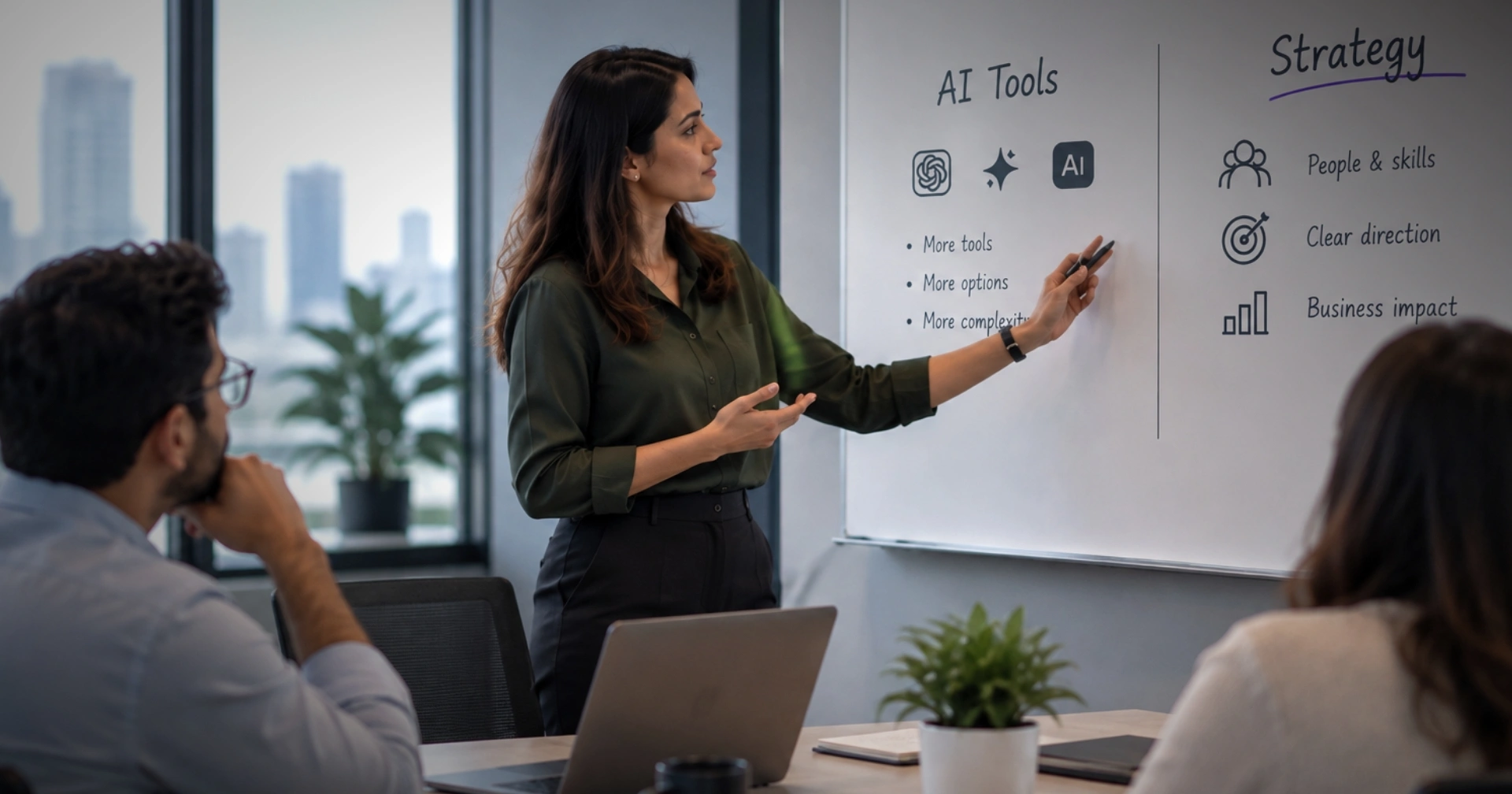
At the same time, there’s a spectrum. On one end, there’s a lot of noise and hype. On the other, there’s what is actually real and useful.
Across industries, the volume of information is overwhelming. But this is also a moment many in L&D have been waiting for—a chance to make a meaningful impact.
The challenge is simplifying what matters and focusing on the fundamentals that won’t be disrupted by the noise.
Reframing Work
Marc: My thinking led me to focus on one central concept: work. We are at a point where we need to decide how work gets done. At the task and workflow level, we need to determine:
- What AI should do
- What humans should do
- What should be shared
Some work is suited for automation or AI-driven execution. Other work requires judgment, decision-making, and human interaction. There’s also a middle ground where humans and AI collaborate.
I spent several months researching this and identified three main areas:
- Understanding how we need to change and move away from old models
- Defining task-level ownership between humans and AI
- Identifying technologies that enable these new ways of working
We cannot continue applying old frameworks to a fundamentally different environment.
The Atomic Model of Work
Marc: I developed a model to think about this, which I call the atomic hierarchy of work. At the center are tasks, the smallest unit of work. Tasks combine into workflows.
Workflows connect skills, particularly human skills. At the highest level, systems and infrastructure orchestrate everything. Around all of these are outcomes, which remain constant.
Tasks are critical because they represent what gets executed.
Nolan: That aligns with the idea that people are paid to perform tasks. Skills are important, but tasks are what drive results.
Data and Systems
Nolan: One thing we’re seeing is the importance of data as the foundation.
Marc: You’re right. Data is central to everything. First, we need interoperability across systems—HR, LMS, CRM, ERP.
Second, data must have consistent meaning so it can be interpreted correctly across systems.
Third, there must be context driving how data flows.
From there, we can move beyond traditional learning structures. Learning has historically been confined within boundaries—time, format, audience.
AI can remove those constraints and deliver dynamic, personalized learning experiences based on the individual and their needs.
Context and Scrap Learning
Marc: This leads to the concept of scrap learning. Scrap learning is the portion of training that does not directly contribute to job performance. Studies showed that between 47% and 60% of training falls into this category. We often include content that provides context but does not help people perform better.
The goal is to focus on learning that is directly applicable and relevant. AI allows us to deliver insights from top performers and tailor learning to everyone’s context.
Rethinking Learning Models
Nolan: This suggests we need to rethink learning models entirely, not just improve them.
Marc: Yes. We often try to improve existing systems instead of redesigning them. AI enables us to rethink how learning is delivered, personalized, and applied.
Leadership development is a good example. Many programs are overly complex. Instead, we should simplify and focus on foundational behaviors, building them progressively.
Value Beyond Content
Nolan: We also need to rethink how we measure value. Learning is not just about knowledge; it’s about engagement and connection. Sometimes the real value comes from people interacting with each other.
Marc: That social amplification is significant. The shared experience often creates more impact than the content itself.
Where to Start
Nolan: Where should organizations begin?
Marc: Start with two questions:
- What is already working?
- What must not change?
These form the foundation. Then balance efforts across core operations, preparation for change, and experimentation. You need both stability and innovation.
Alignment with Business
Nolan: How do you align L&D with broader business goals?
Marc: Use a cascading model:
- Company goals define direction
- Functions align to those goals
- Execution happens through programs and tasks
At the same time, organizations should encourage bottom-up input to refine strategy.
Nolan: We’re seeing both top-down and collaborative approaches.
Marc: Yes, and data connects everything. It must be structured, clean, and consistent to be effective.
Breaking the Linear Model
Nolan: Traditionally, impact scales linearly with cost. With AI, that changes. The more you use it, the more efficient it becomes.
Marc: Exactly. Collaboration and shared systems reduce cost while increasing impact. We can achieve better outcomes through smarter integration and use of technology.
Closing Thoughts
Nolan: Marc, thank you for joining us. This has been a great conversation.
Marc: Thank you for the invite.
Nolan: We’ll see you next time.