


Ryan McCrea is a seasoned talent development and organizational development leader with more than 20 years of experience in HR and learning strategy. Throughout his career, he has worked with leading organizations such as Bayer Monsanto, Amarin, Atlassian, and Commerce Bank, helping build leadership capability and drive measurable business performance. With a background in Industrial-Organizational Psychology, Ryan focuses on practical, results-driven approaches to learning and leadership development. He is passionate about equipping managers and leaders with the skills they need to succeed and believes organizations thrive when their people grow. Ryan is also the author of Quick Bites of Insights, a leadership book offering practical guidance for professionals navigating the modern workplace.
Nolan Hout, Senior Vice President, Growth, Infopro Learning
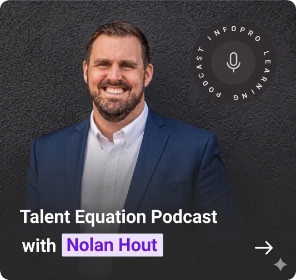
Nolan Hout is the growth leader and host of this podcast. He has over a decade of experience in the Learning & Development (L&D) industry, helping global organizations unlock the potential of their workforce. Nolan is results-driven, investing most of his time in finding ways to identify and improve the performance of learning programs through the lens of return on investment. He is passionate about networking with people in the learning and training community. He is also an avid outdoorsman and fly fisherman, spending most of his free time on rivers across the Pacific Northwest.
What if learning programs were treated like products instead of one-time initiatives? In this episode, Nolan sits down with Ryan to explore how L&D teams can adopt a product mindset, apply agile principles, and rethink how learning solutions are designed, launched, and scaled to drive measurable business results.
- Why L&D teams need to start thinking like product teams.
- What a “product mindset” really means for learning professionals.
- Why the “if you build it, they will come” approach rarely works in L&D.
- How agile methodologies can accelerate learning program development.
- The importance of speed-to-market for learning solutions.
- What a Minimum Viable Product (MVP) looks like in learning design.
- Why marketing and branding are critical for L&D success.
- How data and customer feedback should shape learning programs.
- Practical ways to increase adoption and impact of leadership development initiatives.

No matter how good the learning solution is, if no one shows up and it doesn’t impact the organization, there’s no return on investment.
President, St. Louis Organization Development Network (STL-ODN)
Introduction
Nolan: Hello everyone. Welcome to the Learning and Development Podcast sponsored by Infopro Learning. As always, I’m your host, Nolan Hout. Today we’re joined by Ryan McCrea, who has been in the talent development sphere for over 20 years with companies like Bayer, Monsanto, Amarin, and Atlassian. His passion is building talent that drives measurable business performance, which those of you who have listened know I love.
Today we’re talking about how L&D practitioners can develop a product mindset and why that matters. Ryan, welcome to the podcast.
Ryan: Thank you, Nolan. Glad to be here.
Nolan: Before we begin, I forgot to ask how you pronounce your last name. I said McCray. Is that right?
Ryan: You got it perfect. People often mispronounce it, so gold star for you.
Nolan: Before we jump into product mindset in L&D, tell us how you got into this field. You’ve led large learning teams at major companies, but that’s not where you started.
Ryan’s Career Journey
Ryan: For me it starts with education. In undergrad I planned to become a chiropractor. From about age six to eighteen, that was the plan. I loved science and worked as a chem lab assistant in high school.
Nolan: Was your parent a chiropractor? That’s a specific career choice.
Ryan: Fair question. My dad wasn’t a chiropractor, but he took me to one regularly. I had open-heart surgery when I was three and also had asthma growing up. The chiropractor helped me manage asthma symptoms, which made a big difference in my life.
We had a great chiropractor who was thoughtful and progressive. I told him one day I’d come work with him. That’s why I pursued it for so long.
Nolan: That’s fascinating. My son has asthma, so I may need to explore that.
Ryan: You’d be surprised how much it can help.
Nolan: So, what changed?
Ryan: Two semesters into the program I realized it wasn’t for me. Some poor teaching experiences made me question whether I wanted to pursue it for several more years.
I always loved psychology. Friends often came to me for advice, and I ended up in leadership roles naturally. So, I switched to psychology with a sociology minor. At first, I struggled with career direction. Many people suggested getting a PhD to teach or become a clinical psychologist, but neither appealed to me. Then I took an Industrial Organizational Psychology class. That was it.
For those unfamiliar, IO psychology focuses on understanding human behavior in organizations. It’s essentially business psychology. You study how people behave individually and in teams and apply that knowledge to the workplace. I’ve been in HR for 22 years now, doing everything except payroll. Most of my career has focused on organizational development, leadership development, and talent development. My purpose is to help organizations improve by helping managers and leaders become better.
Why Leadership Development Matters
Ryan: Managers have an enormous impact on our lives. A Gallup study showed managers influence us more than mentors, coaches, physicians, or therapists. The only comparable influence is a spouse.
Leaders create ripple effects that last for years. Everyone deserves good leadership, but being good at a technical job doesn’t make someone a good leader.
You might be an excellent accountant or engineer, but leadership requires different skills. Organizations need to prepare people for that.
Choosing Corporate Work Over Academia
Nolan: Why did you choose corporate work instead of academia?
Ryan: I enjoy research but wanted practical application. Academic environments often focus heavily on theory without emphasizing how to apply it in real organizations.
I’m a mix of someone who enjoys reading research but also wants to know how to use it in business. I also prefer being inside organizations. You see what works, what doesn’t, and you can adjust quickly. You collaborate with teams and experiment. That environment fits me best.
What is a Product Mindset in L&D?
Nolan: Let’s get into today’s topic. What is a product mindset in L&D?
Ryan: Many L&D professionals create programs, courses, or resources and assume people will come. They operate under the Field of Dreams mindset — “If you build it, they will come.”
That rarely happens. You might build something valuable, but five people sign up when you expect a hundred. A product mindset changes how you approach this.
Products solve specific problems or needs. You identify demand and create supply to meet it. Learning programs should work the same way. You also think about:
- Speed to market
- Customer feedback
- Iteration
- Demand and adoption
Agile and the Minimum Viable Product
Ryan: About ten years ago I attended an Agile bootcamp, which changed my thinking. Agile originated in software development but applies well to HR and L&D. One core idea is the Minimum Viable Product (MVP).
Instead of spending 12 months building the perfect program, launch something valuable quickly. Then improve it based on feedback. If you wait for perfection, the business might move on. Think about the iPhone. The first version wasn’t perfect. Neither is version 16. But if Apple waited for perfection, the product wouldn’t exist.
Why Customer Feedback Matters
Ryan: Traditional project management follows a waterfall model:
- Conduct analysis
- Build the program
- Reveal the finished product
Often leaders say, “This isn’t what we wanted.” With Agile, customers stay involved throughout the process. They see progress and provide feedback continuously. That drastically improves alignment.
Building Programs with Cross-Functional Teams
Ryan: At one organization we needed a new leader development program. Instead of building it alone, I created a cross-functional team including:
- HR partners
- Talent acquisition
- Compliance
- Technology teams
- Business learning professionals
Fifteen people collaborated on designing the program. We discovered one key gap: new leaders didn’t understand budgeting. So, we partnered with finance to build learning around financial basics. Because stakeholders were involved throughout development, the final product met real needs.
The Importance of Marketing in L&D
Ryan: Marketing is critical for L&D. Even excellent programs fail if nobody knows they exist. Common scenarios include:
- Employees saying, “I didn’t know that training existed.”
- Leaders asking for programs that already exist.
L&D teams must think like marketers.
Branding Learning Programs
Ryan: Branding helps build trust. At one company they wanted to call our program “Commerce University.” I pushed back.
Calling it a university implies classroom learning only. But development includes mentoring, experiences, coaching, and more. Instead, we created Commerce for You with the tagline:
“Your future, our focus.”
We built a strong brand with consistent messaging and resources. Eventually other teams asked to place their initiatives under our brand because of its credibility.
Marketing With Data
Ryan: Another challenge is understanding usage data. You must know:
- Who completed programs
- Who dropped out
- Who hasn’t participated
- What audiences need the training
A marketing-focused team member on my team used data to target individuals directly. Instead of blasting messages to everyone, he contacted specific people who would benefit from certain programs. Within hours he could fill training sessions that previously struggled to reach enrollment targets.
The Role of Data in Learning Strategy
Nolan: Data plays a huge role. Many organizations underestimate the real cost of unused learning resources. For example, if you buy licenses for thousands of learners but only a small percentage use them, your true cost per learner skyrockets. Measuring real usage gives a clearer picture of learning ROI.
Ryan’s Data-Driven Business Case
Ryan: I had to defend keeping LinkedIn Learning at one organization. Instead of talking about learning benefits, I presented the financial impact.
Many employees used the platform for continuing education credits (CEUs) required for certifications. Replacing that training externally would cost 81% of the license price alone.
When I added other learning uses like AI training and Excel development, the total replacement cost would have been 2.5 times higher. Once leadership saw the financial data, the decision was obvious.
Ryan’s Upcoming Book
Nolan: Ryan has an upcoming book. Tell us about it.
Ryan: The book is called Quick Bites of Insights. It contains 60 short articles, each about 300–500 words. They provide practical insights for leaders and professionals navigating work environments.
Not everyone wants to read a 400-page book. This format allows readers to absorb ideas quickly. Each piece includes practical guidance on applying the ideas immediately.
Closing Thoughts
Ryan: Learning only matters if people apply it. If knowledge isn’t used, it fades quickly. Everything in the book focuses on turning learning into action.
Nolan: Ryan, thank you for joining us today.
Ryan: Thanks Nolan. Great conversation.