


Kevin M. Yates is a globally recognized learning and development strategist, keynote speaker, and advisor known as the “L&D Detective.” With more than 30 years of experience in training, talent development, and performance consulting, Kevin has worked with leading organizations including McDonald’s, Meta, Kantar, and Grant Thornton. His expertise focuses on measuring the impact of learning and development initiatives and connecting them to business performance outcomes. Kevin helps organizations design evidence-based impact measurement strategies that move beyond traditional surveys and learning metrics. He is also the founder of the nonprofit Meals in the Meantime, which fights food insecurity by providing fresh, healthy food to communities in need.
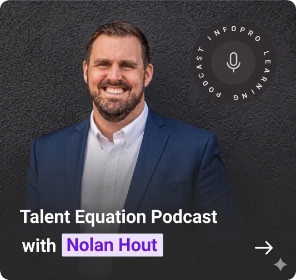
Nolan Hout, Senior Vice President, Growth, Infopro Learning
Nolan Hout is the growth leader and host of this podcast. He has over a decade of experience in the Learning & Development (L&D) industry, helping global organizations unlock the potential of their workforce. Nolan is results-driven, investing most of his time in finding ways to identify and improve the performance of learning programs through the lens of return on investment. He is passionate about networking with people in the learning and training community. He is also an avid outdoorsman and fly fisherman, spending most of his free time on rivers across the Pacific Northwest.
Learning and development teams are under increasing pressure to prove their impact. In this episode, Nolan speaks with Kevin about how organizations can move beyond surveys and LMS metrics to measure real performance outcomes and business impact.
- Kevin Yates’ career journey from education to corporate learning and talent development.
- Why he calls himself the “L&D Detective” and what that means for measurement.
- How the ROI Institute methodology influenced his work in impact analytics.
- Why surveys and LMS data alone fail to measure learning effectiveness.
- The concept of the “workplace performance ecosystem” and collective contributions.
- Why L&D professionals should act as performance consultants first.
- The importance of measuring both performance improvement and performance maintenance.
- How AI will evolve (not replace) roles in learning and development.
- Kevin’s nonprofit Meals in the Meantime and its mission to fight food insecurity.

Training, learning, and talent development by itself will never move the needle on performance. It takes a village to impact workplace performance.
‘L&D Detective,’ Founder, Meals in the Meantime
Introduction
Nolan: Hello everyone and welcome to the Learning and Development Podcast sponsored by Infopro Learning. As always, hosted by me, Nolan Hout.
Joining me today is Kevin Yates, the L&D detective, which is one of my favorite titles I’ve ever heard. We will get to that shortly. Kevin is an advisor, keynote speaker, and workshop facilitator who has worked with some of the most recognizable brands in the world, including McDonald’s and Meta.
Today we will talk with Kevin about measuring contributions in the workplace performance ecosystem. Anyone who listens to this podcast knows that when we start talking about measurement and performance, that’s what really excites me.
Kevin, welcome to the podcast.
Kevin: Hey Nolan, good to see you. Great way to start off 2026. Happy New Year to you and all the listeners.
Nolan: Thanks Kevin. Let us start with your origin story. You have worked with some major brands, but that was not your first job out of college. People love hearing how someone got started in this industry. How did you enter L&D and what are you doing today?
Kevin’s Career Journey into L&D
Kevin: When I was in college, I had no idea I would enter training, learning, and talent development. I earned an undergraduate degree in business management from Hampton University in Virginia. After graduating, I imagined wearing a blue suit, gold tie, white shirt, carrying business cards and a briefcase. I just wanted to be a businessman.
After working for a while, I realized the business world did not resonate with me. So, I quit my job and returned to graduate school. I earned a master’s degree in curriculum instruction because I wanted to teach. I wanted to be in a classroom and help people learn.
I collaborated with a school district in the Chicago suburbs and spent time with Chicago Public Schools. I discovered a passion for teaching and education. Unfortunately, the salary for public school teachers did not align with my personal life goals.
That is unfortunate because teachers are among the most important professions in the world.
Since I had a passion for teaching and learning, I transitioned that passion into corporate training. That allowed me to do what I loved while building a career that supported my life goals.
Over the years I have worked with global brands including Kantar, Chicago Tribune, McDonald’s, Facebook, Meta, and Grant Thornton. I have spent more than 30 years working in training, learning, and talent development.
Today I am a solopreneur helping organizations with impact measurement strategies, delivering global keynotes, and leading workshops. I also founded a nonprofit called “Meals in the Meantime,” which fights food insecurity.
Discovering Impact Measurement
Nolan: You mentioned education early in your career. When did the focus on measurement and performance begin?
Kevin: It started around 2015. At that time, I had worked in many L&D roles including facilitation, instructional design, curriculum development, learning operations, onboarding, leadership development, and more.
After doing so many things in the field, I began considering leaving the profession because I felt bored and believed I had hit a ceiling. During that time, I attended a training conference in Illinois and met Patti Phillips.
Patti and her husband Jack Phillips founded the ROI Institute, which focuses on measuring the impact of training. Before that, my measurement approach was mostly surveys. Patti introduced the ROI methodology, and it fascinated me.
I told her I wanted to become an expert in measurement and asked if she would mentor me. She said yes. That moment changed everything. Since around 2015 or 2016, I have focused my career on measurement and impact analytics.
Measuring Performance Beyond Surveys
Nolan: What are the fundamentals of that measurement model?
Kevin: The foundation is evaluating how training and learning influence measurable performance outcomes. We must think beyond surveys and LMS data.
Instead, we should connect training experiences with measurable performance outcomes and business results. My focus is finding facts, clues, evidence, and data that reveal how training contributes to the workplace performance ecosystem and influences business goals.
Legacy Thinking in L&D Measurement
Nolan: Are organizations moving toward this type of measurement?
Kevin: I see progress, but legacy habits still exist. Many organizations still rely heavily on surveys and LMS data.
However, expectations are changing. Leaders want to see how learning solutions influence human performance and business outcomes. The conversation is shifting faster than the methods.
Why Workplace Performance Takes a Village
Nolan: What are the biggest barriers when organizations try to measure business impact?
Kevin: One major barrier is acknowledging the truth. The truth is this: It takes a village to impact workplace performance.
Training alone will never move or sustain performance improvement. Many factors influence workplace performance. Training is only one contributor within a larger performance ecosystem. When we measure collective contributions across that ecosystem, the impact story becomes more accurate.
Performance Consulting vs Training Requests
Nolan: What should the conversation look like when someone asks for training?
Kevin: The conversation should not begin with “we need training.” Instead, it should start with two questions:
- What is the business goal?
- What performance is required to achieve that goal?
When we start there, the focus shifts toward performance outcomes rather than training solutions. I believe L&D professionals should see themselves as: Performance consultants first and L&D practitioners second.
When Training Has Zero Impact
Kevin: There are times when training programs create zero impact. They exist because someone requested training, not because they were designed to influence performance. In those cases, we must stop and reassess. We should return to a performance mindset and ask whether the solution has the potential to move or maintain human performance and business performance.
AI and the Future of L&D Roles
Nolan: How do you see AI affecting L&D roles?
Kevin: AI will change how we work, but I do not believe it will replace our roles entirely. AI will enhance and evolve roles.
For example, instructional designers will need strong AI skills. AI will assist them in creating solutions more efficiently. Artificial intelligence can support our work, but it cannot replace the uniquely human aspects of our roles. I think of AI as Watson to my Sherlock Holmes. It helps me work smarter, not harder.
Meals in the Meantime Nonprofit
Nolan: Let us talk about your nonprofit, Meals in the Meantime.
Kevin: Meals in the Meantime fights food insecurity. We provide free, fresh, healthy, high-quality food through mobile pop-up food pantries in the Chicago South suburbs.
Our mission is to fill the food gap with nourishment and dignity. Nourishment means providing healthy food from major food groups like fruits, vegetables, proteins, dairy, and grains.
Dignity means honoring the humanity of every person we serve. Visitors are greeted warmly, treated respectfully, and welcomed into a supportive environment. Food insecurity is a condition, not a condemnation. Anyone who wants to support the mission can visit: mealsinthemeantime.org.
Closing Thoughts
Nolan: Kevin, thank you for joining us and sharing your insights with the L&D community.
Kevin: Thank you, Nolan. I appreciate the opportunity.