


Koreen Pagano is a learning and workforce transformation expert focused on building skills-based organizations. She is Co-Founder of Rising Tide Cooperative and the author of Building the Skills-Based Organization: A Blueprint for Transformation and previously wrote Immersive Learning. Koreen has led product innovation and learning technology initiatives at organizations such as LinkedIn, Degreed, Wiley, and D2L. Her work explores how companies can better understand employee capabilities, leverage skills data, and prepare their workforce for an AI-driven future. With deep expertise in AI transformation, analytics, and learning science, Koreen helps organizations rethink jobs, develop human capabilities, and design systems that enable people and technology to work together effectively.
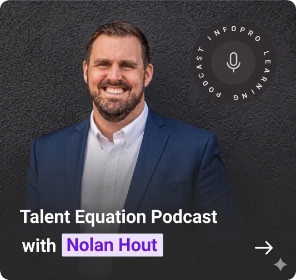
Nolan Hout, Senior Vice President, Growth, Infopro Learning
Nolan Hout is the growth leader and host of this podcast. He has over a decade of experience in the Learning & Development (L&D) industry, helping global organizations unlock the potential of their workforce. Nolan is results-driven, investing most of his time in finding ways to identify and improve the performance of learning programs through the lens of return on investment. He is passionate about networking with people in the learning and training community. He is also an avid outdoorsman and fly fisherman, spending most of his free time on rivers across the Pacific Northwest.
As AI reshapes work, organizations are being forced to rethink jobs, skills and how people create value. In this episode, Nolan speaks with Koreen about the shift toward skills-based organizations, the growing importance of human skills and how leaders can navigate rapid technological change.
- Why do many organizations still organize people around job titles instead of skills and why that model is breaking down.
- How the pandemic exposed major gaps in understanding workforce capabilities.
- Why skills data is becoming essential for companies adopting AI.
- The difference between academic expertise, practitioner expertise and emerging expertise.
- How AI is changing the tasks humans perform at work.
- Why human skills like critical thinking, creativity and empathy are becoming more valuable.
- The challenges organizations face in preparing early-career professionals when entry-level tasks are automated.
- How leaders can balance technological innovation with the human side of organizations.
- Why curiosity and experimentation are essential for navigating the AI era.

Jobs have become a limiting construct. Work is changing so quickly that organizing people only around job titles doesn’t make sense anymore.
Co-Founder, Rising Tide Cooperative
Introduction
Nolan: Hello everyone and welcome to the Learning and Development podcast hosted by Nolan and sponsored by Infopro Learning.
Today we’re joined by Koreen Pagano who just released her new book “Building the Skills-Based Organization: A Blueprint for Transformation.” If you’re on LinkedIn or in L&D space, you’ve probably already seen it everywhere. With deep expertise in AI transformation, analytics, and learning technology from building products at places like LinkedIn, Degreed, and Wiley, Koreen has been focused on a question many organizations are getting wrong.
Why are we still organizing people around job titles when skills are what get the work done? Today we’re going to talk about why it’s time to flip that script and how AI is making this shift more urgent than ever. Koreen, welcome to the podcast.
Koreen: I appreciate you having me on.
Koreen’s Career Journey
Nolan: Before we dive into the topic, I want to talk about you. I mentioned your background working with these large organizations, but how did you start in this field? Where did you cut your teeth before writing your second book?
Koreen: It might not seem like a logical path, but my first book, Immersive Learning, led me to where I am today focusing on skills and skill development. That book explored how to improve performance and change behavior. Today I will map that idea more directly to skills.
I started my career fascinated by how to scale practice and how to let people try things, fail, and get better over time. Much of my inspiration came from the gaming industry. Most games aren’t meant to be played once. You improve as you play repeatedly, learning mechanics and navigating challenges.
Games are designed for repetitive practice. That concept inspired Immersive Learning and my thinking about building realistic practice environments so people could develop skills. After writing that book more than a decade ago, I said I would never write another one.
Nolan: You lasted twelve years. That’s impressive.
Koreen: I did make it a long time. During that decade I transitioned from instructional design into product development. I built products to scale learning across multiple organizations, each approaching the problem differently.
Around 2018 I was working at D2L. They are well known in higher education but also serve corporate clients. I was helping them think about how their product could better meet corporate needs.
Eventually they asked me to research the connection between higher education and employers. Why were universities struggling to prepare students for work? Why were employers saying graduates weren’t ready?
Through that research I realized something important. Higher education focused on competencies, while employers talked about skills. That became the catalyst for the last seven or eight years of my career.
I started asking: What exactly are skills? Do organizations share a common understanding of them? The answer was no. There is still a lot of nuance and complexity around what it means for someone to have a skill, and which skills are needed for different jobs.
Last year I was asked to write a research paper on expertise for the Learning Guild. After writing that paper I realized I had so many ideas that it should become a book.
Understanding Expertise
Nolan: Is there something about this field that fascinates you more than others? What keeps you exploring it deeper?
Koreen: My master’s degree is in curriculum and instruction. Initially I thought I would become a classroom teacher. I did teach for a while, but my first job after graduate school was as a training manager at a company that built distribution software.
I trained customer-facing employees in shipping, logistics, and inventory management. While working there I became fascinated by the relationship between business needs and employee capabilities.
How do you connect what a business needs with what people can actually do? Later I taught for a few years, but eventually returned to corporate learning. I joined a company that built simulations with Wharton Business School, which pushed me to think about human capabilities in the context of work. All of those experiences shaped how I think about skills today.
Nolan: I’ve been thinking about expertise recently. There are people with deep academic expertise and people with practical field experience. Both are valuable but in different ways.
Koreen: When I wrote the research paper on expertise, I explored several types.
There is academic expertise, which is deep theoretical knowledge. There is lived expertise from practitioners who do the work. There are practitioner experts inside organizations who may not publish books but are the people everyone goes to for answers.
Then there is emerging expertise — people early in their careers who are learning quickly in new fields. AI is creating many of those emerging experts right now. Entire skill areas are brand new, so organizations are trying to identify who is ahead of the curve.
AI, Skills, and the Changing Workforce
Nolan: Let’s move into the main topic. How is AI transforming leadership and feedback culture, and how does that connect to the idea of skills-based organizations? At a high level, what does shifting from job-based thinking to skills-based thinking mean?
Koreen: Two major shifts triggered this conversation.
The first was the pandemic. When COVID disrupted organizations, companies realized they didn’t have enough information about their workforce. They didn’t know what skills their employees actually had.
That lack of data made it difficult to redeploy people quickly. Skills are essentially data about people’s capabilities. During the pandemic many organizations realized they didn’t have that data.
The second shift was the arrival of AI, particularly large language models. AI depends on data, and if organizations don’t have good data about their people, AI produces poor results.
Suddenly HR, L&D, and managers were under pressure to understand and document skills across their workforce.
AI also introduced new skill requirements. Employees now need to work alongside AI tools. So, organizations face two challenges at once:
- They need data about existing workforce skills.
- They need to build entirely new AI-related skills.
Why Skills Matter More Than Jobs
Nolan: Why does that matter though? Why not simply measure whether someone completes the work assigned to their job?
Koreen: That’s a good question.
Organizations often measure job responsibilities through business metrics. For example, marketing might measure the number of leads generated. Historically we assumed someone’s job title represented their abilities. But AI is challenging that assumption.
AI can complete many individual tasks, but it doesn’t always achieve strategic outcomes. It can generate ideas, but it lacks judgment, oversight, and context. As AI takes over tasks, the question becomes: what role do humans play?
Jobs were traditionally structured around collections of tasks. As those tasks become automated, the structure of jobs starts to change. That is why organizations are focusing more on underlying skills rather than job titles.
The Return of Human Skills
Nolan: What kinds of skills are becoming more important now?
Koreen: We’re seeing renewed interest in what used to be called soft skills. Today people refer to them as human skills or power skills.
These include critical thinking, problem solving, creativity, agility, and empathy. AI is very good at repetitive tasks within defined boundaries. But it struggles with context, judgment, and creativity. Humans still provide oversight and decision-making.
Even when I train my own AI model using everything I’ve written over the last ten years, it still produces outputs I wouldn’t publish without editing. AI can help, but it still requires human guidance.
The Future of Work and Early Career Development
Koreen: Another major challenge involves early career development.
In the past, people learned through entry-level jobs that involved low-risk tasks. They received feedback from experienced colleagues and gradually developed expertise. Many of those entry-level tasks will now be automated by AI.
So, the question becomes: how do we develop expertise when those training-ground jobs disappear? Organizations will need new approaches to developing talent.
Society, Work and AI
Nolan: We’re also facing broader societal changes. Productivity is rising while many individuals feel economic pressure. AI adoption is happening faster than any technology in history. Electricity took decades to reach homes. AI reached millions of users almost instantly.
We’re at a crossroads.
Koreen: Yes, and there are big questions ahead.
If AI eventually replaces many knowledge-work tasks, we need to rethink systems built around employment — education, healthcare, retirement, and economic models. We need to pace the rate of technological change so society can adapt.
Advice for Leaders Facing AI Change
Nolan: What advice would you give to leaders who feel overwhelmed by all of this change?
Koreen: The worst strategy is ignoring it. When the internet emerged, organizations eventually had to adapt. AI will be the same. My advice is to approach it with curiosity. Experiment with new tools and evaluate what works.
Ask:
- What is AI good at?
- What is it not good at?
- What opportunities does it create?
- What risks does it bring?
Balance optimism with realism. We shouldn’t ignore potential problems, but we also shouldn’t let fear prevent us from exploring new possibilities.
Closing Thoughts
Nolan: That’s a great way to end the conversation. Thank you so much for joining us and sharing your insights today. You made me smarter, which is the goal of the podcast. Hopefully our listeners learned something along the way as well.
Koreen: Thank you so much.