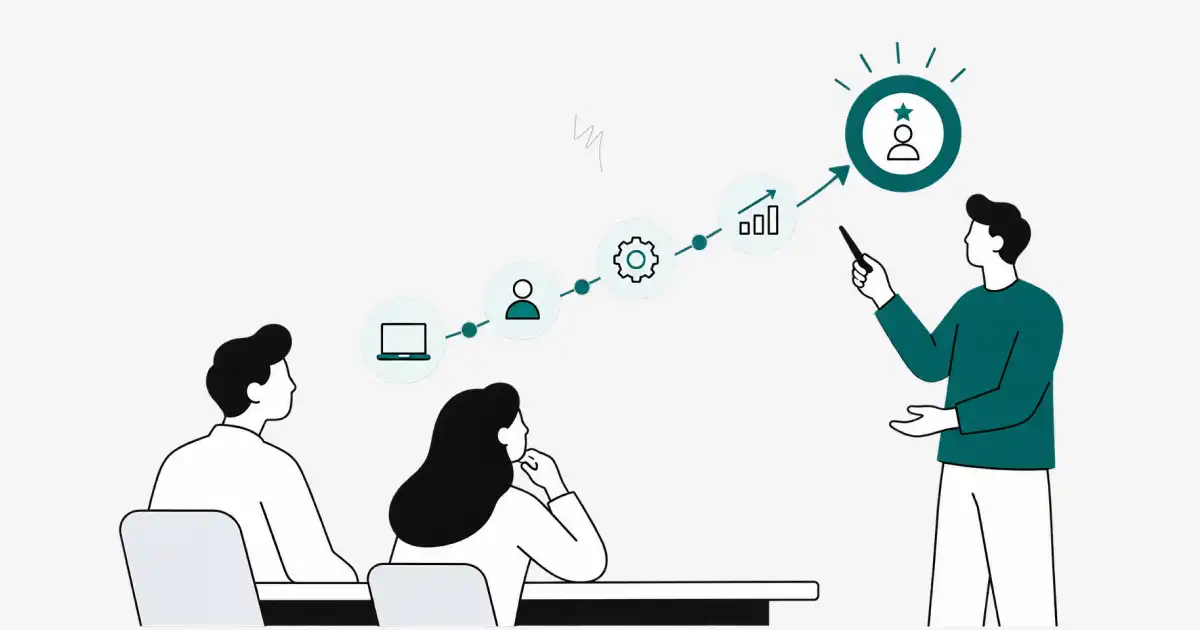
Employee onboarding is the foundation for long-term engagement, productivity, and retention. Yet, too often, onboarding feels like a chaos of paperwork, disjointed communication, and information overload. Employee onboarding powered by AI-driven innovations is transforming this critical phase of the employee journey, making it more productive and more human. By adopting AI technologies, companies can deliver a human-centered, action-oriented onboarding experience that connects the strategic vision to meaningful daily experiences. According to ‘The State of Employee Onboarding in the US’ report, over 50% of organizations have moved to virtual hiring and onboarding, with 68% already using AI to automate these processes. Driven by measurable gains in productivity and engagement, 41% of respondents expect to implement further automation within the next 6–12 months.
The Value of AI in Employee Onboarding
AI enables HR professionals to perform tasks, allowing them to build meaningful connections. Rather than taking time away from productive work, AI enables HR professionals to build engagement, personalize learning, and create experiences that matter. Doing so more in line with strategy, experience, and a human-focused practice helps with onboarding. Furthermore, AI integration in employee onboarding offers benefits such as saving time, achieving consistency across regions, and supporting new hires at every step of their journey.
1. Personalized Onboarding Experiences
No two employees are alike. Some learn best through visual content, while others learn best through interactive tasks. Using AI, employee profiling, and preferences helps create content tailored to everyone based on their role, background, and learning style. This ensures that employees get the right information at the right time.
Instead of being “one-size-fits-all,” personalized by AI means onboarding is highly targeted without forgoing ease of use, finding the right balance between big-picture strategy and the smallest level of detail.
2. AI-Chatbots for Instant Assistance
When joining a new company, a few of the common questions that come to a new hire’s mind are: “Where do I look for my benefits?” “How do I organize my workspace?” These are the questions that AI-powered chatbots can answer instantly.
Instead of being a burden on the HR department with repetitive questions, AI chatbots in HR give employees and teams the freedom to do what they are best at – making connections.
3. Automated Paperwork and Process Tasks
Onboarding usually involves mounds of paperwork, verification steps, and approval processes. AI simplifies the process by automatically creating documents, handling data entry, and automating compliance workflows. This not only helps eliminate potential errors but also speeds up the onboarding process and enables new employees to access essential resources such as contracts, tax information, and software systems with ease.
This use case is indicative of a combination of speed and skills, because fast processing of administrative work enables HR professionals to dedicate time to interactions that matter.
4. Check-Ins and Feedback Loops Using Data
Feedback is gold, particularly when feedback is solicited early. There are AI tools that can schedule automated feedback sessions and help identify trends in experience and engagement by analyzing feedback responses. Feedback, for instance, can help identify areas through which new employees might feel overwhelmed.
These insights enable HR and managers to act proactively, strengthening relationships and fostering a supportive culture. Feedback becomes more than a metric; it becomes a catalyst for continuous improvement.
5. Tailored Learning Paths and Early Career Growth
The best onboarding does not stop after the first week; instead, it evolves into ongoing learning and development. AI helps in creating learning paths by understanding their skills, knowledge gaps, and role expectations. Employees who receive learning recommendations from AI systems follow a learning pathway tailored to their career and performance expectations.
This action-oriented approach ensures that learning isn’t generic; it’s relevant, engaging, and aligned with both individual and organizational goals. PwC’s Global Workforce Hopes and Fears Survey 2025 shows that AI’s influence is rapidly expanding, with optimism about its potential far outweighing concern. Yet findings from one of the world’s largest workforce studies—drawing on insights from nearly 50,000 respondents across 28 industries in 48 major economies—reveal that everyday use of AI remains limited. This gap presents a significant opportunity for leaders to unlock motivation and fast-track reinvention and growth.
6. Predictive Engagement & Retention Support
AI doesn’t just react to situations—it anticipates them. By observing interactions and progress in the eLearning process, AI models predict disengagement and trigger an alert. This enables the management to interact with new employees.
Such predictive power emphasizes a human-centric approach, keeping individuals in mind and being there for them to succeed right from the outset.
7. Content Generation & Translation Capabilities
Diversity, including linguistic and cultural requirements, is essential for global teams. Training materials can be produced by AI tools in a variety of languages and formats, making them available to all. AI improves accessibility while preserving messaging consistency, whether it’s translating documents or creating interactive tests. AI enables all employees worldwide to have engaging onboarding experiences by streamlining content creation.
Conclusion
Adopting AI to transform employee onboarding isn’t just a technological upgrade; it’s a strategic investment in people. From personalization and automation to real-time support and predictive insights, AI strengthens every stage of the onboarding journey. When implemented with purpose, AI empowers HR teams to create experiences that accelerate learning, boost engagement, and cultivate long-term success. With AI handling the administrative load, HR professionals can focus on what truly matters: building meaningful connections and helping new hires thrive.
Frequently Asked Questions (FAQs)
-
remove What are the key functions of AI in employee onboarding?AI supports employee onboarding by automating administrative tasks, personalizing learning paths, accelerating time-to-productivity, providing real-time support through virtual assistants, analyzing onboarding data to identify gaps, and ensuring consistent experiences across roles and locations.
-
add How is AI used in employee onboarding?AI is used in employee onboarding to automate paperwork, personalize training paths, answer new-hire questions via chatbots, track progress in real time, and surface insights that help HR teams improve speed, consistency, and new-hire productivity.
-
add Can employee onboarding be automated with AI?Yes, onboarding can be automated—partially and strategically. Administrative tasks, documentation, training delivery, and progress tracking can be automated, while human interaction remains essential for culture, coaching, and role-specific judgment.