


Edmund (Ed) Monk, CEO & Co-Founder, The Learning & Performance Institute (LPI)
Ed Monk is an internationally recognized expert in workplace learning, performance improvement, and professional accreditation. He is the CEO and Co-Founder of the Learning and Performance Institute (LPI), guiding its transformation into a globally trusted authority in learning standards and practice. Over more than 25 years, Ed has helped organizations integrate learning with business outcomes, served advisory and board roles across the sector, and led initiatives in learning accreditation, research, and innovation. Under his leadership, LPI supports thousands of professionals and organizations in over 50 countries.
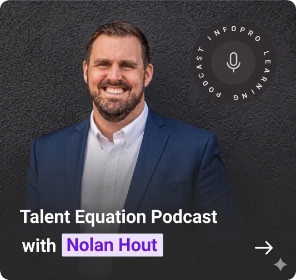
Nolan Hout, Senior Vice President, Growth, Infopro Learning
Nolan Hout is the growth leader and host of this podcast. He has over a decade of experience in the Learning & Development (L&D) industry, helping global organizations unlock the potential of their workforce. Nolan is results-driven, dedicating most of his time to identifying and improving the performance of learning programs through the lens of return on investment. He is passionate about networking with people in the learning and training community. He is also an avid outdoorsman and fly fisherman, spending most of his free time on rivers across the Pacific Northwest.
Every L&D leader today is asking a vital question: How can we build trust and foster genuine learning cultures in an AI-driven world? In this insightful episode, Ed and Nolan discuss how organizations can align people, performance, and technology to achieve lasting learning impact.
Listen to the episode to find out:
- How the LPI’s mission evolved from IT training to global learning performance leadership.
- Why trust has become the new currency in today’s learning and business ecosystems.
- The #1 challenge for Chief Learning Officers worldwide and why it’s not artificial intelligence.
- How organizations can foster a culture of learning rather than “create” one.
- Why user-generated and authentic content often outperforms expensive eLearning programs.
- How AI can be used to deepen engagement rather than just generate more content.
- The growing demand for face-to-face learning experiences in a post-digital world.
- Why linking organizational values to learning experiences is essential for lasting impact.

We’re living in an age where trust is a premium currency. Technology may drive learning forward, but it’s the human connection that sustains it.
CEO & Co-Founder, The Learning and Performance Institute (LPI)
Introduction
Nolan: Hello everyone, and welcome to the Learning and Development Podcast sponsored by Infopro Learning. I’m your host, Nolan Hout. Joining me today is Ed Monk, CEO and co-founder of the Learning and Performance Institute, or LPI. Ed founded the LPI with a mission to raise the global standards of the L&D industry through measurable, innovative learning solutions that align with technology and business trends.
Today, we’ll talk with Ed about the Institute’s mission and how organizations can leverage the LPI to cut through the noise in corporate learning and focus on what truly impacts business today.
Welcome to the podcast, Ed.
Ed: Hey Nolan, great to talk to you. I don’t know if I’m more important than you, but I think we can agree we’re equal.
Nolan: That’s fair. When I started this podcast, my goal was to make it all about the guest. It began as a way to have meaningful conversations with people I wouldn’t otherwise get to meet during COVID. What I’ve found most rewarding is helping people, helping their businesses, and connecting with others.
Ed: Then we’re definitely equal, because we seem to share the same purpose. Though maybe we could just sit silently and admire each other—but that’s probably not great for an audio podcast!
Nolan: True. Well, before we start, tell us a little about how you got here and what led you to found the Learning and Performance Institute.
Ed Monk’s Journey
Ed: Thanks, Nolan. I actually wanted to be a journalist first—I loved uncovering authentic stories and exposing poor practices. I applied for a job in publishing, but instead of writing, they gave me a sales role in advertising. I needed the money, so I learned about the commercial side of the industry.
That led to starting two or three magazines, one of which was IT Training Magazine. It became very successful and was later bought by one of the largest publishers in the UK. The proceeds from that helped me start what became the Institute of IT Training in the late 1990s.
At that time, we focused heavily on technology training. Every time Microsoft released new software, we saw a surge in activity. But over time, we realized our members weren’t all IT trainers—they were professionals using technology as a medium for learning. That’s when the L&D space really opened up for us.
Since then, the organization has evolved into one of the most influential in corporate learning and development worldwide, second only to ATD in membership size. Though we began in Europe, our presence now extends across Asia-Pacific, the Middle East, and North America.
It’s been nearly 30 years since we began, and we’ve had some lucky breaks along the way. For example, in 2010 we created a course on teaching in virtual classrooms using WebEx and Adobe Connect. At the time, no one cared. Then, when Microsoft entered the space and later COVID hit, the program became our top course overnight.
The Learning and Performance Institute (LPI) Mission
Nolan: For listeners who aren’t familiar, could you share the purpose of the LPI and how it creates value for members?
Ed: Of course. First, we’re a not-for-profit organization, and we’ve been that way for 30 years. Our mission is simple: Making Learning Work.
In the 1990s, much of what we saw in training had no real impact. People would go off for a five-day team-building course and return unchanged. Learning had a bad reputation and was often the first thing cut during a financial crisis.
We knew it could be better. Many in the industry were passionate about helping others but weren’t recognized for driving business results. So, we set out to bridge that gap between learning and business performance.
We now support a global membership community, provide self-assessment tools, and offer development programs such as Performance Consultancy and AI for Learning Professionals.
We also accredit training providers, learning departments, and tech companies, and we host major events like The Learning Awards—which now has participants from 47 countries—and Learning Live, our annual conference for senior L&D leaders.
We also built the Learning and Performance Accelerator, a free diagnostic platform for L&D teams that gives instant feedback on how their departments are performing.
Accreditation vs. “Top 20” Lists
Nolan: There are many organizations that release “Top 20” vendor lists, but you’ve taken a different approach—focusing on accreditation. Why do you think that direction?
Ed: The short answer is that we’re vendor-agnostic. Everything we do starts from the learner’s perspective.
If a learner asks us for recommendations, we don’t point them to one provider. We show them all the accredited ones. Accreditation gives them confidence that their money is being well spent.
There’s been an explosion of “Top 10” and “Top 20” lists in recent years. Some are great, like Jane Hart’s Top 50 Tools or Fosway’s research, but others have limited scrutiny—or even pay-to-play placements. We’ve stayed away from that model to maintain fairness and credibility.
Accreditation, by contrast, creates a clear and transparent standard that learners and companies can trust.
Trust as the New Currency
Ed: We’re living in an age where trust is the new currency. Many people no longer know which sources to rely on.
When we started, before the internet was widespread, people came to institutes like ours for reliable information. Then everything was democratized online—information became free but also unreliable. Now, people want expert validation again.
That’s where accreditation helps. It mitigates risk and gives assurance in a time when trust is scarce. If companies like Microsoft and countless others continue to renew their accreditation every year, we must do something right.
Top Challenges in Corporate Learning
Nolan: With all your data and global reach, what are the biggest challenges L&D leaders face today?
Ed: The number one challenge is building a learning culture. Everyone assumes it’s AI, but it’s not. It’s the human side of AI adoption.
Many organizations invest heavily in learning platforms, but no one uses them. That’s not a tech issue—it’s a culture issue. There’s no engagement strategy, managers don’t coach or protect time for learning, and employees are often afraid to step away from work to develop themselves.
The second challenge is, of course, leveraging AI effectively. But again, it’s ultimately a people issue, not a technology one.
Linking Learning to Company Culture & Values
Ed: When we evaluate organizations for accreditation, one of the first things we look at is whether their learning experiences align with company values. That alignment is often missing, yet it’s essential for building a learning culture.
You can’t “create” culture—you can only foster it by providing the right conditions.
We also live in a convenience-driven world. People assume faster equals better, but convenience doesn’t guarantee impact. Some organizations have bought dozens of learning platforms, thinking each new one will finally work. The real issue is that learning remains a human challenge, not a technical one.
Interestingly, we’ve found that user-generated content—even an informal video shot on a phone—often gets more engagement than a polished, expensive eLearning course. People value authenticity over perfection.
Blended Learning & AI in Modern L&D
Nolan: I see AI as a tool to deepen engagement, not just to create more content. It allows us to take one piece of learning and adapt it into multiple formats—podcast, article, video, or translation—so people can learn in the way that suits them best.
Ed: Exactly. If the content is strong, people will engage no matter how it looks. The rise of “BookTok” on TikTok is a great example. Teenagers are reading more because they connect with others authentically recommending books.
So yes—what’s easy isn’t always impactful. Good learning requires effort, and that’s okay.
Nolan: There are definitely a shift back toward deeper, more meaningful experiences—longer reads, richer conversations—and even more in-person learning. People are craving human connection again.
Ed: Absolutely. Face-to-face learning is thriving. People are paying for shared experiences, concerts, workshops, conferences—not for convenience but for meaning.
It’s like artisan bread. You’re not paying for the loaf; you’re paying for the experience of visiting the market, meeting the baker, and enjoying that personal connection. When learning feels that authentic and premium, people engage deeply and value it more.
Nolan: Learners pay with their time, not money. When we create meaningful, relevant learning experiences, they’re happy to invest that time.
Ed: Exactly. The key is to combine convenience with challenge—make learning easy to access but hard to forget.
Closing Thoughts
Nolan: Ed, thank you so much for joining us during such a busy week. We really appreciate your time and insights, and we’re looking forward to seeing what’s next for the LPI.
Ed: Thanks, Nolan. It’s been a real pleasure.