


Molly Endres, I/O Psychology Expert | Former Global Director, Learning & Development, Alcoa
Molly Endres is a seasoned L&D executive and I/O Psychology expert dedicated to transforming the employee experience through data-driven learning strategies and leadership development. As Global Director of Learning at Alcoa, she led efforts that impacted over 14,000 employees, redesigned flagship programs, and drove more than $1.5 million in cost savings. Molly specializes in integrating employee-centric practices that align with business goals, creating scalable programs that enhance engagement and performance. Her background in behavioral psychology and passion for building inclusive cultures make her a trusted voice in modern workforce transformation. She believes the key to business success starts with investing in people.
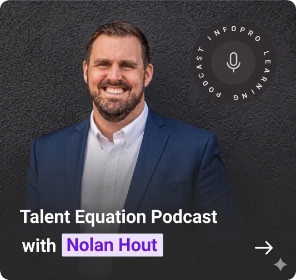
Nolan Hout, Senior Vice President, Growth, Infopro Learning
Nolan Hout is the Growth leader and host of this podcast. He has over a decade of experience in the Learning & Development (L&D) industry, helping global organizations unlock the potential of their workforce. Nolan is results-driven, investing most of his time in finding ways to identify and improve the performance of learning programs through the lens of return on investment. He is passionate about networking with people in the learning and training community. He is also an avid outdoorsman and fly fisherman, spending most of his free time on rivers across the Pacific Northwest.
What does it mean to put employees first? In this insightful conversation, Molly and Nolan discuss the role of I/O Psychology in building workplaces that prioritize human experience without sacrificing results. They unpack how psychology, data, and empathy combine to shape better employee experiences, leading to greater engagement, retention, and impact.
Listen to this episode to find out:
- What Industrial and Organizational (I/O) Psychology is and how it applies to real-world workplaces
- Why employee-first strategies drive better engagement, retention, and business outcomes
- How workplace design elements like lighting and layout influence well-being and performance
- The role of psychological safety in unlocking employee contribution and innovation
- How to use data—from engagement surveys to exit interviews—to guide decision-making
- Why recognition and rewards need to evolve for modern workforce expectations
- How personalized learning and development build stronger leaders and loyalty
- What “wellbeing intelligence” means and why it’s a rising leadership skill

I think of I/O Psychology as a superpower—it blends data and human behavior to create workplace strategies that actually work.
Global Director of Learning & Development, Alcoa
Introduction
Nolan: Welcome to the Learning and Development Podcast, sponsored by Infopro Learning. As always, I’m your host, Nolan Hout. For those who have listened to the podcast before, you’ve probably noticed that I’ve a broad range of knowledge about various topics. Unfortunately, today’s topic—Industrial and Organizational Psychology, or I/O Psychology—isn’t one of them.
But lucky for you, we have Molly Endres joining us today. With nearly 20 years of experience in this field and a master’s degree in the subject, Molly brings a wealth of expertise. She has utilized I/O Psychology to transform workplaces across several organizations, primarily through a wide range of employee-first strategies, which is exactly what we’ll be discussing today.
Nolan: So, let’s go ahead and meet our guest, Molly. Welcome to the podcast. Thanks for joining us.
Molly: Hey, thanks! I’m excited to be here. Thanks, Nolan.
Nolan: You know how we always start, Molly—before we get into the exciting stuff. Wait, that makes it sound like you’re not exciting! Let me rephrase: before we dive into the topic at hand, we like to start with a little background.
How did you get into this field? What drew you to corporate training, L&D, and leadership? Tell us your origin story.
Molly’s Journey Into I/O Psychology
Molly: I’ll try to keep it brief—I love storytelling. Way back, I was determined to become a fourth-grade teacher. Then, in university, I made a pivot. I considered psychiatry—until I realized it required courses like organic chemistry. That was a deal breaker.
So, I thought, let me stay in the field of psychology.
Nolan: Great.
Molly: But I realized clinical psychology wasn’t the right fit either. I still wanted a connection to human behavior, and that’s when I stumbled into I/O Psychology. It was a relatively new field at the time. I was one of only six people in my master’s program—very niche. But that’s what made it exciting.
People were curious—what does this even mean? It wasn’t as well-known as clinical or child psychology. But it’s essentially about applying psychology to business—understanding how people function in the workplace. For a long time, I don’t think organizations fully grasped the power of that relationship.
Nolan: Yeah, for sure.
Molly: I stumbled into the academic side of it and realized, wow—there’s real power in leveraging human skills in business. That realization set me on a path. I worked in higher ed for a bit after graduating, then landed in an incredible organization. I stayed curious and kept exploring everything related to employee engagement.
That’s really what led me to where I am now. Sometimes when I talk to younger professionals, I say, I know you’re supposed to have a career plan—but mine was loose. I followed where my energy and passion took me. I didn’t turn down opportunities where I saw a chance to grow. And here I am, 20 years later.
Nolan: Yeah—I don’t know if it’s great advice or not, but I share that mindset. I’m someone who doesn’t have a vision board. I know I should have a vision board. That sounds cool. But I don’t. So, I feel you.
Inspiration Behind Choosing Education
Nolan: What’s interesting to me is that you started in childhood education. What do you think drew you to teaching in the first place? Were your parents teachers? Did you have a great teacher—or maybe a terrible one you wanted to outdo?
Molly: I do feel very fortunate. I had amazing teachers, and it’s funny, I remember the ones from grade school. Middle school was a little bit funky, but I attribute that to being a weird teenager. In high school, I recall it as being a mix of good and bad experiences. I think there was something very special about my elementary school years. My dad worked in manufacturing, and he would print books at home, bringing them for us to read. I would use them to create lesson plans for all my stuffed animals, my brother, and my sister. I think I was just excited about writing with chalk and banging erasers. I thought I had it all figured out. I was enamored by teaching. And I get to do that now in the world of adult learning, which I think is funny.
I had numerous reflective moments. You were, maybe I should have a vision board about this, but I’m not sure if I’m organized enough to put one together. However, I’ve uncovered a series of events. I always had a classroom set up downstairs and would bring my brother and sister in for lessons during the summer, trying to impart all my worldly knowledge to them at the age of eight. There was always something happening in the background that led me to where I am today.
Nolan: Wow, that’s wonderful. Thank you for sharing that. Today, as I mentioned at the beginning, we will be discussing the concept of an employee-first strategy. However, we will highlight how we’re leveraging IO psychology. And to start with, I have to admit, I didn’t know what the I or the O stood for. I knew what the O stood for. I did, I know the O is organizational, but I don’t know what the I is. I think I thought it was an institution, I think that’s what I thought.
It’s industrial. I’m, in case you didn’t know, in the industry. Aside from just being able to say what it is, which is the extent of my knowledge, tell us a little bit about the idea of I/O psychology and why you think it is such an important topic today.
Understanding I/O Psychology
Molly: That’s a good guess. According to the academic definition, it’s the scientific study and application of psychological principles to understand and improve human behavior in the workplace. And that can range from the setup of the workplace to the processes and operating model within it. It focuses not only on individuals, but also on organizational and group dynamics. In real-life terms, I think of I/O psychology as a superpower that blends data and psychology of human behavior.
And I think that’s where science meets some interesting art, because every employee life cycle moment, if you think about talent attraction through recruiting and onboarding, and the way we retain and develop our employees, as well as how we manage performance, even the way we offboard individuals.
Let’s consider how we want to achieve certain outcomes as an organization and put that through the lens of understanding and meeting the needs and expectations of our employees. We can significantly optimize our approach. We have a greater impact on both how we meet the needs of the employees and how we meet the needs of the organization.
The Impact of Workplace Environment on Employee Wellbeing
Nolan: And it’s interesting, I feel, and this may be connected, I had a friend in college who wanted to get into, I swear it was the lighting of a building and the colors of a building. Now, is that environmental, or does it fall within the category of how the decor is set up and the lighting? Does that fit into that category as well?
Molly: It does, especially on the industrial side of the I/O equation. How your workplace is set up and the dynamics of the workplace flow. Does it optimize collaboration over individual contribution? Does it support the lighting and ergonomics that people need to function without harm and optimize their well-being? There are several interesting factors, and we’ve seen this come to life. 10, 12 years ago, there was this trend of open concepts and treadmills in the office, right? And all of that was focused on employee engagement and allowing individuals to show up in a way that optimized their work delivery, rather than being confined to the typical cubicle approach.
Nolan: For sure, and it’s fascinating. I think many people’s first instinct is that the lighting, culture, or stress has an impact on employees. I think a lot of people think of it as a woo-woo kind of thing. And I can even remember these interviews on the Google campus many years ago, where they are, look at how weird they are. They spent millions on soft lighting. And they were just being, is this an expense? However, if you look at where we are today, there has been mass adoption of it, right?
I think people have realized that, and I think the interesting thing is what you mentioned – it couldn’t be more outside of the woo-woo fields because it is a science. It’s a science. In the office where I work, not my home office, I was talking to the gentleman who created it. It’s a WeWork-type station. And I was working in the basement one day, and he said, It’s interesting. I always see you in the basement. I designed the main level to be vibrant and bright, while also accommodating those with longer days.
You can get a headache from being in such a vibrant space for too long. I created this basement. It’s a speakeasy. It’s a cool office park. Anyone who ever comes to Northern Idaho, specifically Coeur d’Alene, please let me know. Hit me up on LinkedIn. I’ll give you a tour. It’s the coolest WeWork space you have ever seen.
But anyway, you had said that, knowing that it gives your mind a little bit of a rest, and you can focus a little bit more. And it’s really interesting; we can then see why that’s important today, right? Because we have, I feel we are being assaulted by more than just light. It’s not just light, but that light is also changing. The things that are assaulting us are not what they used to be. And the constant barrage of things is.
Molly: Yes.
Nolan: We were talking right before this call, Molly, about how the volatility has just gone up and kind of how that makes people change their decision-making principles. I can understand why, now more than ever, this is an important thing to understand, because the rules have certainly changed. We’ve adopted remote policies. We’ve allowed people to work digitally. I now have to be on camera for every single call of the day, which I don’t love.
The Concept of Employee-First Strategy
Nolan: But we haven’t stopped and taken a look at the psychology of what this new work-life balance looks like, and how we can help? With that, one of the things Molly discussed was the idea of creating an employee-first culture strategy and how it can help drive many of the initiatives in that direction. Can you talk a little bit about when you see an employee-first strategy that leverages IO psychology? What are we talking about here?
Molly: And I think the application can look different depending on the industry, but for me, it’s about the essence, we tend, especially in HR, we get excited about processes and we get excited about programs. And we usually do that because someone from above is saying, ‘We need a process to do X, Y, Z.’
And we measure ourselves on it; we implemented it, and it was great, so we pat ourselves on the back. But when we step back and identify, is that what the employees needed? Is that helping the employees, their development, their growth, and the energy they bring to the organization, as well as how they connect with the culture?
Did we set out what we were trying to do? Did we achieve that? We would be hard-pressed to find any organization that is currently completely automated and run by robots. There are still humans who are doing tasks. They’re leading people. They’re bringing talents and skills into these organizations.
And when we can create these environments where people feel safe enough to bring their whole selves to work, we can optimize performance, operational efficiency, and drive whatever it is that your organization delivers or your mission is.
Data-Driven Approaches to Employee Engagement
Molly: When you have an optimal employee experience, they can contribute more fully to achieving those outcomes. And whenever we’re thinking about processes, we’re looking at the data that our people readily provide us with all the time through engagement surveys, exit interviews, and one-on-one conversations with leaders. There is sufficient information that we can gather from our employees to determine what they truly want, value, and need from their organization. And it’s more important than ever because our employees have a choice.
They have many choices about where they can end up, how long they want to stay, and how much value they place in that organization. Several factors can now contribute to the employee experience. Why not establish our processes and programs by putting them in place first? Because they’re the ones who are the talent that are doing the everyday work day in and day out.
Nolan: And I firmly believe that. I saw a post that said, ‘training dad’ or something like that. And it was, of course, a trained person; it was clickbait to say, ‘no, it’s not.’ But I needed to put in my two cents, I did. And what I said was, listen, in a world where we’re automating much and AI is helping to level the playing field somewhat, as talent is a long-term investment. It is not something you can necessarily put a dollar in and get a dollar back. You can’t buy this software off the shelf. You can’t buy a person off the shelf and plug them in. Even the best person you have to integrate into your culture, your policies, and your processes is dynamic.
Yes, now more than ever, that employee becomes important. And one of the things I think sometimes when we think of employee choice, we almost go to such an extreme of, we’ll go across the street. However, I think that if we examine it, an employee who doesn’t bring their best is actually where you’re probably losing the most value in your organization, which you may never really know.
If, after Molly’s boss has checked out for the day, she also checks out, you’re losing productivity in a major way. It doesn’t necessarily always mean that the employee chooses to walk across the street and make the same amount of money. It means that they’re just doing a half-assed job or they’re leaving their ideas behind because they know, hey, if I speak up now, I’m going to get my neck chopped. I don’t want to do that.
Molly: Absolutely.
Nolan: Interesting, and it gave me a kind of parallel to this idea. I was watching or listening to an NPR article from a billion years ago, and it was about how this town in Japan had designed its streets. It was designed for the safety of children to walk around, and they said that when they started implementing fire trucks, they created a fire truck, but they realized that the fire truck was getting stuck because it couldn’t make those tight turns.
And instead of making the roads wider, they made the truck smaller because it was important to them to have their children first. And it was just talking about obviously the dynamic between that and then here, where we both are in the United States, my street is incredible. Right out front of my house, it’s 40 miles an hour. It’s super wide. It’s not designed with the safety of my children in mind. I can confirm that for you. I don’t know what it’s designed for, but it’s not that. All these things are important, and they all make a significant difference in the long term. What are some of these, if we can all agree that yes, it is important?
Components of an Employee-First Strategy
Nolan: What does it look like? What does an employee’s first strategy look like? And I’m sure they’re a huge strategy, but what are maybe some components of the strategy that would tell you, I’m heading in the right direction here?
Molly: I think the data that you collect helps you to prioritize where your efforts are going to be. Whether you’ve seen spikes in turnover or decreases in employee engagement and retention, I recently read that being intelligent is an emerging leadership competency. That’s the first I’ve read about wellbeing intelligence, the ability to tap into understanding what exactly. And there’s a connection to that and mental health, absenteeism, and healthcare costs.
There is some very true economics behind all of this. I think you have to decide where your focus area is going to be, but let the data be the one that influences where you prioritize. If you see spikes in your turnover, for example, is it at the team level? Is it a connection or a lack of connection to the business that leads employees to leave? They don’t feel a part of the mission, or their values don’t align, or they’re seeing and hearing things that differ from the experiences and behaviors they believe are being recognized and rewarded.
Unpacking that to begin tackling those things one step at a time, because if you try to tackle everything at once, nothing will be a priority. Or you may realize that there are just slight tweaks that need to be made. Perhaps you’re experiencing high turnover in one particular function, and it’s due to the leaders of that function or some toxicity in the team environment.
And something is driving that. It may not be across the entire organization. Things that we can focus on in the wellbeing world, too, are constantly evolving and shifting. We’re examining recognition and reward models. What does that look like? I was talking with someone just last night, and we asked, are our current recognition and rewards programs in any company going to be enough to draw in future generations? Be aware that some of these organizations offer a 10th anniversary bonus, which includes an additional two days of vacation. Ten years is a lifetime to new generations coming into the workplace. Nobody’s going to get that extra two days of vacation. And is that what motivates people?
Nolan: I’ve been here for 10 years. You give me two days, and I don’t even know how many I’ve to be honest, because I’m invested in the guy. I’m not that person. That’s no value to me. Give me those days. I don’t know what I do with them.
Real-World Examples of Employee Experience
Molly: I think there’s just, we have to get more diligent about understanding and listening to our people and then using that to drive the employee experience and the employee-centric work design that we’re going to need in the organization. And I think it will look different, right? I mentioned earlier that, depending on the industry, for example, my sister works in healthcare, and there is a significant focus on interprofessional teamwork. You consider the way that clinicians, nurses, and the clinical staff all need to work together for effective patient care.
Nolan: I’ve watched the pit. I’m not sure if you’ve watched the pit, but if you haven’t, it’s available on HBO Max.
Molly: Yes. I think there are pieces of it, right? In manufacturing, there’s a greater focus on optimizing job performance, workflow, and operational efficiency, as well as implementing safety protocols to minimize workplace incidents. The core remains the same. You need to optimize the employee experience.
Nolan: I’m not sure if it’s realistic, but it’s pretty good. Totally.
Molly: Because they’re the ones that are going to contribute to the outcomes that you want to achieve as an organization. However, one thing that drives me a little bit nuts is when organizations lead with what’s in it for the organization instead of what’s in it for the employee, because that’s where the employee is going to feel that connection.
Nolan: One thing I want to touch on is that I haven’t seen it, nor have I looked for it, to be honest. However, an old colleague of mine, Bruce Valles, created a company called MindBase. Phenomenal, I think. Five years ago, it was a phenomenal product. Its idea was pretty simple. It said, in response, the police force and the first responders are facing a real psychological challenge right now. It was during the ‘defund the police’ movement, and many other things. And it was really hard psychologically to kind of deal with a lot of that. And he said, we’ve seen that there’s a really big connection between the mental health of these people and how they show up on the streets and how that changes the decision making.
And he created this product that ties into the police network and says, if there were an officer-involved shooting, if there were maybe child violence, if there were any number of these things, it would cue an alert in the app the next day. When the person logs in and says, Hey, how are you doing? I see that you took a tough case last night. Did you get enough sleep? Kind of thing. And it was just capturing it and then sending it, anonymized, to the police captain, the fire chief, or whoever was in charge, to give them a pulse check of how we were doing.
However, they could, and somewhat in real-time, check mental health, while also gathering data on the stressors involved in our lives. And I was thinking about it because in the workforce, we don’t necessarily have those kinds of triggers, right? It’s Ok, our stock price fell by 10%. What does that mean for a company?
What does it mean for all the people who have stock in the company? The stock’s already down. And tomorrow, if all people talk about for the first five hours is the stock price being brought down? That productivity is now down. You’re hit twice. What are these things that play on it?
I was thinking that was a long way back to the idea that data should be your driver, or that data can be your driver, there. Some organizations measure this within their organizations. I’ve seen a couple of them; every day before you log in, it says, ‘ How are you feeling today? ‘ Happy face, sad face, whatever. And then it was queued up, now and then, also to ask how many hours of sleep you got the night before.
Molly: Yup, exactly.
Nolan: And send that link as just two baselines. There’s a lot of data you can capture. Some companies specialize solely in that.
Molly: I love it. There was one organization that went out of their way to set up little reminders for us. And I know now that teams have that, but you can enable it in your organization or not, to say, ‘Hey, when was the last time you got up and stretched?’ When was the last time you took a water break? Important, right? And I think after many years, there is this movement now that, my gosh, these people are not just the workers that come in and walk through the door and then do their job and leave. We are complex human beings. We want to bring our whole selves to work.
Nolan: This isn’t severance, where if you haven’t seen it on Apple TV, you don’t take the elevator, and now you’re not even a human anymore. But one of the things you mentioned is the idea that investment in your people trickles down, and I think we’re kind of tired of hearing ‘trickle-down’ economics. I think we’ve heard that to death.
However, it’s interesting because I do feel that this is one of those areas where, if you invest in your people, it will ultimately translate to value in your stock, and we’ve seen this. I’m not sure if ATD currently reports on that, but they used to report on the amount companies invest per employee. A correlation was then established between the stock prices of these companies and their investments. It was always a positive correlation. The more you spend, the higher your stock price, the better your performance.
Employee-First Initiatives Driving ROI
Nolan: Have you seen or do you’ve any programs in mind where an investment in an employee-first initiative has translated to real ROI?
Molly: Absolutely. One of the things I was thinking about was a program we ran a couple of years ago. We asked at the beginning of the program about the intention to leave before the program started. These are also fairly senior leaders within the organization. We’re talking vice presidents, very costly to bring these people on board, right? I think LinkedIn published that, once, they estimate that an employee can cost two and a half times their salary to replace. That’s huge. We examined the intent to stay before and after the program, and for this cohort of senior professionals, intent to stay increased by 68%.
Nolan: How do you measure intent to stay?
Molly: We just asked them, how are you feeling about the organization? And if another opportunity came up, what would your likelihood be to take that external opportunity?
Nolan: Right, and then what was this program about? Do you remember?
Molly: It was primarily focused on that level of helping them understand enterprise-wide what they would need to do to move into a future-ready role. In many organizations, you often reach a certain level, having climbed the corporate ladder, and now you’re a leader across the entire enterprise. You don’t know anything really about the enterprise beyond what you do.
Nolan: Here’s how you get promoted.
Molly: Right, it would be great if I were the CHRO, but if I only know HR related matters and I don’t know finance, or I don’t know legal, or I don’t know sustainability. I’m kind of at a disadvantage. Suppose we can prepare those individuals in the pipeline for senior roles to think more holistically about the organization and where all those paths intersect. In that case, it’s because, after all, we’re all connected. They all impact the employee at some level.
How can we weave that connected story? We wanted to ensure that those individuals felt they had a stronger focus on the entire corporate strategy, rather than just their functional strategy, as it’s one of the things they discuss frequently. I’m not guessing that people thought I’d find a way to bring this back, but I’m always discussing what this investment is in this and what the payoff is.
The second part is always centered on learner engagement. And these things are connected. If you can show a person how they can make more money by learning what you want them to learn, or change their approach, or achieve their goals, then you’ve achieved a significant benefit. If they consume what you’re saying and they can make more money, they’re going to listen.
And if you can’t connect those two, the likelihood that they will do it is small. This is a great example that allows you to think from a company perspective. All you’re doing is, the name of this training could be, ‘ How do you make more money? ‘ How do you make yourself look better on your resume?
Which is an interesting thought because it’s, ff they know that, where would they go? However, it shows that in this case, if you’re the one promoting it and opening up these doors to get down to some dollars and cents, what a great strategy. What a great example of how investing in your people pays off big time, replacing a VP, versus the enormous cost of a couple of hours of training. I don’t know how much that program cost, it couldn’t have been that much.
Molly: Exactly. One brilliant aspect of that program, I think, is that we gave the individuals in it a choice about what they wanted to participate in. We offered coaching that’s as much or as little as you need. We offered a curated curriculum, but provided some flexibility in the course you wanted to pursue for that month, depending on your own development needs.
I think there are many ways we can explore, especially with my learning and development hat on, to suggest that there can be grand solutions, yes. But when I got to it, I put a strategy person through a whole course on strategy. If this is what they’ve been doing for 30 years? Or perhaps they need one that allows for some flexibility to consider the employee experience or the learner experience, and to be more specific in that situation. It takes a little more time because it’s not as generic a solution, but it pays off because the employee feels more invested in the process. They’re feeling more special about it, as this is customized and curated to meet my personal needs, and it will pay dividends down the road when that individual gets promoted into a new role.
Nolan: I not only found that the course itself focused on how to improve their value, but the design of the program was very personalized, and that’s the trick, right? How do you tell them that it’s valuable? When they decide to make that decision, how do they make it valuable specifically to me? And that’s the topic of many podcasts, including those related to AI and other topics. I’m sure we’ve had 30,000 of those. You can find a different one for that.
Closing Thoughts
Nolan: Molly, thank you very much for taking the time to discuss I/O psychology and employee-first strategies with us, and for sharing your insights on how companies should be investing in this right now. Now is the time. I appreciate you sharing with us. It’s been great.
Molly: Absolutely. Thanks again for having me. This world is evolving at an extremely rapid pace. There are many great aspects of AI, as well as some concerning aspects. However, I don’t think we can ever underestimate the importance of the human connection and the spirit of the employee that it brings to an organization. The employees are what make up the culture.
Spending a little more time thinking about that experience will reap significant rewards for the employee, the organization, and ultimately, your stock price. But pay attention to that because the employees talk. They talk within the organization. They talk once they leave the organization. Brand ambassadorship is real. And the dedication to that, and it just takes a little bit more work. Ultimately, it pays off in the end.
Nolan: Totally, thank you, Molly, for sharing that with us. And maybe we’ll have you back to discuss some of those other initiatives. Thank you very much, Molly.
Molly: Thank you.