


Matt Gjertsen is the Founder and CEO of BUILT. His career has been built around serving others, a drive that goes back to his first jobs as a busboy and a lawn mower, and one that led him to the U.S. Air Force Academy. He spent nine years as an instructor pilot training future military leaders to fly the T-1 and KC-10 aircraft. He later became Head of Training and Development at SpaceX, then built the learning team at Cloud Kitchens as it scaled from 500 to 2,500 employees. He is also the author of “Minimum Viable Manager: Three Essential Skills for Leading Technical Teams That Solve Big Problems.”
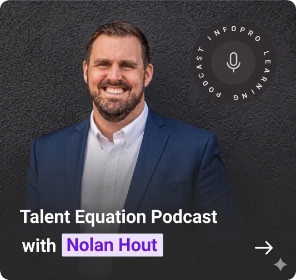
Nolan Hout, Senior Vice President, Growth & AI Strategist, Infopro Learning
Nolan Hout is the growth leader and host of this podcast. He has over a decade of experience in the Learning & Development (L&D) industry, helping global organizations unlock the potential of their workforce. Nolan is results-driven, investing most of his time in finding ways to identify and improve the performance of learning programs through the lens of return on investment. He is passionate about networking with people in the learning and training community. He is also an avid outdoorsman and fly fisherman, spending most of his free time on rivers across the Pacific Northwest.
Most brilliant technical performers become managers, and most of them struggle. In this episode of the Talent Equation Podcast, Nolan and Matt discuss why that happens and what it actually takes to give a new manager a stable foundation fast.
- Why don’t most managers even hit the “minimum viable” threshold, and what that means.
- The First Principles Leadership framework, and the three jobs every leader has.
- Why connection, not trust falls, is the missing piece of team trust.
- What Commander’s Intent means and how it applies outside the military.
- The difference between delegating tasks and delegating authority.
- Why asking for feedback the right way matters more than giving it.
- Why leadership techniques feel formulaic before they feel natural.
- The real cost organizations pay for disengaged managers.
- The single question Matt says every manager should ask themselves today.

Training, learning, and talent development by itself will never move the needle when it comes to performance impact.
Founder & CEO, BUILT
Introduction
Nolan: Hello everyone, and welcome to The Talent Equation, sponsored by Infopro Learning. As always, I’m your host, Nolan Hout. My guest today is Matt Gjertsen. I’ve had him on before, a couple years back. If you don’t remember, Matt went from teaching people to fly planes to building the leadership pipeline at SpaceX, which when you think about it isn’t as big a leap as it sounds. Both jobs require taking highly technical people and quickly turning them into effective decision makers under a lot of pressure.
Matt has spent his career obsessed with that problem, and he’s written a book about it. It comes out this week, August 17th, called Minimum Viable Manager. We’re going to talk to him about that today and learn why so many brilliant people become terrible managers, and what we can do about it. Matt, welcome back to the podcast.
Matt: Thank you so much, Nolan. I’m really excited. I have to correct one thing, or people will yell at me for it. I never actually taught people to fly fighter planes. I taught them to fly planes, but not fighters, and in the flying world there’s a difference. I flew the KC-10, which is a tanker.
Nolan: That’s right. Yeah, you’ll have to forgive my hyperbole there. I like the idea of saying fighter jets, so you’ll have to forgive me.
Matt: The thing we always say to defend ourselves is, you can’t kick ass without tanker gas. The fighters aren’t going anywhere if they don’t have us.
Nolan: There has to be a sticker with that. Somebody has to have made one. That’s the coolest thing ever, I’ve got to track one down. So thanks for being on, Matt. Excited to talk about this book that just launched this week, Minimum Viable Manager. For those who aren’t aware, talk about the play on minimum viable product, and how you got to that title.
The Minimum Viable Manager Concept
Matt: It’s a perfect place to start, because I’ll be honest, when I first came up with the title and was shopping it around, there was always a reaction, and it wasn’t always positive. Certain HR leaders would say, minimum viable? Why do I want minimum viable managers in my organization? I always had two answers to that. One: according to the latest Gallup workplace engagement surveys, around 22 percent of the workforce is classified as engaged, and among managers it’s only 20 percent. So, if your people aren’t engaged, and you as a manager aren’t engaged, that signals the majority of managers aren’t even hitting the minimum viable threshold. There’s clearly work to do there.
The other thing that matters is understanding what minimum viable product actually means. A lot of people hear that and think of some hastily put together, bailing wire and duct tape thing you push out to the world. Really, a minimum viable product is the simplest version of a product that allows you to start learning things. What’s the least amount you can do so you can put it out there and get feedback? When I thought about being a manager, that was my goal: what are the first initial steps a manager needs to take that give them breathing room to start developing the more advanced skills? So, they’re not immediately decreasing their team’s productivity or causing relationship issues. What’s the foundation you have to start from so you have a stable base, and then you can iterate on what it means to be a leader for you, because everyone leads slightly differently depending on their personality and their team.
Nolan: So, do you think this only applies to that first-time manager? I ask because I was chatting with a really smart friend of mine who worked at Amazon forever, Darren Nerland. He was saying, when I’m advising on leadership skills and gaps, the classic thing is: I bought Eightfold, I see we have fifty leadership gaps, let’s just close them all. Well, how many gaps can a leader actually close? He made the point that he can only work on maybe two skills a quarter, because if he really wants to develop a skill to the point where it’s not just “I took a LinkedIn Learning course, therefore I know it,” he can’t do more than that. So, I understand it for a first-time manager, when the leadership programs tell you, now you’ve got to be proficient in ten skills, and it’s like, who has time for that and still be productive? But I feel like this probably exists for other managers too, not just first-level ones. What’s your read on that?
Matt: I think it depends, every situation is different, and we all learn things and then forget them. Honestly, the minimum viable manager concept sits within a broader framework I call first principles leadership. It says any leader has three jobs: get people to work together, get them working on the right things, and improve the work over time. That’s the frame I like to use for a leader at any level. What am I doing to get people to come together, connect, partner with one another, make sure they’re on the same page? What am I doing to make sure people are focused on the right things and working on priorities? What am I doing to improve the work over time, remove barriers, improve the bench strength of my team? Regardless of what level you’re at, think of things through the simplest lens possible. How that plays out day to day will differ, setting expectations means something different for a CEO than a frontline manager, but it still comes back to setting expectations.
Nolan: Makes a lot of sense. So, when you put this out, you’re not saying get away with doing the bare minimum. It’s really what are the critical things a first-time or early manager has to do. What are the most important elements, because if they don’t hit those, they won’t have time for the mastery-level stuff. It’s like the flip side would be going to college and taking Math 101, 201, and 301 in the same semester because you figure you can learn it all in six months instead of three years.
Matt: Yeah, exactly. And I love that you framed it as not having time, because one of the ways I sometimes talk about this from a manager’s perspective is to ask: where are you spending the majority of your time? Are you spending all your time mediating personality disputes, people sniping at each other? Are you spending all your time re-explaining what people need to do because everyone comes to you and nobody knows the next step? Or are you constantly fixing the same mistake again and again? Those three buckets represent a big chunk of where managers find themselves spending their time. So, ask yourself which one is you, and now you know what skill you should be working on. If it’s personality disputes, you need to focus on building trust and connection on the team. If you’re having to make all the decisions, you’re clearly not setting clear enough expectations. If you’re always fixing the same mistake, you’re probably not giving feedback in a way people can actually act on. Where you’re spending your time is a great lens for figuring out your weakest pillar.
Pillar One: Building Trust
Nolan: And talking of those pillars, there are three identified in the book: building trust, setting clear expectations, and asking for and giving better feedback. Let’s take a look at each. Building trust first, talk to us about how this should be applied. I think you’re more of a believer that trust falls don’t build trust. What does build trust?
Matt: Trust ultimately comes down to three things: the skills you have, the decisions you make, and the connections you build. If I trust you in a given situation, it’s because I believe you have the skills required, I believe in your ability to make decisions, and I have some kind of connection with you, where I trust that you care about me and I care about you, at least within the context of the situation. And it’s the same thing in reverse if you trust me. If there’s a lack of trust, you start diagnosing which of those three is the reason. The book focuses on what I think is both the easiest to fix and the most commonly forgotten: the connection piece.
I’ve seen firsthand that if you take the time to connect people on a team, so many problems go away, because you stop having a purely transactional relationship, where I’m only concerned with what you’re doing for me and what I’m doing for you, and I start to see you as another human being. It makes problems become a lot smaller. I give you more grace, I understand where you’re coming from. The techniques we talk about in the book are simple: in a team meeting, take the first five minutes to talk about non-work stuff. What’d you do this weekend, what’s the last movie you saw, just to get people talking as people instead of purely coworkers. Those are the initial steps to filling in that third piece of trust so you can build stronger relationships on the team.
Nolan: I’m trying to remember, I had a gentleman who just wrote a book and sent it to me, and he talked about this idea of taking the first five minutes. How many times have you been in a meeting, or maybe you ask for a meeting and say, can I just get five minutes, but it’s actually going to take a long time? He said, instead reframe it: ask, what are you working on? If you call somebody who’s expecting you to ask them to do work, and you reframe it as, let me start by just learning what this person has going on, maybe in that five minutes they tell you they’re already doing something too big, and you learn that before piling more on. I thought that was fascinating. I think that first five minutes, especially in digital environments, is a critical leadership moment.
It’s so easy to lose. I don’t know how many in-person meetings you have these days, Matt, probably not many. I don’t either. But I remember the first in-person meeting I went to after COVID, with a head of learning at a company, I forget where, but a big corporate office. I’d forgotten how early you have to show up just to find which building the person is in. We’d booked a 30-minute meeting, and it started 10 minutes late because she finished her prior meeting and had to walk to the elevator, go down fifty floors, come scan me in, we had to walk to find a spot to meet, sit down, and then end 10 minutes early so she could get to her next call. And I realized, that walk from the elevator to the meeting spot and back is actually part of the relationship. You use that time to learn a little about each other, so that when you sit down you already know why you’re there. It was almost built into the meeting. We’ve lost that.
Matt: So that she could get to her next meeting. Yeah, there’s actually a term for that: phatic communication. It’s the in-between stuff, the water cooler talk. I think it became important because of COVID, and because the world became more digital and we’re all dislocated from one another. The kinds of connections that used to happen accidentally, just because of the way the world worked, now have to be deliberately planned for. That’s the difference. That’s why taking those five minutes at the beginning of a meeting matters, because if you don’t, it’s easy to go straight to the to-do list, the burn-down, the agenda, and never actually realize who the person is you’re talking to.
Nolan: You know what bothers me? The word “playdate.” I’ve got kids around your age, an eleven-year-old and an eight-year-old. When my eleven-year-old asks, can you set up a playdate with my buddy, I think, just go meet up. When I was a kid I literally rode my bike, knocked on the door, asked if John was home. Everything’s become this regimented thing. Not my kids’ fault, that’s on me, the environment I’ve created has led him to believe this has to be set up rather than just showing up. Anyway, we can come back to the podcast now.
Pillar Two: Setting Clear Expectations
Nolan: That’s probably a good segue: setting clear expectations. When you have trust, people know what to expect, but it’s more than that. You talk about a concept called commander’s intent, can you expand on the second pillar?
Matt: I love that you brought that up, that’s the way we frame it. It comes from the military. If you go back centuries, the leaders of armies were right there with the army, kings would be on the front line because they had to command everything directly. As technology changed, commanders became more and more dislocated from the front lines. That really happened in World War II with airplanes, which could travel vast distances very quickly. The Army Air Corps was formed because originally airplanes were given to individual ground commanders like a tank, but a tank can only operate in a small space. If that commander doesn’t need anything specific, you want to be able to send that plane elsewhere.
Commander’s intent was a way to solve that: if the commander is far away from the field, how do you give the person in the field, the pilot, enough information that you can trust them to take action themselves, without radioing back to ask permission for every decision? You’ve given them enough information that they know whether they can drop the bomb. The framing we use in the book is context, outcome, and constraints. When you’re delegating something, you give the person the full context: why this is happening, what’s happened before, who else is involved. Then the outcome: what you’re trying to achieve, what does done actually look like (a term from Scrum, the definition of done). Then finally, the constraints: how much rope am I giving you, when do I want you to check back in with me, how much budget or time authority do you have, what would cause you to need to come back and ask permission. The way I talk about delegation in the book is, don’t think about delegating tasks, think about delegating levels of authority. If you’re just delegating task after task, you’re not really delegating any authority, you’re dictating everything the person does. Setting a constraint means giving them room to operate.
Nolan: What were the three C’s again, I missed them. Context.
Matt: Context, outcome, and constraints.
Nolan: I think so much of this, both the clear expectations piece and the trust piece, is about freeing up the manager to get back into the work. At least that’s been my experience as a manager: without these things, the amount of time you spend managing the mechanics is enormous. Was that the intent behind minimum viable? These people are hard-pressed for time, especially first-level managers who are often still doing the work themselves, so give them the tools to lighten their load by building a team that doesn’t require a morning check-in and an evening check-in, or re-explaining the same thing for the thirtieth time?
Matt: A hundred percent right. I think a lot about how Jeff Bezos talks about moving up in an organization: as you move up, you should be making fewer and fewer decisions, but those decisions mean more and more. As CEO of Amazon, he needed to make maybe two good decisions a year, and everything else in his life was organized to make sure he made the right decision on those two. Every moment you spend on a lower-level task is a moment not spent on the things only you can do. The reason you’re delegating isn’t because that work is beneath you, it’s because there are things you can do that your team can’t: fighting with the higher-ups for more resources, building connections with other parts of the business, going elsewhere to get more information. That’s not their role, their role is the hands-on work. The most important thing for managers to realize isn’t “I don’t do this anymore, it’s beneath me,” it’s “if I want to best serve my team, I need to be doing the things only my role allows me to do.”
Pillar Three: Asking For and Giving Better Feedback
Nolan: The last pillar, which I really love, is ask for and give better feedback. So much of leadership talk is about how you give feedback to your team, but you’ve made the point that you should ask for it first. Why is that important?
Matt: There are hundreds of courses out there on how to give feedback, techniques for giving it better, all that. But if you’re a manager just getting started, maybe with a low-trust team or a team without a culture of feedback, the first way to build it is to get people used to giving feedback to you. The problem is we don’t often think about how to ask, how to make it so people actually give us feedback. I’ve been in leadership development courses where the facilitator flat out said, never give upward feedback, it’s too dangerous. And sometimes it can be, you don’t know how people will react. So, if you’re a manager and you just go to your team and say, do you have any feedback for me, the chances of getting good feedback are pretty low.
One reason is the power imbalance, but two, what we talk about in the book is that “do you have any feedback?” has two problems. First, it’s unspecific, it creates blank-page syndrome, their brain just goes blank. Second, it puts pressure on them, and if they don’t know how you’ll react, that’s daunting. Asking in a way that’s specific and assumes there is feedback makes it easier for them to give it. So instead, you say: in the meeting today, there is one thing you think I could have done better to organize it or keep it on track. You’re narrowing the scope, and you’re not asking, “is there,” you’re asking “what is one thing,” so you’re the one signaling that of course there’s something to improve, not putting the burden on them to bring it up. That’s the first step to creating a feedback culture where there wasn’t one before.
Nolan: I was thinking about how this works in practice. If you really wanted meaningful feedback, it’s going to happen in a real conversation, something where you can look at each other, doesn’t have to be in person, but it has to be intentional, finding thirty minutes when your calendar is jam-packed and knowing it’s not going to feel urgent in the moment.
I always wonder about this myself. When I do the podcast, I work from my house instead of my office because I don’t want to lug all my equipment in. I call people on the way to work, on the way back, same at the airport, because that’s dead time for me, I’ve got nothing going on, and my instinct is to maximize every second of the day. I don’t want to just drive in silence during work hours. But sometimes I wonder if people recognize that I’m not just calling to fill space, that there’s real value in it. We just talked about this: be intentional about catching up with people.
Obviously if you have trust in your team to do the right work, and you’re not constantly having to check back or make every decision, that gives you time back in your day. But I think part of it is framing this as an equal part of your job, alongside everything else. It’s rare that your KPI is leadership. It’s how many widgets did you make, how many sales did you close, not “do your people like you.” People assume that’s happening if you’re doing your job. Maybe it’s just baked into how we’ve designed our businesses that it’s not an actual criterion we hold people responsible for.
Matt: There are two things I want to unpack there, Nolan, and I’m glad you asked. To where you ended: yes, we don’t think enough about the long-term impact bad leadership has. So many of our KPIs are short-term. But if we zoom out, where are we going across the year, what’s retention looking like on the team? The cost of bad retention is incredible. Going back to Gallup’s work on workplace engagement, I don’t remember the exact figure, but it’s staggering, something like they estimate it costs the global economy around two trillion dollars.
Nolan: Yeah, it really is a staggeringly low amount of people who are engaged, and managers tend to be one of the least engaged groups, they’re also incredibly low.
Matt: Yeah, so I think part of it is truly realizing how important this impact is. But the other thing you were hinting at is, can you be too intentional? Does it become formulaic, something you’re doing just because you know you’re supposed to? I think the most important thing to remember is everybody’s going to have their own leadership style. What it takes to build connection on a team is going to be different everywhere, but you have to start somewhere. I think of it like running drills, or swimming drills, where a drill overaccentuates a particular movement so your body starts to learn it, and then in practice you do it a little differently, you develop your own version.
The example I always give is active listening. Anybody who’s taken an active listening course has probably been told: when a person finishes talking, the first thing you say is, “so what I hear you say is…” That feels awkward and formulaic, and when I say it, people know it’s not natural to me. That’s fine, it’s a drill. It’s not meant to be something you do forever, it’s something you do for a short period to build the muscle while you figure out your own way to achieve the same ends. Whether that’s asking a personal question in the first five minutes of a meeting, using a strict architecture like commander’s intent, or a very clear way of asking for feedback, it will feel formulaic at first, and that’s the point, because that’s how you learn. It’s important for managers growing a new skill to be transparent about it with their team: say, hey, there’s a thing I’m working on right now, I’m going to try some new things, it might feel weird sometimes, let me know if it’s getting in the way, so everyone’s aware you’re not suddenly speaking a different language for no reason.
Authentic Leadership vs. Copying an Archetype
Nolan: I love the scaffolding you’ve built with minimum viable manager. Truth be told, I don’t have the full book, just a couple of abstracts, but the way you’ve framed it doesn’t seem like it’s trying to build an archetype of a leader, like a leader has to be super emotional, or not emotional, whatever it is. By the time this podcast comes out there’s an article I felt compelled to write, because I feel like we look at leaders, some who write leadership books, some in business or politics, and try to emulate them because we think that personality is what leadership is. But the problem is that’s inherent, those people got where they are because that is their personality. Like it or not, Elon Musk is Elon Musk, he’s not trying to be some other version of himself, he’s consistently that way, or inconsistently in a way that lines up with who he is.
I see so many people trying to be a shade of something that isn’t them, and it’s so obvious, everybody sees through it. It also makes your life a lot harder, it takes real work to pretend to be something you’re not.
Matt: Yes, exactly.
Nolan: So, in minimum viable manager, it’s, here are the tools, here are the things you should be doing, now apply your personality and your style to them. As you develop your voice, figure out your strengths and weaknesses, get feedback from your team, if they say hey, stop with all the jokes, we get it but we don’t need so much of it, okay, you adjust, you’re a little more serious. That’s how you calibrate it. People thrive on these things, they need trust, they need clear expectations, they need to give and get feedback. But the ones that connect with you feel that you’re being authentic, not trying to be some Tony Robbins motivational speaker if that’s not who you are. If you’re an introvert, be an introvert, but still do these things.
Matt: Yeah, exactly, it matters about you, it matters about your team, it matters about your company’s culture, all of those things will influence it. The other thing I’d add is it’s so hard to know what’s going on internally. We saw the same thing with Steve Jobs; there was a big trend of everybody wanting to lead like Steve Jobs. I don’t know anything about what was going on internally there, but anybody who’s spent time at SpaceX would say one of the reasons SpaceX is so successful is because Elon has Gwynne, Gwynne Shotwell, the president of SpaceX, this generational second in command. The two of them have this amazing partnership, it’s been written about all over the place. So even if it’s genuine to you to act like Elon, you have to ask, who’s your Gwynne? Because that’s what makes the magic work. There are so many variables, your personality, the people around you, that go into what’s actually going to be successful.
Closing Thoughts
Nolan: So, wonderful. Takeaway for me: obviously buy the book, it’s out now, called Minimum Viable Manager. Aside from that, Matt, what’s one easy thing someone can do today to start living this philosophy?
Matt: I think the simplest thing it all comes back to, if you’re a manager or an informal leader, is to ask yourself: am I helping the people I’m working for be more productive, or am I getting in their way? Just ask yourself that question. If you’re a leader who likes to make all the decisions, is that speeding things up or slowing things down? If you like to hold on to information, is that speeding things up or slowing things down? The number of direct reports in your organization, the number of layers, is that speeding things up or slowing things down? There are a bunch of ways this can play out depending on the situation, and it’s up to you to reflect on what’s going to ultimately help you move faster.
Nolan: Lovely. Well, thanks for sharing that, Matt, and thanks for sharing some time with us. Look forward to having you on again, maybe for a third time, our first third-time guest, if possible. Thanks, Matt, I’ll catch up with you soon. Bye.
Matt: There we go, let’s do it, Nolan. Thank you so much.